
High Voltage Switchgear: Definition, Function, Example
Modern factories depend on power distribution infrastructure, but many buying teams have trouble finding key parts because their equipment doesn't work with others, supplies are late, and they don't get enough expert support. High-voltage vacuum circuit breaker is one critical example of such a key part. High-voltage switchgear is one of the most important investments in this infrastructure because it has a direct effect on operating safety, system stability, and long-term upkeep costs. In power plants, factories, and building projects across the United States, this guide talks about the problems that procurement managers, chief engineers, and project leaders have to deal with in the real world.
We look at how choosing the right switchgear solution—one that comes with a track record of production excellence and full expert support—can get rid of common problems and make sure that strict safety standards are met. We're not just interested in simple definitions; we're also interested in practical things like how to choose equipment, how to keep it in good shape, and the real benefits of working with makers who know about the whole span of power distribution equipment.
What Is High-Voltage Switchgear?
High-voltage switchgear is specialized electrical gear made to manage, safeguard, and separate power lines that work above 1,000 volts, usually between 6kV and 40.5kV in industrial settings. When things are normal, this equipment does important switching tasks. When things go wrong, it stops fault currents and makes sure that repair work can be done safely. The machine combines different parts, like circuit breakers, disconnectors, busbars, insulators, and control systems, into a single unit that controls the flow of electricity and keeps people and equipment below safe.
Core Functions and Operating Principles
The main job is to connect circuits when they are under load, stop problem currents in milliseconds, and physically separate parts of the equipment so they can be safely accessed for repair. Modern units use vacuum or SF6 arc-extinguishing technologies in their circuit breakers to stop the electrical spark that happens when the current stops.
Disconnectors make it possible to see where two circuits are separated, and busbars send power to many circuits at once. Control systems keep an eye on working factors all the time and take safe steps when things go wrong. This organized operation keeps the power good, keeps equipment from breaking, and cuts down on downtime as much as possible during planned and unplanned events.
Key Components and Material Considerations
Circuit breakers are the most important part of any switchgear system. Vacuum types are becoming more popular because they don't need to be maintained and are better for the environment. The equipment made by Yuguang uses fixed magnets to operate vacuum circuit breakers. This makes the equipment stable over long periods of time without needing regular upkeep.
Insulators made from epoxy glue and composite materials are strong at conducting electricity and don't break down easily in harsh environments. Busbars made from metals that don't rust ensure long-term transmission, especially in tough industrial settings. The choice of materials has a direct effect on how long the equipment lasts. Parts that are properly defined usually last 25 to 30 years with the right upkeep.
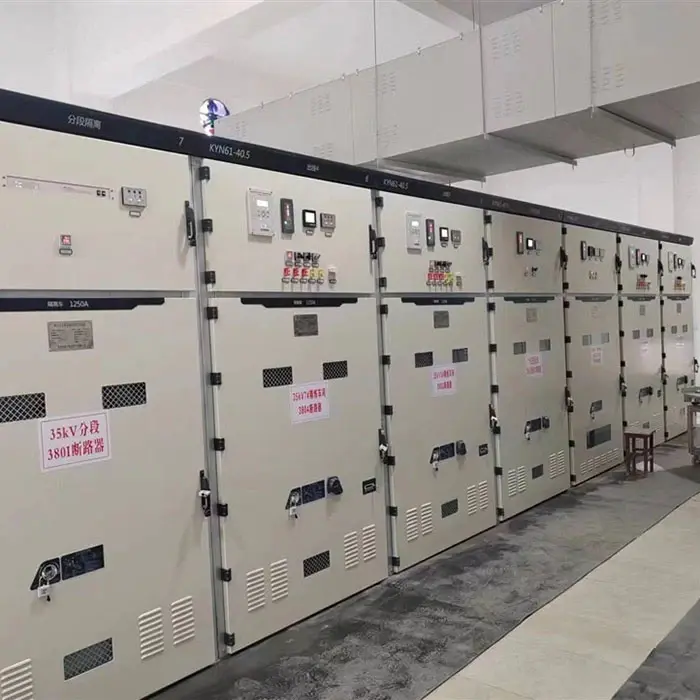
Types of High-Voltage Switchgear and Their Industrial Applications
Learning the differences between switching designs helps buying teams match the features of equipment to specific needs and space limitations.
Air-Insulated vs. Gas-Insulated Solutions
The main insulation material in air-insulated switchgear (AIS) is the air itself. This type of switchgear takes up more space but is easier to maintain and costs less at first. These layouts work well for new construction projects that have room for them, especially in open substations that serve power plants. Gas-Insulated Switchgear (GIS) uses SF6 gas inside sealed boxes to make installations up to 90% smaller than comparable AIS installations.
This small size is very important for substations in cities, data centers, and airports, where the cost of land justifies the higher equipment investment. Yuguang's metal-enclosed armored designs, like the KYN61-40.5 series, have aluminum-zinc coated steel enclosures that are made through CNC machining. These enclosures are strong enough to protect internal components while still being small enough to fit in tight spaces.
Vacuum and SF6 Circuit Breaker Technologies
High-voltage switchgear technology extends the same core principles into higher voltage ranges, while vacuum circuit breakers are most common in medium-voltage uses ranging from 6kV to 40.5kV. They don't need to be maintained and don't produce greenhouse gases. The technology works great for apps that need to switch between tasks often, like those found in factories where more than 50 switching events can happen every day.
SF6 breakers are still commonly used in places with high power and extreme temperature changes, but environmental laws are pushing for vacuum replacements more and more. Yuguang's vacuum circuit breakers have fixed magnet mechanisms that get rid of the need for hydraulic or gas systems. This cuts down on failure points and increases the working life to more than 30,000 mechanical operations under rated circumstances.
Modular and Digital Switchgear Evolution
Modular designs let you gradually increase capacity without replacing the whole system. This is helpful for businesses like steel production and chemical processing that need to grow and change their power needs as they increase production capacity. Yuguang's merged modular method lets you service individual parts without affecting nearby circuits, which cuts down on downtime during maintenance.
Digital switchgear has sensors, communication links, and diagnostic tools that let repair plans be planned ahead of time. These systems find problems with insulation, contact wear, and temperature changes before they become problems. They do this by providing condition-based maintenance programs, which operations teams are using more and more to lower the total cost of ownership.
Advantages and Maintenance of High-Voltage Switchgear
When High-voltage switchgear is properly designed and kept, it provides practical benefits that go far beyond basic circuit protection. These benefits have a direct effect on the safety and productivity of the facility.
Enhanced Safety and System Reliability
Modern switchgear has interlocking systems that stop dangerous mistakes like opening disconnectors while they are loaded or going into sections while they are live. Yuguang's machines have "Five-Prevention" locking systems that physically limit the order of operations.
This lowers the chance of human mistake during swapping processes. Designs that are resistant to arcs keep people safe from internal faults, and systems that relieve pressure keep powerful forces away from work areas. These safety features are especially helpful in unmanned substations and places where operators are rotated and institutional knowledge may not be the same.
The segmented design keeps busbars, circuit breakers, and wire connections in their own casings that are labeled IP4X when closed and IP2X when open. This keeps people from touching live parts by mistake. This separation lets repair work be done on certain areas while neighboring lines stay on, which keeps the building productive during service breaks. This kind of freedom is very important in industries with ongoing processes, like petroleum plants, where shutting down completely can cost a lot of money.
Maintenance Protocols and Lifespan Extension
With vacuum circuit breakers, you don't have to check the contacts or repair them as often as you had to with older air-blast or oil circuit breakers. Yuguang's High-voltage switchgear features fixed magnet systems that require even less upkeep because they don't need to be powered by a controller or have their links adjusted mechanically. For regular checks, the recommended repair times are 24 to 36 months, while for older methods they are 6 to 12 months. These longer breaks directly lower running costs while lowering the safety risks that come with doing repair tasks often.
Infrared thermography of busbar connections, insulation resistance tests of core circuits, and contact resistance readings across circuit breakers are all important maintenance chores. Timing checks make sure that the breaker's working speeds stay within the manufacturer's guidelines. This makes sure that the breaker can stop a problem.
Ceramic coating and powder coating are surface treatments that are used during making to make things more resistant to rust. This is especially useful in seaside areas or industrial settings where chemicals are present. Yuguang's aerospace-grade precision cutting of arc-extinguishing chambers and solid-sealed poles keeps the dimensions stable even when the temperature changes, so the sealing stays strong for the whole life of the equipment.
How to Choose the Right High-Voltage Switchgear for Your Business
When choosing the right High-voltage switchgear, you have to weigh technical requirements against project limitations, practical goals, and long-term cost factors.
Technical Specifications and Environmental Factors
The voltage rating of the equipment must be at least as high as the standard voltage of the system. For example, equipment rated 40.5kV can be used with 35kV systems by giving insulation coordination safety factors. The interruption capacity, which is given in kiloamperes (kA), needs to be 20 to 30 percent higher than the highest possible fault current at the placement point.
The recommended short-circuit breaker currents for Yuguang's KYN61-40.5 range are between 25kA and 31.5kA, so it can be used in most industrial distribution uses without being too big. When choosing a rated current between 630A and 2500A, you should think about both the current loads and the expected growth. This way, you can avoid the efficiency losses that come with chronic underloading.
The environment has a big impact on the choice of tools. For installations in wet coastal areas, better closing requirements are needed, while higher temperature rates are needed in desert areas. Yuguang's IP67-rated locks and corrosion-resistant metal construction are made to work in tough environments like steel mills, mines, and offshore platforms. The dielectric strength changes with elevation. For systems above 1000 meters, derating or design changes are needed to keep the insulation working well.
Total Cost of Ownership Analysis
The price you pay for industrial equipment at first is only 30–40% of how much it costs over its lifetime. Over a normal 25-year working span, maintenance costs, the supply of extra parts, and the length of the guarantee all have a big effect on the total cost of ownership (TCO). Yuguang's maintenance-free vacuum technology and permanent magnet systems lower ongoing service costs by getting rid of parts that need to be replaced, like contacts, oil, and air seals.
Delivery times have a direct effect on project plans. Standard goods that ship within 7–15 days keep project delays to a minimum, while personalized solutions need 30–60 days to make changes that fit each unique situation. This adaptability lets both emergency replacements and planned growth projects happen without having to give up on technical details.
After-sales support options should be carefully looked at. How quickly problems with equipment can be fixed depends on how quickly installation instructions, operational help, and extra parts are given. Yuguang offers installation help, upkeep contracts, extra parts, and free change plans, covering all the support areas that operations teams need.
With a minimum order number as low as one unit, the company can handle both small trial projects and large setups. This makes it easier for facilities to try new sources or technologies without having to worry about how to get the goods. These service promises lower the risk of the project, which is a big deal for EPC workers who have to meet tight completion schedules.
Safety Standards, Regulations, and Best Practices
Following well-known rules makes sure that the equipment is safe and makes it easier for regulators in different areas to accept it.
International and Regional Standards Compliance
The IEC 62271-200 standard sets strict rules for metal-enclosed switchgear with a rating above 1kV. These rules cover everything from design and tests to how the equipment works. In North American markets, ANSI and IEEE standards set the same requirements. The IEEE C37 series covers specific topics like interruption rates and insulation tests. Yuguang has three certifications: ISO 9001:2015 for quality management systems, ISO 14001 for environmental management, and ISO 45001 for worker safety.
These show that the company takes an organized approach to both product quality and working safety. The fact that the company is a High-voltage switchgear and "High and New Technology Enterprise" shows that it invests in research and development. It has 39 utility model patents that support ongoing product improvement.
UL rating and CSA approval make it easier for authorities having jurisdiction (AHJs) in the US and Canada to accept equipment. The equipment with these marks has been tested by a third party to make sure it meets building and performance standards. This validation by a third party cuts down on the time it takes to get building permits and deals to connect utilities, which speeds up project plans.
Operational Safety Practices
What kind of personal safety equipment is needed depends on the job and the power level. Clothing that is rated for arcs, padded gloves that are rated for system voltage, safety glasses, and hearing protection are the basic safety gear that switching activities need. Lock-out/tag-out (LOTO) methods keep power from being turned on during repair work, and locking systems make management controls more solid. Yuguang's separated designs help LOTO processes by separating certain useful areas. This lets repair work be done without turning off the power to the whole building.
Training classes need to cover both normal activities and what to do in an emergency. Operators need to know how standard switching processes work, how interlocks work, and how to read alarms. Maintenance workers need to know how to do tests, do touch inspections, and figure out what the results mean. Regular repeat training keeps people's skills up to date. This is especially important in places where maintenance doesn't happen very often, because skills can slip between tasks.
Environmental Considerations and Sustainability
SF6 gas is 23,500 times more likely to cause global warming than CO2, which is why it is limited by regulations and industries are moving toward alternatives. This problem is completely solved by vacuum switchgear, which is in line with companies' green goals. Yuguang's vacuum technology meets environmental concerns while keeping scientific performance.
Compared to SF6 options, it reduces greenhouse gas emissions right away. Responsible end-of-life dumping practices make sure that valuable materials are recycled and that dangerous materials are disposed of in the right way. This supports the circular economy principles that stakeholders are increasingly expecting.
Conclusion
When choosing High-voltage switchgear, you need to think carefully about its technical specs, how it will be used, and how it will be supported in the long run. Problems like equipment compatibility, repair needs, supply dependability, and making changes based on the situation are ongoing issues that have a direct effect on the success of the project and the costs of running it.
When a manufacturer has a large patent portfolio and official certifications showing that their products cover voltages from 6kV to 40.5kV, buying teams can be sure that they are technically capable. Integrated modular designs with small sizes, strong closing, and long lifespans deal with space issues and hard climate uses that happen in many industry sectors. Full-chain service, which includes study, manufacturing, installation, and support after the sale, turns buying equipment into long-term partnerships that lower organizational risks and make project completion easier.
FAQ
What is the typical lifespan of high-voltage switchgear?
When properly kept and used within the stated limits, quality switchgear usually lasts between 25 and 30 years. Vacuum circuit breakers with permanent magnet systems can work for more than 30,000 mechanical cycles without needing any upkeep. This means that they can be used for decades in most situations. The real service life is directly affected by environmental factors, working job cycles, and maintenance practices. For example, equipment that is kept in a controlled indoor environment and inspected regularly always lasts longer than outdoor setups or units that aren't taken care of.
Can switchgear be customized for specific industrial applications?
Modern makers offer a wide range of customization options to meet specific operating needs. Yuguang's scenario-based design method makes equipment work in difficult conditions like high humidity, extreme temperatures, and toxic atmospheres that are common in chemical processing and seaside facilities. Customization includes things like control integration, communication methods, and making sure the actual measurements fit within the limits of the current infrastructure. Customized solutions need 30 to 60 days for planning and production, while standard goods can be shipped in 7 to 15 days.
How does digital technology improve switchgear performance?
Integrated sensors constantly check the temperature, partial discharge activity, contact wear, and performance of the working mechanism. Diagnostic tools find patterns of wear and tear before they happen, which allows condition-based maintenance to change parts only when data shows that problems are about to happen, rather than at random times. Communication features connect the state of switches to facility-wide monitoring systems. This gives operations staff real-time information about the conditions of the distribution network, which helps them make smart choices when something goes wrong.
Partner with Yuguang for Reliable High-Voltage Switchgear Solutions
To solve operational problems, you need tried-and-true methods backed by factory know-how and a full support network. Yuguang was founded in 2008 in Baoji, Shaanxi, which is known as China's vacuum circuit breaker production hub. The company combines advanced production techniques with rigorous quality management to create long-lasting High-voltage switchgear that doesn't need to be maintained and is used in power generation, heavy industry, and important infrastructure.
Our 39 patents show that we are always coming up with new ideas for permanent magnet systems, vacuum arc-extinguishing technology, and combined modular designs that make things work better together, make servicing easier, and speed up project plans. As a company that makes high-voltage switchgear and has ISO 9001:2015, ISO 14001, and ISO 45001 certifications, we take care of the whole product lifecycle, from helping with the design to installing the equipment and providing extra parts.
Our engineering team does all the technical calculations, plans, and finishing work to make sure that your project goes smoothly. This is true whether you need standard 6kV-40.5kV equipment shipped within two weeks or special equipment made for difficult settings. Contact our team at ygvcb@hotmail.com or visit ygvcb.com to talk about your specific needs and get a full technical plan backed by our professional skills and decades of experience providing cross-border services.
References
1. IEEE Standards Association. "IEEE Std C37.20.2: Standard for Metal-Clad Switchgear." Institute of Electrical and Electronics Engineers, 2015.
2. International Electrotechnical Commission. "IEC 62271-200: AC Metal-Enclosed Switchgear and Controlgear for Rated Voltages Above 1 kV and Up to and Including 52 kV." IEC Standards, 2011.
3. Garzon, R. D. "High Voltage Circuit Breakers: Design and Applications." Second Edition, CRC Press, 2002.
4. Slade, Paul G. "The Vacuum Interrupter: Theory, Design, and Application." CRC Press, 2017.
5. Dufournet, Denis. "Gas Insulated Switchgear and Substations: Technical and Environmental Challenges." CIGRE Technical Brochure, 2012.
6. National Electrical Manufacturers Association. "NEMA SG-6: Power Switching Equipment Standards." NEMA Standards Publication, 2016.

Send Inquiry
You may like
