
High-Voltage Vacuum Circuit Breaker vs Traditional Switch: Key Differences
By breaking the contacts in a sealed vacuum interrupter, a high-voltage vacuum circuit breaker stops fault current. A normal switch can only switch loads or isolate them. Load-break switches carry and switch normal current, isolators make an open gap that can be seen, and air or SF breakers stop the arc in other types of media. A protection relay can only tell a circuit breaker to open when there is a short circuit. Vacuum designs also don't need as much regular maintenance as gas designs, and they don't need to handle SF₆. This guide was written to help engineers, EPC buyers, OEM switchgear builders, and distributors choose the right device for the job.
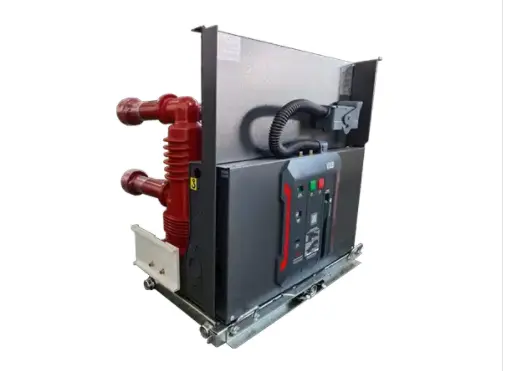
What Is a High-Voltage Vacuum Circuit Breaker and How Does It Work?
Core Components and Configurations
The five main parts of a vacuum circuit breaker are the vacuum interrupter, the operating mechanism, the trip and closing coils, the terminals with insulation, and the interlocks with extra contacts. The contacts are held in place by the interrupter inside a sealed ceramic or glass envelope. One or more springs or permanent magnets move the mechanism to open and close them. Buyers can pick from types that are fixed in place or can be pulled out. They can also choose between indoor and outdoor housings and use them in metal-clad panels or on outdoor poles. It takes less time to replace units that can be pulled out of the cabinet for service. Fixed units are better for simple feeders and cost less. The first thing I do to make sure an order is compatible is match this layout to the switchgear.
How the Vacuum Interrupter Extinguishes the Arc?
There is a mechanism that pulls the contacts apart when a relay or control command trips the breaker. In the space between them, a short metal-vapor arc forms. The gap is empty, so there is no gas to keep the arc going. The arc ends at the first current zero. The gap quickly gets its dielectric strength back, which keeps the circuit open. A short arcing time keeps contact wear to a minimum, which is why vacuum devices work well with a lot of use. This physics is talked about in great detail in Paul Slade's book on the vacuum interrupter. Switching overvoltage can happen when the breaker cuts off small inductive currents, like those that come from motors or transformers that are not loaded. RC snubbers or surge arresters work well in those circuits.
Ratings You Must Verify
It may look like a simple datasheet, but it has five numbers that tell you if a breaker fits: the insulation level, the rated voltage, the rated continuous current, the rated short-circuit breaking current, and the short-time withstand current. How often, how they work, and how much they can make are also important. These ratings are set by IEC 62271-100 and IEEE C37.04 for AC circuit breakers that are more than 1,000 V. The ANSI/IEEE C37 series is often used in US projects, so I always check to see which standard the specification names come from. Rated current alone is never enough to prove suitability. If the fault rating on a 1,250 A breaker is too low, it might not work at all the first time a short circuit hits the bus.
Key Differences Between Vacuum Breakers and Traditional Switches
Breaker, Load-Break Switch, and Isolator
"Traditional switch" refers to a group of very different devices, unlike a high-voltage vacuum circuit breaker. A load-break switch lets normal load current flow and some types close when there is a fault, but it can't stop short-circuit current. An isolator, which is also known as a disconnector, should work with almost no current and leave a clear opening for safe maintenance. Disconnectors and earthing switches are talked about in IEC 62271-102. The system is protected by the circuit breaker, which also clears faults. The isolator keeps the work area safe. Most buyers need both devices because they each protect a different part of the safe operation process.
Versus SF₆ and Air Circuit Breakers
Breakers made of SF₆ put out the arc in gas. The IPCC Sixth Assessment Report says that SF₆ has a global warming potential more than 23,000 times that of CO₂ over 100 years. They are still common at higher voltages. SF₆ limits are also put on new medium-voltage switchgear by Regulation (EU) 2024/573. The first units up to 24 kV will be affected in 2026. Since air circuit breakers are mostly used for low-voltage systems, they can't be used instead of medium-voltage vacuum equipment. Because the interrupter stays closed for life, a vacuum unit doesn't need to be checked for gas or refilled. I never say that one technology is best for every site because gas breakers can still work with existing fleets or meet certain utility standards.
Advantages, Limits, and a Quick Comparison
Vacuum breakers put out arcs quickly, stay small, last a long time, and can handle a lot of switching. But they have limits too. They cost more than a load-break switch at first, need to be watched out for overvoltage, have different levels of quality interrupters, and often still need gas for very-high-voltage tasks. The table below shows how the jobs are different.
| Device | Main duty | Interrupts short-circuit current? |
|---|---|---|
| Vacuum circuit breaker | Switching and fault protection | Yes |
| SF₆ circuit breaker | Switching and fault protection | Yes |
| Air circuit breaker | Mainly low-voltage protection | Yes, within its rating |
| Load-break switch | Load switching | No |
| Isolator | Visible isolation | No |
Don't compare the purchase price but the lifecycle cost. It includes the cost of installation, testing, maintenance, spare parts, downtime, and making sure the gas is safe.
Applications, Installation, and Selection
Where Vacuum Breakers Work Best
Transformers, motors, generators, and feeders in utility and industrial substations are kept safe by vacuum breakers. I think there will be a lot of demand in mining, petrochemical plants, power distribution, communication facilities, and renewable energy systems. The choice is based on the type of load and the switching frequency. Motor starters and arc furnaces are used a lot, so a mechanism that lasts a long time is important. Models that can handle capacitive switching are needed by capacitor banks. Yuguang supplies these businesses and also makes combined electrical appliances for renewable sites that are designed to work with wind power. Give the supplier the fault level and load type before you ask for a price. These two things change the model.
Indoor, Outdoor, and Harsh Environments
Breakers for indoor use like a high-voltage vacuum circuit breaker are kept in switchgear rooms, where a cabinet protects them from the weather. Outdoor models have to deal with dust, rain, pollution, temperature changes, and salt spray, so their housings need to be sealed and their finishes need to be resistant to corrosion. Height is also important. Normal service conditions are set by IEC 62271-1 up to 1,000 m. Above that, the external insulation strength drops because the air is thinner. In places that are prone to earthquakes, you may need to do more checks. On the first call, I ask buyers about the site's height and the temperature range. Yuguang makes custom products for harsh environments by using IP67 seals, alloys that don't rust, and ceramic plus powder coating to protect against rust and wear.
Selecting the Right Model
Start with the diagram with only one line. Check the load type, operating voltage, rated current, frequency, fault current, and earthing method. Then look at the capacity for making and breaking, the level of insulation, the mounting arrangement, the control voltage, the type of mechanism, the interlocks, and any communication or remote control needs. The workings of springs are well known and simple to fix. Mechanisms with permanent magnets have fewer moving parts and can work at high frequencies. Finally, check the mounting dimensions against the cabinet or the breaker you want to replace. Failure to do this can cause many delays in the retrofit process.
Testing, Maintenance, and Procurement Checks
Factory Testing That Matters
Bugs are found before they are shipped by routine tests. Ask for mechanical characteristic tests, which check the speed at which the doors open and close, the contact bounce, and how well they work together. The main circuit won't get too hot thanks to a contact resistance check. A power-frequency withstand test shows that the insulation is strong and that the vacuum is complete across the open gap. Measurement of partial discharge finds flaws in insulation that aren't obvious. IEC 62271-100 lists routine and type tests, and a factory acceptance test lets you see them happen. In addition to checking for compliance and reliability against national high-voltage standards and ISO requirements, Yuguang does multiple rounds of tests to see how well the equipment stops arcs, insulates, and adapts to different loads.
Maintenance and Replacement
Many gas-based breakers need more regular maintenance than vacuum breakers, but every breaker should still be checked. Follow the rules for your site when you check the mechanism, contacts, coils, terminals, auxiliary switches, lubrication points, and control wiring. Yuguang makes its permanent magnet models so that they don't need any maintenance, but I still recommend that you do visual and electrical checks on a regular basis. Before you order for retrofits, compare the sizes, rated values, control voltage, and interlocks. Yuguang also makes special trucks for maintenance and assembly needs, such as fuse trucks and arrester trucks, and designs oil-free transformation schemes for free.
Quotation and Supplier Evaluation
The price is different for each voltage class, rated current, short-circuit rating, mechanism, accessories, control voltage, degree of testing, certification, quantity, packaging, and location. Send each supplier the same single-line diagram, specification, fault level, site conditions, switchgear interface, quantity, and delivery location so that they can all give you fair quotes.
Ask for a list of all the prices, Incoterms, lead time, payment terms, warranty, spare parts, and terms for after the sale for a high-voltage vacuum circuit breaker. Check to see if the company makes, sells, or distributes goods, and then look at its factory, quality control, certificates, and OEM experience. A simple decision matrix can help you make the right choice: vacuum for protecting against medium-voltage faults and frequent switching, gas when utility rules say so, and switches only for load or isolation duties.
Why Buyers Work with Yuguang?
Product Range and Qualifications
Shaanxi Yuguang Electric Co., Ltd. was founded in 2008 in Baoji, Shaanxi, which is where vacuum circuit breakers are made. We work on equipment from 6 kV to 40.5 kV and use vacuum arc extinguishing and permanent magnet mechanisms to make it work without any maintenance. Our team has 39 patents. We have been certified with ISO 9001:2015, ISO 14001, and ISO 45001, and we are a High and New Technology Enterprise. We also have Intellectual Property Management Standardization certification and a number of national inspection reports. These credentials help with bidding and give documents for your quality and technical teams to look over.
Manufacturing Process and Design
Choose the right materials to start with quality. Alloys that don't rust and IP67 seals are checked before they are used. As an aerospace company, we use precision tools and shear and stamp structural parts. We also machine core parts like solid-sealed poles and arc-extinguishing chambers. We put together important parts ahead of time and then connect them to the frame and shell in a way that keeps the size small, the seal strong, and the life long. Ceramic coating, powder coating, and curing at a constant temperature keep things from rusting and wearing out. After several rounds of testing, we put units in wooden cases that keep out moisture and shock. For orders going abroad, we follow international packaging standards.
Delivery, Customization, and Service
It takes 7–15 days to ship standard items, and 30–60 days to ship custom items. You can order as little as one unit or set, or you can set up a bulk run with your own specifications. Along with technical support for cross-border supply, scenario-based customization, OEM and ODM work is something we can do. After-sales service includes help with installation, maintenance agreements, providing spare parts, and offering free plans for changes. R&D, production, installation, and after-sales service are all taken care of by the same team. This setup directly handles issues with compatibility, slow delivery, and needs that are specific to a certain environment.
Conclusion
A traditional switch and a high-voltage vacuum circuit breaker are mostly different in how they work. On command, it changes the load and cuts off the short-circuit current. Load-break switches and isolators, on the other hand, only change the load or make the isolation visible. Compared to SF₆ and air types, vacuum designs are small, last a long time, can switch on and off often, and don't need to handle gas. However, buyers still need to think about the initial cost and switching overvoltage. Voltage, current, fault rating, insulation level, environment, and mounting fit must all be checked to make sure the right choice is made. Suppliers can be compared using factory tests, scheduled inspections, and itemized quotes based on the same information. The right way to make a choice is based on lifecycle cost, not just purchase price.
FAQ
Q1: Is a vacuum breaker better than an SF₆ breaker?
A: Vacuum is a good choice for medium-voltage jobs up to 40.5 kV because it doesn't need to handle gas and doesn't need as much regular maintenance. Even so, SF₆ might still work for current fleets or utility standards.
Q2: Can a load-break switch replace a circuit breaker?
A: There is no way for a load-break switch to stop short-circuit current, which means it can't keep a circuit safe from faults.
Q3: What do you need for an accurate quotation?
A: Send the system voltage, rated current, short-circuit level, whether it will be used indoors or outdoors, the type (fixed or retractable), the quantity, the delivery location, and any drawings or information about an existing breaker.
Q4: Can a new breaker replace an old one?
A: Most of the time, if the sizes, ratings, control voltage, and interlocks all match. Send us information about the old unit, and our engineers will see if it works with the new one.
Request a High-Voltage Vacuum Circuit Breaker Quotation from Yuguang
Want to buy high-voltage vacuum circuit breakers from a company that does research and development, production, installation, and customer service? Send Yuguang the voltage, current, fault level, type of installation, amount, and location of your system. Our engineers will look over your information and suggest a good model, which could include OEM options. Please email ygvcb@hotmail.com to get datasheets and more information.
References
1. IEC 62271-100: High-voltage switchgear and controlgear – Alternating-current circuit-breakers, 2021
2. IEEE C37.04: IEEE Standard for Ratings and Requirements for AC High-Voltage Circuit Breakers with Rated Maximum Voltage Above 1000 V, 2018
3. IEC 62271-102: High-voltage switchgear and controlgear – Alternating current disconnectors and earthing switches, 2018
4. The Vacuum Interrupter: Theory, Design, and Application (Paul G. Slade, CRC Press), 2007
5. Climate Change 2021: The Physical Science Basis, IPCC Sixth Assessment Report, 2021
6. Regulation (EU) 2024/573 on fluorinated greenhouse gases, Official Journal of the European Union, 2024

Send Inquiry
You may like
