
How do different types of high-voltage circuit breakers compare?
When comparing different kinds of high-voltage circuit breakers, the main things that are looked at are how they work, how they interrupt, and how long they last. Vacuum, SF6, or oil-based breakers are often used in High-voltage switchgear systems. Each has its own benefits. Because they don't need to be maintained and are small, vacuum circuit breakers are perfect for industrial settings where switches need to be made often. SF6 breakers are better at stopping arcs, but they are getting more and more attention from the surroundings. Even though oil circuit breakers are an old technology, they need a lot of upkeep. Understanding these differences helps procurement managers and chief engineers select equipment that balances reliability, compliance, and total cost of ownership across power generation, transmission, and heavy industrial applications.
Overview of High-Voltage Circuit Breakers
High-voltage circuit breakers serve as critical protective devices in electrical systems operating above 1kV, designed to interrupt fault currents and isolate equipment during abnormal conditions. High-voltage units protect substations, power plants, and industrial sites from electrical failures that can damage expensive equipment and cause long power blackouts. Low-voltage breakers protect building connections.
High-voltage switchgear assemblies, which are the backbone of power distribution networks, use these safety devices. At Yuguang, we've seen that a lot of buying teams have trouble with equipment that doesn't work well together and doesn't change well enough to different working conditions. Our engineering work in thermal power plants, wind farms, and mining plants has taught us that the choice of breaker has a direct effect on how reliable the system is and how much it costs to run.
Common Types and Their Role
There are different types of circuit breakers on the market, and each one uses a different material to stop electrical sparks. Vacuum circuit breakers dominate the 6kV-40.5kV range due to their sealed construction and minimal maintenance requirements. SF6 gas-insulated breakers handle higher voltages and breaking capacities but require monitoring for gas leaks. Air-blast and oil circuit breakers are old technologies that are still used in older buildings.
It is very important to know what power class you need. Yuguang focuses on the 6kV–40.5kV range, which includes most industry and medium-voltage gearbox needs where dependability and fast delivery are most important. The frequent use that happens in factories is handled by our permanent magnet operating mechanism, which has a lot less mechanical wear than spring-operated alternatives.
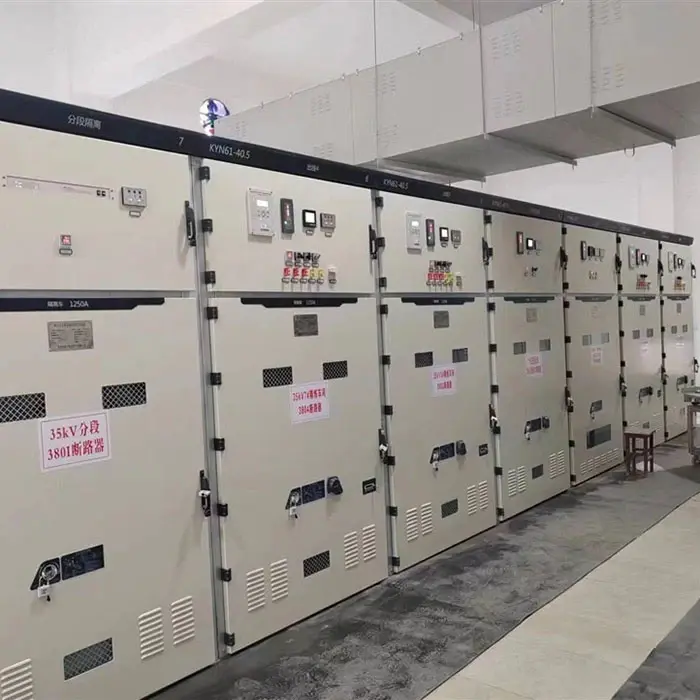
Comparative Analysis of High-Voltage Circuit Breaker Types
Operating Principles and Interruption Mechanisms
Vacuum breakers interrupt current by separating contacts within a sealed vacuum chamber, where the absence of oxygen prevents arc sustenance. This technology works very well for breaking capacities of up to 31.5kA, which is enough to handle the fault currents that are common in distribution networks. The small arc-extinguishing box doesn't need to be maintained for decades, which solves one of our customers' biggest problems. As a key component of modern high-voltage switchgear, vacuum breaker technology offers an optimal balance of compact footprint, reliable fault interruption, and minimal maintenance requirements—making it the preferred choice for utilities and industrial facilities seeking to maximise system availability while reducing lifecycle costs.
Sulphur hexafluoride gas is used in SF6 breakers as both an insulator and an arc-quencher. The gas has a very high dielectric strength, which lets manufacturers make parts that are smaller while still having high voltage ratings. But SF6 has 23,500 times the global warming potential of CO2, which is why it is limited by rules in the US and Europe. More and more, procurement managers are asking us about environmentally friendly options.
Oil circuit breakers put contacts in insulating oil. When the arc heats up, the oil breaks down into hydrogen gas, which cools the arc and puts it out. This old technology still works well, but it's not as appealing for new projects because it needs to be maintained with oil tests, replacements, and fire risk management. We've helped a lot of facilities switch from oil to hoover technology, which has cut their maintenance costs by 60% and made them safer.
Performance Metrics Across Applications
Breaking capacity tells you how safely a breaker can stop fault currents. The breaking capacities of Yuguang's vacuum circuit breakers range from 20kA to 31.5kA, meeting the needs of most industrial and utility applications. Because we use modular design, a single cabinet layout can hold a variety of breaker ratings. This makes it easier to keep track of spare parts and teach technicians.
The real story of lifecycle success can be found in reliability measures. Vacuum technology demonstrates mean time between failures exceeding 25 years in properly specified applications. Our field data from steel mills and chemical plants shows that permanent magnet mechanisms don't have the coil breakdowns and spring wear that are common in electromagnetic operators. This means fewer unexpected outages and lower costs for running the business and keeping it in good shape.
Environmental adaptability is what sets good solutions apart from good equipment. A lot of common breakers don't work when they're exposed to high humidity, extreme temperatures, or atmospheres that are bad for them. Yuguang uses aerospace-grade precision manufacturing and seals with an IP67 rating to make sure that our core components work reliably in coastal substations, desert solar farms, and dusty mining operations. This scenario-based customization capability stems from our 39 patents and vast field experience across diverse industry sectors.
Cost Evaluation and Total Ownership
The initial purchase price is only one part of the total cost. Procurement teams that are smart look at things like installation costs, maintenance needs, expected lifespan, and downtime costs. Vacuum breakers cost more up front than oil-based options, but they save money in the long run because they don't need to be maintained and have small sizes that lower the cost of building infrastructure.
Yuguang's method to manufacturing, which includes processing raw materials and checking the finished product, saves money without sacrificing quality. Our factory in Baoji takes advantage of the benefits of China's vacuum breaker manufacturing base in the regional supply chain. This lets us offer reasonable prices even for custom solutions. Customers like that our minimum order number is flexible and starts at just one unit, so we can support both pilot projects and large-scale installs.
Lifecycle costs include the risk of failure and the supply of spare parts. When you work with Yuguang, our full after-sales service guarantees that you'll get spare parts and free plans for changes as your system needs change. This worry-free process protects your infrastructure investment over its 30-year design life. This keeps you from having the stranded asset problems that come up when you buy a line of products that is no longer being made.
How to Choose the Right High-Voltage Circuit Breaker for Your Needs?
Technical Requirements Assessment
Breakers are chosen based on their voltage level and how the system is set up. Usually, distribution systems work with minimum voltages of 6kV, 10kV, or 35kV, so they need breakers that can handle 7.2kV, 12kV, or 40.5kV, respectively. Yuguang's full voltage class coverage means you don't have to buy from multiple sellers. This makes buying easier and makes sure that the quality of your entire electrical infrastructure is the same.
The breaking capacity must be greater than the highest possible fault current at the installation site. System studies figure out these numbers by looking at the capacity, impedance, and configuration of the network. Our technical team helps engineers make sure that the equipment they choose meets the needs of defence coordination and their plans for future growth by providing calculation support and application advice.
Industry-Specific Recommendations
The operating environment determines the protection ratings and material requirements. Installations inside climate-controlled substations need different requirements than those in outdoor switchyards that are exposed to pollution, extreme temperatures, and sunlight. Yuguang's ceramic coating and powder coating surface treatment, followed by curing at a constant temperature, protects against corrosion and ageing, which makes the product last longer, even in harsh coastal or industrial environments.
Vacuum breakers with fixed magnet mechanisms are useful in steel mills, chemical plants and manufacturing centers, among other places. These installations turn things on and off a lot, so they need tools that can keep working after thousands of mechanical cycles. Our maintenance-free design gets rid of the need for regular lubrication and adjustments, which slow down output and require a lot of upkeep work. Within the broader category of high-voltage switchgear, vacuum breakers equipped with permanent magnet mechanisms stand out for their exceptional durability and reduced maintenance burden, making them particularly well-suited for heavy industrial environments where production continuity is critical and maintenance windows are limited.
Applications that send and distribute power put reliability and standardisation first. Utility companies that are in charge of hundreds of breaker setups value interchangeability and reliable performance. Yuguang's products meet IEC, GB, and important U.S. standards, which makes sure that they work well with other systems. Our official certifications, such as ISO 9001:2015 and the High-Tech Enterprise designation, give utility buying departments that don't want to take risks the quality guarantee they need.
Supplier Evaluation Criteria
Renewable energy installations have their own problems, like being in remote areas, having variable generation profiles, and having to be fully operational quickly. Solar and wind farms need equipment that shows up on time and works well with little field service. Yuguang's delivery schedule—7 to 15 days for standard goods and 30 to 60 days for custom solutions—meets the needs of projects without the need for long wait times that slow down making money.
Long-term project success is directly linked to how trustworthy the manufacturer is. Yuguang was founded in 2008 and is located in China's vacuum breaker production hub, which shows that the company has a long-term commitment to this technology. Instead of mass production, our 39 utility model patents show that we are constantly coming up with new ideas. Our customers trust us because we have ISO 9001, ISO 14001, and ISO 45001 standards, and we are also known as a "Quality and Trustworthy Unit."
Support after the sale is what sets partners apart from sellers. When equipment breaks down, it doesn't care what time it is, and the costs of downtime quickly rise in key infrastructure. As part of our services, we offer help with installation, upkeep agreements, extra parts, and repairs for electrical equipment. We offer free transformation plan design for equipment changes that help asset life extension strategies that get the best return on investment.
In global supply lines, cross-border service skills are becoming more and more important. Yuguang blends a lot of experience making things in China with service standards from around the world. For example, they use moisture- and shock-proof wooden packaging that meets the needs of foreign shipping. Our expert team can easily talk to customers from other countries, and our ygvcb@hotmail.com contact answers quickly to questions from people in different time zones. This gets rid of the communication problems that make international purchasing harder.
Installation, Maintenance, and Testing Best Practices
Pre-Installation and Commissioning
A thorough site assessment and equipment inspection upon delivery are the first steps to a proper installation. Make sure that the measurements of the foundation, the way cables can enter, and the conditions of the surroundings all match the equipment's requirements. With every shipment, Yuguang includes full instructions on how to install it. Our expert support team is also available during the commissioning process to help with any problems that come up with adaptation and integration.
Safe handling methods keep people and things safe during installation. For lifting high-voltage parts, you need special tools and know-how for grounding them. When compared to traditional multi-piece constructions, our modular assembly method and compact integrated design make installation easier. The small size saves important substation space, and the strong sealing keeps building dust and moisture out of the internal parts while they are being set up.
Commissioning checks make sure that the equipment was installed correctly and that it works at a basic level. Primary injection testing makes sure that the current paths and protection relays work together. Control circuits and interlocking sequences are checked by secondary injection. Dielectric testing makes sure that the insulation is still good after being shipped and handled. Yuguang does many tests in the factory, such as arc extinguishing, insulation, and load adaptability verification. This makes sure that the equipment is ready for final approval, without having to go through the fixing steps that take longer to do in the field.
Routine Maintenance and Predictive Tools
Different types of breakers have very different maintenance needs. Vacuum circuit breakers with permanent magnet mechanisms don't really need any scheduled maintenance other than regular checks and monitoring of contact wear. This operation doesn't need any maintenance, which directly addresses the customer pain point of difficult maintenance by lowering the work and skill needs of the operations and maintenance departments.
Every year, inspections should check the outside conditions, make sure that indicating devices work right, and test the emergency trip circuits. Talk to manufacturers like Yuguang about how often you should inspect their products based on how they are used and the weather. Our technical documentation makes things easy to understand, and our servicing agreements give sites that don't have their own high-voltage experts professional help.
Digital tracking technologies allow for planned repair methods that stop problems before they happen instead of just fixing them when they do happen. Online tracking tools keep track of how worn out the contacts are, how long they've been used, and how healthy the mechanism is. Integrating with platforms for managing assets helps make replacement decisions based on data. Even though these systems cost more at first, they quickly pay for themselves in important applications because they prevent downtime and improve repair scheduling. For modern high-voltage switchgear, the adoption of digital monitoring and predictive analytics represents a paradigm shift—transforming traditional maintenance from reactive to proactive, extending equipment life, and delivering measurable returns through reduced unplanned outages and optimised maintenance expenditure.
Future Trends and Innovations in High-Voltage Circuit Breakers
Environmental Sustainability Initiatives
There is growing pressure on the power industry to get rid of SF6 gas because it is a very strong greenhouse gas. Some other technologies are vacuum interruption for medium voltages, dry air mixtures, and new fluorinated compounds that are better for the environment. For the 6kV–40.5kV range, hoover breakers like the ones Yuguang makes are already an environmentally friendly choice. This puts our customers ahead of any changes to the law.
Regulations in the US and EU are making it harder and harder to use SF6 in new installations. California laws limit the use of SF6 equipment in utility uses, and EU rules say that leaks must be cut down and eventually phased out. When making decisions today, procurement managers should look at the rules that will be in place in 30 years, not just the rules that are in place now. Yuguang's hoover technology platform makes sure that new environmental rules are followed without having to pay a lot of money for expensive upgrades.
Digital Integration and Smart Monitoring
Internet of Things monitors built into circuit breakers give you a new level of information about the health of your equipment and the state of the grid. Monitoring temperatures, finding partial discharges, and analysing vibrations can help find problems early on. These smart devices talk to centralised asset management systems, which helps improve the reliability of the whole system as well as the efficiency of individual pieces of equipment.
Predictive analytics use operational data to guess when maintenance will be needed and when to replace things. Machine learning systems find patterns that show failures are about to happen, so they can be fixed before they happen. Yuguang is dedicated to new ideas, as shown by our 39 patents and ongoing R&D investments. This puts us in a good position to use these technologies as customer needs change and business cases get stronger.
Modular Compact Designs
The gas-insulated switchgear (GIS) systems make great use of room by putting many parts in sealed compartments. Manufacturers are making more and more small GIS solutions in the 40.5kV class, which used to only be available for high-voltage uses. Compared to traditional air-insulated designs, these systems make substation sizes 70% smaller. This is useful in cities with limited room for substations and high-priced real estate markets.
Yuguang's integrated modular design philosophy achieves similar space optimisation while keeping the accessibility benefits of equipment that is insulated from air. Because our building is small and tightly sealed, the cabinet is smaller without losing safety or usefulness. Our hoover technology and materials that don't rust mean that today's compact installation will work reliably for decades, protecting the value of your infrastructure investment.
Conclusion
To choose the right high-voltage circuit breakers, you need to carefully look at the technical needs, the working setting, and the total costs over their entire life. Vacuum technology is the most popular in the 6kV–40.5kV range because it doesn't need any upkeep, is good for the environment, and has been used reliably in many commercial settings. Partnering with makers that offer full support, from special engineering to installation help and long-term parts supply, is good for procurement teams.
As electrical infrastructure moves toward smarter, smaller designs, it's important to pick equipment that meets both current needs and the needs of the future. This is important for both operational success and financial performance. In the broader context of high-voltage switchgear selection, the same principles apply—balancing technical performance, environmental adaptability, and lifecycle economics ensures that the chosen solutions deliver sustainable value while supporting the evolution toward more intelligent and compact substation designs.
FAQ
What advantages do vacuum circuit breakers offer compared to SF6 types?
Vacuum circuit breakers get rid of the environmental problems that come with SF6 greenhouse gas and don't need much maintenance. The sealed vacuum interrupter lasts as long as the equipment does, so there are no worries about gas monitoring, refilling, or leaks. Small sizes make installation room needs smaller, and the lack of hazardous materials makes disposal easier when the product is no longer needed.
How often should high-voltage circuit breakers be checked?
How often you inspect depends on the type of breaker, how often it is used, and the weather. Most hoover breakers with fixed magnet systems only need to be visually checked and tested for functionality once a year. Equipment that is used for switching operations a lot or that is in harsh environments may need more frequent attention. Manufacturers like Yuguang give specific advice based on the details of the application, and maintenance agreements include professional help for planning the best times for inspections.
What safety considerations apply when evaluating refurbished circuit breakers?
There are risks with used tools, like not knowing how it was used before, having broken parts, and using old technology. For important safety features to work, the tools must have a full manufacturer warranty and a history of good performance. Sometimes, limited budgets force people to choose refurbished options, but the risk of unexpected failures and lack of parts availability quickly wipe out any savings. New equipment from reputable makers has consistent performance and full support, which lowers the risk of a project.
Partner with Yuguang for Reliable High-Voltage Switchgear Solutions
With 39 patents and a long list of certifications, including ISO 9001:2015 and High-Tech Enterprise recognition, Yuguang demonstrates its skill in the production of High-voltage switchgear. With scenario-based customisation and integrated modular design, our 6kV–40.5kV vacuum circuit breakers solve important problems like equipment not working with each other, a lot of maintenance work and delivery delays. We offer full lifecycle support as a seasoned maker of High-voltage switchgear, from unique research and development to quick production, installation help, and ongoing after-sales service.
Email our expert team at ygvcb@hotmail.com to talk about the needs of your project. Yuguang's full-chain service approach guarantees stable, safe operation and stress-free project completion, whether you need a single replacement breaker or a whole switchgear system for a new building.
References
1. IEEE Standards Association. "IEEE Guide for the Application of Transient Recovery Voltage for AC High-Voltage Circuit Breakers." IEEE Std C37.011-2011.
2. International Electrotechnical Commission. "High-Voltage Switchgear and Controlgear - Part 100: Alternating Current Circuit-Breakers." IEC 62271-100:2021.
3. Dahiya, Rajesh Kumar and Singh, Balwinder. "Comparative Study of Different High Voltage Circuit Breakers." Journal of Electrical Engineering & Technology, Vol. 16, 2021.
4. Smeets, René P.P. "Capabilities and Limitations of Vacuum Circuit Breakers." Electrical Engineering Handbook, Third Edition, CRC Press, 2018.
5. National Electrical Manufacturers Association. "Application Guide for AC High-Voltage Circuit Breakers Rated on a Symmetrical Current Basis." NEMA SG 4-2020.
6. Williams, Brian and Chen, Michael. "Maintenance Strategies for High-Voltage Switchgear in Industrial Applications." IEEE Transactions on Industry Applications, Vol. 58, No. 3, 2022.

Send Inquiry
You may like
