
How Do Electrical Transmission and Distribution Systems Work? Find Out
Modern power infrastructure is held together by electrical transmission and distribution systems, which move energy from power plants to homes and businesses. Power transmission and distribution equipment work together in a coordinated network. High-voltage transmission lines safely send electricity over long distances with little loss, and distribution systems lower the voltage so it can safely reach factories, businesses, and homes. During this trip, transformers, circuit breakers, switchgear, and safety relays all work together to keep the power flowing smoothly, separate problems, and keep the system reliable.
Understanding Electrical Transmission and Distribution Systems
The Fundamental Distinction Between Transmission and Distribution
Transmission systems move large amounts of electricity from power plants to substations over long distances. They do this by using voltages that are usually between 69kV and 765kV. Long-distance travel with these high-voltage lines loses as little energy as possible, which is very important when serving industry clusters or metropolitan areas. On the other hand, distribution systems work at medium to low voltages, usually between 6kV and 40.5kV for main distribution and then even lower to 120V to 480V for end-user uses. This voltage drop is made possible by step-down transformers that are placed carefully across the distribution network.
The difference is very important to people who work in buying. Transmission equipment has to be able to handle a lot of electrical stress, harsh environmental conditions, and almost perfect efficiency because when it breaks down, it affects thousands of users. Different types of distribution equipment are needed, such as equipment that can be easily moved around in cities, quickly isolate faults, and work with a wide range of loads, from factories to data centers.
Critical Components in the Power Chain
Circuit breakers are the main safety devices. They stop problem currents in milliseconds to keep equipment from breaking and people from being hurt. Vacuum circuit breakers are the standard for medium-voltage uses because they don't need to be maintained, last a long time, and put out arcs better than other types. These breakers are kept in switchgear assemblies, which are small, sealed boxes that keep out dust, moisture, and toxic atmospheres. They are housed with disconnect switches, busbars, and control systems.
Transformers change voltages. Power transformers handle voltages at the transmission level, and distribution transformers serve networks at the neighborhood level. Protection switches constantly check the system's settings and activate the breakers when they find abnormalities like overloads, ground faults, or phase imbalances. These parts have to work perfectly together, which requires exact engineering and thorough testing while they are being made.
How Energy Flows Through the Grid?
Power plants make energy with middle voltage, which is usually between 11kV and 25kV. At the plant center, step-up transformers raise this to transmission voltage, which makes long-distance transfer possible. Transmission substations lower the voltage to sub-transmission levels (69kV to 138kV) so that energy can be sent to homes and businesses in the area. At distribution substations, the voltage is lowered even more to main distribution levels. This is where circuit breakers and switchgear protect and control the lines that serve different areas.
Power distribution boxes and motor control centers in industrial sites change and distribute electricity even more. They make sure that production equipment, HVAC systems, and other loads get the right voltage. This multi-stage method improves efficiency at each level while keeping safety gaps and allowing selective security that keeps faults from affecting the whole system.
Key Types and Technologies of Transmission and Distribution Equipment
Medium-Voltage Switchgear: The Cornerstone of Reliability
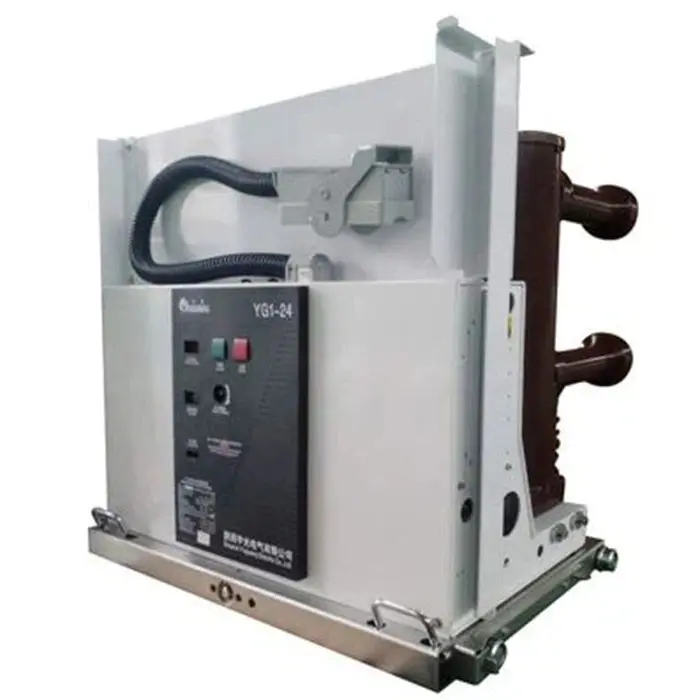
Medium-voltage switchgear that works in the 6kV to 40.5kV range is the most important type of Power transmission and distribution equipment for utility and industry uses. Modern vacuum circuit breaker technology has changed this market area a lot. Instead of oil-insulated designs, permanent magnet operating systems that don't need any upkeep have taken their place. These devices can handle being used a lot, which is important for wind farms, solar systems, and factories with changing loads.
Yuguang is an expert in this voltage class and has vacuum circuit breakers with fixed magnet systems that don't need to be serviced regularly and are very reliable. The vacuum arc-extinguishing technology stops the sparks cleanly, without releasing gases or needing oil changes, which lowers the overall cost of ownership by a large amount. The small, flexible design makes it possible to put in places with limited space, and the IP67 sealing standards keep out harsh industrial atmospheres like those found in mines, metalworking plants, and chemical processing plants.
Emerging Smart Grid Technologies
Digital tracking systems built into modern switchgear give real-time information about the health of the equipment, how it is being used, and the quality of the power. By finding signs of wear and tear before they happen, these tools help predictive maintenance plans. Communication standards like IEC 61850 make it possible for SCADA systems to work with other systems without any problems. This lets managers watch over multiple substations from one central control room.
Smart grid technologies are especially helpful for people who run complicated networks like airports, data centers, and public transit systems in cities. Unplanned outages in these areas can have big financial and operational effects. Maintenance changes from responding to problems to managing assets proactively when workers can check on equipment state from afar, look at past performance data, and get early signs of possible problems.
Specialized Equipment for Demanding Applications
For wind power systems to work, the switchgear needs to be able to handle frequent switching operations, voltage changes, and being outside in settings with high and low temperatures and salty air. In response to these specific needs, Yuguang has created combined electrical equipment for wind power that includes better sealing, corrosion-resistant metal construction, and strong arc-extinguishing chambers made to last longer in tough conditions.
Furthermore, equipment with great fault current withstand and thermal control is needed in steel mills, metal smelters, and other businesses that use a lot of energy. Leading makers use an integrated modular design theory that lets them make changes based on specific situations while keeping production costs low and quality high.
Challenges and Solutions in Transmission and Distribution Systems
Addressing Equipment Aging and Compatibility Issues
The number of failures in older systems is going up because the insulation is wearing down, the mechanical parts are wearing out, and the way the protections work together isn't working with how the grid works now. Replacement choices involve a lot of different things to think about, such as making sure the new parts fit with the old ones, making sure they work better, and making sure the lead times for buying parts match up with repair windows. When pieces of equipment from different makers or stages of technology don't work well together, it can be hard to integrate them and take longer to commission.
Yuguang solves these problems with complete upgrade solutions for power transmission and distribution equipment and the ability to make designs that are unique to each customer. Our engineering team offers a free change plan design service for changing oil-filled circuit breakers to vacuum technology that doesn't need to be maintained, while keeping the same footprints and connection points. This scenario-based approach to customization makes equipment fit the needs of each place instead of making customers change their infrastructure to fit standard goods.
Maintenance Burden and Operational Efficiency
Traditional machines need a lot of upkeep, like oil sample and replacing, contact check and adjustment, mechanism lubrication, and regular testing, which takes a lot of time and work. These repair needs make things harder for sites that are far away, platforms that are in the water, and places where there aren't many operations staff members or specialists who can help.
The fixed magnet working mechanism in Yuguang vacuum circuit breakers means that they don't need to be maintained regularly and can handle hundreds of thousands of operations without any problems. The vacuum arc-extinguishing technology doesn't need any replacement parts or adjustments, and the protected design keeps outside contaminants from affecting the inside parts. This feature of not needing maintenance directly lowers costs and boosts efficiency by getting rid of planned downtime, lowering the number of extra parts needed, and freeing up expert staff to do more useful tasks.
Safety Standards and Regulatory Compliance
Industrial facilities have to follow a lot of different rules and laws. These include IEC standards for electrical equipment, OSHA rules for worker safety, and industry-specific codes for dangerous areas or mission-critical uses. When equipment fails acceptance testing or regulatory checks, not following the rules can lead to legal problems, problems with insurance, and delays in the project.
Shaanxi Yuguang Electric Co., Ltd. has three certifications: ISO 9001:2015 for quality management, ISO 14001 for environmental management, and ISO 45001 for health and safety at work. Our goods are put through a lot of tests that make sure they meet national standards for high-voltage electrical equipment. They also come with all the paperwork that is needed for bids and regulatory submissions. The company's 39 patents show that it is always coming up with new ideas while also keeping up with changing technical standards. This detailed qualification profile gives purchasing managers peace of mind that the tools they buy will work and be in line with regulations from a reliable provider.
Choosing and Procuring the Right Power Transmission and Distribution Equipment
Critical Selection Criteria for Industrial Applications
The voltage values must meet the needs of the system and include enough safety margins to account for both regular working conditions and short-term overvoltages that can happen during switching operations or grid disturbances. The current rates should be able to handle peak loads plus room for growth. The short-circuit current interrupting capability should be higher than the highest fault current that can flow at the placement point. Energy economy factors include how much power machinery uses when it's not in use and how much power it uses when it's not in use. These factors add up over 20 to 30 years of service life.
Different industries have very different application-specific needs. To keep operations going, data centers put a high priority on redundancy and quickly fixing problems. In order to make things, factories need tools that can handle the frequent motor starting transients and harmonic distortion that come from variable frequency drives. Outdoor substations need to be built to withstand the weather and work in a wide range of temperatures. Knowing these differences is what sets buying goods apart from smart sourcing that lowers the total cost of ownership.
Evaluating Suppliers and Manufacturers
Leading companies around the world, like Siemens, Schneider Electric, ABB, Eaton, and GE, have wide ranges of products, strong service networks, and well-known names. These companies are great at providing standard solutions and working on big projects that benefit from having a footprint around the world. But buying strategies are becoming more and more aware of the value of specialized makers who can offer better customization options, quick technical support, and reasonable prices.
When buying medium-voltage tools, Yuguang has clear benefits. Our focus on 6kV–40.5kV systems gives us more scientific knowledge and more customization options than makers with a wider range of products. The company is located in Baoji, Shaanxi, which is China's vacuum circuit breaker production base. This gives it access to supply lines and manufacturing skills that were especially designed for this type of Power transmission and distribution equipment. This narrow focus leads to goods that solve real-world operational problems through useful design improvements instead of adding features just for the sake of marketing.
Practical Procurement Checklist
Defining specifications should start with thorough site surveys that record the current equipment, available room, weather conditions, and needs for integration. Instead of just looking at the original buy price, factors for evaluating suppliers should take into account their technical skills, quality certifications, shipping reliability, and service commitments. Lead time management is very important when equipment is needed to keep projects on plan or to replace broken units that are slowing things down.
It's important to pay close attention to the details of warranty terms, like how long they last, what they cover, how long they promise to respond, and whether extra parts are available. After-sales service options like installation help, commissioning help, and servicing agreements add value that goes far beyond the technology itself. Yuguang lets you place an order as little as one unit, so they can accommodate both small pilot setups and large-scale projects. Standard goods can be delivered in 7–15 days, while customized solutions can be delivered in 30–60 days, which fits in with most project plans.
Practical Insights for B2B Clients: From Understanding to Action
Real-World Implementation Success
An arc furnace at a mining facility kept breaking down because the oil circuit breakers were getting old. Each outage cost the facility more than $50,000 in lost production. In order to replace the old equipment, new equipment had to be able to handle high fault currents, frequent operations, and corrosive dust conditions while still fitting into the existing substation plans. Vacuum circuit breakers with better arc-extinguishing chambers and sealed construction were chosen, built, and put during a planned repair window after a thorough site assessment and custom engineering.
The results for the power transmission and distribution equipment were better than expected: no more costs for moving and disposing of oil, 75% less work for repair staff, and no unexpected outages in three years of operation. Monitoring the power quality showed that the voltage was more stable while the furnace was running, which led to less electrode use and better product quality. This case shows how choosing the right power transmission and distribution equipment and working together with a supplier can add value above and beyond basic practical needs.
Yuguang's Comprehensive Solution Portfolio
We have all the products you could need for medium-voltage power distribution, from vacuum circuit breakers and load break switches to full switchgear systems and custom-built solutions. The way we make things shows how much we care about quality and dependability. When choosing raw materials, corrosion-resistant metals and IP67-rated sealing parts that go through a strict checking process are given the most weight. Core parts like solid-sealed poles and arc-extinguishing tanks are precisely machined using aerospace-grade tools that guarantee accurate measurements and strong sealing.
Using modular building methods lets you change the layout easily while keeping production costs low. Surface treatment with ceramic coating and powder coating, followed by curing at a steady temperature, makes things less likely to rust and increases their useful life in harsh settings. Multi-round testing makes sure that the product meets national and ISO system requirements and checks its practical performance, such as its ability to put out arcs, keep its insulation in good shape, and handle different loads. Products that meet foreign shipping standards are sent in wooden boxes that are resistant to moisture and shock. This makes sure that the equipment comes ready to be installed.
Why Partnership with Yuguang Delivers Results?
The company's full-chain service model includes research and development, production, installation, and assistance after the sale. It's not just selling products; it's a real relationship that lasts the whole lifespan of the equipment. Our expert team guides the installation process, helps with setup, and trains operators to make sure everything works well together. Maintenance agreements, programs for getting extra parts, and free plan development for modifications all help meet changing operating needs over the course of a service life of decades.
This end-to-end process method gets rid of the problems with planning and pointing the finger that come up with projects with more than one vendor. When problems happen, they can be quickly fixed by a single person who knows everything about the system. This is faster than having to deal with multiple departments and technology experts. Yuguang is a great partner for international projects that need both cheap pricing and quick technical help because they can both make things efficiently in China and provide services across borders.
Conclusion
Procurement workers can make better power transmission and distribution equipment choices that improve reliability, lower costs, and support long-term business goals when they understand how electricity transmission and distribution systems work. The move toward vacuum technology that doesn't need to be maintained, tracking features that are built in, and custom solutions for specific uses has caused a big change in how businesses spend in power infrastructure. Choosing the right tools and production partner affects not only the success of the project at the start, but also how well it works over many years or even decades. Shaanxi Yuguang Electric Co., Ltd. offers the best value for demanding industrial and utility uses around the world by combining specialized technical knowledge, a wide range of products, and full-lifecycle service promises.
FAQ
What distinguishes power transmission from distribution systems?
Transmission systems use high voltages (usually 69kV or more) to move large amounts of power over long distances with little loss. They do this by connecting power plants to substations in different regions. Power is sent from substations to individual buildings through distribution systems, which work at medium to low voltages (40.5kV down to end-user levels). Power transmission and distribution equipment for each serves different purposes: transmission focuses on efficiency and bulk capacity, while distribution focuses on versatility, safety, and compatibility with a wide range of loads.
How can facilities extend equipment service life and reduce maintenance costs?
Choosing maintenance-free vacuum circuit breaker technology with permanent magnet working mechanisms gets rid of the need for regular upkeep while still giving reliable performance. Putting in place condition tracking systems lets you use predictive maintenance plans to fix problems before they break. Following the manufacturer's instructions for proper installation, keeping the surroundings in good shape, and working with providers who offer full after-sales support are all things that can be done to make equipment last longer and lower its lifecycle costs.
What factors most significantly impact procurement costs?
Class of voltage and current values have a direct effect on the size of tools and the cost of materials. Customization needs, like extra environmental protection, specific size limits, or interaction with existing systems, raise the cost of planning and production. Quality and level of approval have an effect on the original price, but through dependability and compliance, they have a much bigger effect on the total cost of ownership.
Partner with a Trusted Power Transmission and Distribution Equipment Manufacturer
Yuguang provides tried-and-true answers to the problems that industry and utility clients face every day, such as compatibility issues, maintenance issues, urgent shipping needs, and situation-specific changes. Our 6kV–40.5KV product range, which is backed by 39 patents and a wide range of approvals, ensures stable and safe operation while cutting costs through designs that don't need to be maintained and longer service lives. Our products are different from those of other companies because they are built using combined modules, are made with aerospace-grade accuracy, and come with a full service chain that includes research and development, installation, and support after the sale.
Our technical team is ready to come up with unique solutions that meet all of your needs, whether you need a few units for a pilot project or a lot of them for a big project. You can email us at ygvcb@hotmail.com to talk about your specific needs and find out how Yuguang's services as a Power transmission and distribution equipment provider can help your project succeed and your operations run more smoothly.
References
1. IEEE Standards Association. (2021). IEEE Guide for the Application of Shunt Power Capacitors. Institute of Electrical and Electronics Engineers.
2. Horowitz, S.H., and Phadke, A.G. (2014). Power System Relaying (4th Edition). John Wiley & Sons.
3. McDonald, J.D. (2017). Electric Power Substations Engineering (3rd Edition). CRC Press.
4. IEC Technical Committee 17. (2019). IEC 62271-100: High-voltage switchgear and controlgear - Part 100: Alternating-current circuit-breakers. International Electrotechnical Commission.
5. Grigsby, L.L. (2018). Electric Power Generation, Transmission, and Distribution: The Electric Power Engineering Handbook (3rd Edition). CRC Press.
6. Schlabbach, J. (2020). Short-Circuit Currents in Three-Phase A.C. Systems: Analysis, Calculation and Measurement of Short-Circuit Currents. Institution of Engineering and Technology.

Send Inquiry
You may like
