
The Difference Between High Voltage Load Switch And Vacuum Circuit Breaker
It is very important to know the difference between a High-voltage vacuum load switch and a vacuum circuit breaker when choosing electrical safety tools for medium-voltage systems. In systems with voltages between 6kV and 40.5kV, a High-voltage vacuum load switch is mainly intended to handle load current switching and separation tasks. A vacuum circuit breaker, on the other hand, is very good at stopping fault currents and keeping electronics safe from short-circuits. Both devices use vacuum arc-extinguishing technology, but their roles, ability to interrupt, and cost are very different. This makes it very important for procurement managers, chief engineers, and project coordinators to make the right choice if they want to improve system reliability and budget efficiency.
Introduction
High-voltage load switches and vacuum circuit breakers are the two main types of switching devices used in utility and industrial power networks. There is a lot of misunderstanding during the buying process because each one has its own protective and operational roles in electricity systems. If you choose the wrong gadget, it might not work with other tools, break down early, cause project delays, and cost more to maintain in the long run.
The goal of this guide is to make the detailed differences between these two important parts less mysterious. We'll look at how they work, what functions they serve, how much they cost, and whether they're right for certain business situations. Whether you're a procurement manager looking at bids from suppliers or a chief engineer planning a new substation, this resource will give you the information you need to make choices that are safe, reliable, and effective.
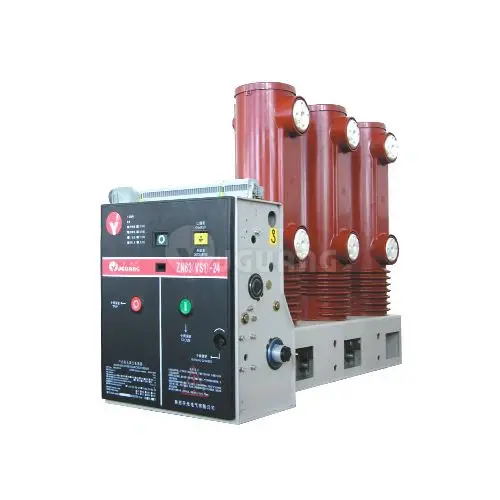
Understanding High Voltage Load Switches and Vacuum Circuit Breakers
What is a High-Voltage Vacuum Load Switch?
In order to make, carry, and break load currents under typical working conditions, a High-voltage vacuum load switch is a switching device. The FZN21-40.5 and YGFZN25B series from Yuguang work in the 6kV to 40.5kV range and use vacuum interrupters to put out sparks while switching is happening. These devices work great in places where they need to switch things on and off a lot, like ring main units, transformer safety, and feeder circuits in wind farms and solar stations. Compared to traditional oil or SF6 alternatives, vacuum technology promises maintenance-free operation, quiet switching, and less damage to the environment.
What is a Vacuum Circuit Breaker?
A vacuum circuit breaker is a safety device that can stop both standard load currents and high-magnitude problem currents. They have strong interrupting powers, usually between 20kA and 63kA, which makes them essential in situations where short-circuit safety is very important. These breakers have complex ways of tripping, relay safety connections, and often the ability to be monitored from afar. Vacuum circuit breakers are important in industries like steel production, petroleum plants, and big power plants to protect expensive equipment and keep systems from failing in terrible ways.
Operational Principles and Arc Extinguishing Methods
Vacuum arc-extinguishing technology is used in both devices. This is when electrical contacts split inside a sealed vacuum room. Because there are no air molecules in the circuit, there is no continuous arcing, which lets the current stop quickly. The style focus, on the other hand, is very different. Load switches care more about how long their contacts last and how often they switch, while circuit breakers are more concerned with how well they can handle the heat and mechanical stresses of cutting off a problem current. Yuguang's advanced manufacturing process uses aerospace-grade precise tools to make core parts like arc-extinguishing chambers. This makes sure that the parts are perfectly sealed and accurate. This attention to detail means that the equipment lasts longer and is less likely to break down, which is a big problem for buying teams that worry about how reliable their equipment is.
Comparison of High Voltage Load Switches and Vacuum Circuit Breakers
Interrupting Capacity and Primary Roles
The most important difference is the ability to stop. High-voltage vacuum load switches usually handle currents up to 630A with limited short-circuit breaking capability, frequently depending on built-in fuses (as in FZRN21 combination units) for fault protection. On the other hand, vacuum circuit breakers can stop fault currents greater than 31.5kA on their own. Load switches can be used for normal switching tasks, isolating transformers, and separating lines. Circuit breakers, on the other hand, are used to protect against faults in main distribution boards and important feeder circuits.
Maintenance Requirements and Reliability
Using vacuum load switches can greatly improve the efficiency of repair. Yuguang's combined modular design has small areas, vacuum interrupters that don't need to be maintained, and sealing that meets IP67 standards. Few routine inspections are done, usually just eye checks and contact trip measurements once a year. Because they are under more electrical stress, circuit breakers need more thorough upkeep, such as checking the tripping mechanism more often, calibrating the switch, and replacing the contacts. This difference in how often repair needs to be done has a direct effect on the total cost of ownership. This is especially true for operations teams that are in charge of big projects and have limited funds and downtime windows.
Cost Analysis and Total Ownership Considerations
The initial buying prices make the differences very clear. Load switches are often 40–60% cheaper than circuit breakers with the same rating, which makes them a good choice for situations where fault interruption isn't necessary. Smart procurement managers, on the other hand, look at the total cost of ownership, which includes how hard it is to install, how much it costs to maintain, how easy it is to get extra parts, and how much energy is wasted. Yuguang takes care of these issues with full after-sales deals that include installation help, servicing agreements, spare parts, and free plans for making changes. Delivery times of only 7–15 days for normal items are great for Yuguang because they solve the big problem of slow delivery that many industry projects have.
Buying in bulk increases worth even more. Yuguang's MOQ policy is very open, so they can take orders for anything from a single unit to large-scale customization. This means they can handle both small projects to improve things and huge projects to build new infrastructure. The company's 39 patents and official certificates (ISO9001, ISO14001, and ISO45001) give buyers even more confidence in the quality of their products, making the buying process less unsure.
How to Choose Between High Voltage Load Switch and Vacuum Circuit Breaker?
Assessing Your Operational Requirements
The selection process starts with a careful analysis of the system's features. A High-voltage vacuum load switch is perfect if you need to switch things on and off a lot without exposing the fault current to a lot of current, like when switching capacitor banks, isolating transformers in wind farms, or separating parts of ring networks. On the other hand, vacuum circuit breakers are needed for systems that need fault protection that works on its own, motor starting, or security for the main feeder. Yuguang's expert team is great at making unique solutions that work in harsh settings and meet the needs of specific industries. They also deal with compatibility issues that often stop projects in their tracks.
Environmental and Installation Considerations
The operating setting has a big impact on the choice of tools. Either device works well for setups inside of controlled settings. Places like mines, metallurgical plants, and seaside stations that are outside or in difficult conditions need strong enclosure grades and corrosion resistance. Yuguang's production process uses ceramic coating and powder coating that cures at a steady temperature. This makes the corrosion protection and aging performance much better. This special surface treatment makes things last longer in harsh settings, which directly lowers the costs of running and upkeep over time.
Supplier Certification and Technical Support
Reputable makers keep strict quality standards and a full help system in place. Along with well-known names like ABB, Siemens, and Schneider Electric, specialized makers such as Yuguang also have their own benefits. Yuguang was founded in 2008 in Baoji, which is the center of vacuum circuit breaker production in China. The company has a lot of experience making products in China and can also provide service across borders. The company's full-chain service approach includes research and development, production, installation, and help after the sale. This makes sure that customers don't just get products, but also full solutions. When procurement teams work with pure trading companies, they often have trouble because they don't have enough technical help. This method solves that problem well.
Future-Proofing and Smart Grid Integration
Digital connectivity skills are becoming more and more important in modern power systems. When looking at tools, think about how it could be upgraded in the future to include smart grid compatibility, remote tracking, and predictive repair algorithms. Yuguang is at the cutting edge of new ideas because they keep investing in research and development. As a National High-Tech Enterprise with 39 patents, this is proof. Because they can be customized for different situations, communication links, intelligent controllers, and condition tracking sensors can be added. This makes sure that the tools you buy today will still be useful as grid technologies change.
Maintenance and Troubleshooting of High Voltage Vacuum Load Switches
Routine Inspection Protocols
Good care increases the life of equipment and keeps it from breaking down when you least expect it. High-voltage vacuum load switches should have regular reviews to ensure contact movement, check mechanism lubrication points, check insulator surfaces for tracking or contamination, and measure loop resistance. Yuguang's equipment has easy-to-reach design features that make these steps easier. The combined modular design lets maintenance staff quickly check important parts without taking the whole thing apart, which cuts down on downtime during planned maintenance windows.
Common Failure Modes and Resolution Strategies
Contact wear is the main cause of degradation, especially in situations where moving happens often. Monitoring contact over-travel lets you know early on when replacement times are coming up. Loss of vacuum integrity, which is rare in high-quality devices, shows up as lower withstand voltage when testing. Other problems include mechanisms getting stuck because they aren't oiled enough or aren't lined up right. Yuguang's multi-round testing procedure during production ensures that the products work well to put out arcs, have good insulation, and are mechanically reliable, which cuts down on field failures. When problems happen, their helpful technical support team quickly figures out what's wrong and sends out new parts, meeting the important need for quick after-sales service.
When to Engage Professional Support
If a fault is complicated and involves replacing a vacuum chamber, overhauling a mechanism, or fixing a safety relay, you should get help from an expert. Yuguang's full service agreements cover expert help on-site, guided installation support, and training for customer care teams in specific skills. This method gives operations teams more power while also giving them safety nets in case things go wrong, which makes the total load on internal resources lighter.
Procurement and Ordering Guide for High Voltage Vacuum Load Switches
Identifying Qualified Suppliers
Choosing the right source is key to successful procurement. Manufacturing licenses, patent portfolios, production capacity, quality control systems, and after-sales infrastructure are some of the most important things that are looked at when judging a company. Yuguang has a lot of impressive credentials, such as ISO9001:2015 certification, Intellectual Property Management Standardization, national inspection reports, and recognition as a "Quality and Trustworthy Unit." Their advanced production line includes careful inspection of raw materials, precise processing of components, modular assembly, thorough testing, and international standard packaging, which makes sure that the quality of the products stays the same from the first item to mass production.
Customization Capabilities and Technical Specifications
Many uses are met by standard goods, but complicated projects often need answers that are made just for them. This need is well met by Yuguang's excellent scenario-based modification features. Customers and their tech team work together to change voltage values, current capacities, mechanical setups, and environmental requirements. Because of this, delivery times are also very flexible: standard goods ship within 7–15 days, while personalized solutions take 30–60 days, which is still incredibly fast compared to the norms in the industry. Tight project plans are a pain point that EPC workers and project managers often have to deal with. This responsiveness directly fixes that problem.
Negotiation Strategies and Value Optimization
Effective buying goes beyond just negotiating the price at the beginning. Total value includes things like product quality, on-time delivery, expert help, warranty terms, and the ability to get replacement parts. Yuguang's one-stop service plan, which includes research and development, production, installation, and after-sales support, gets rid of the problems that come with working with multiple vendors. Their minimal order quantity (MOQ) policy allows for both small-scale installations and large-scale deployments, and their full coverage from 6KV to 40.5KV makes sure that they have stable source relationships across a wide range of projects. All of these things work together to make buying less risky and project performance more efficient.
Conclusion
To tell the difference between High-voltage vacuum load switches and vacuum circuit breakers, you need to know how they work, how much they cost, and what kinds of uses they are best for. Load switches are great for uses that need to switch between tasks often and have low fault exposure. They are also cheaper and require less upkeep. Critical infrastructure needs strong damage security, which circuit breakers provide. Yuguang's wide range of products, protected by 39 patents, covers a full range of voltages and offers full service from start to finish. These products solve the main problems that come up in industrial buying, such as compatibility issues, maintenance issues, shipping delays, and not enough customization. Their combined method ensures stable operation, low costs, compliance with regulations, and stress-free execution, giving procurement workers the confidence to choose the best option.
FAQ
Can High Voltage Load Switches Replace Vacuum Circuit Breakers?
Vacuum circuit breakers cannot always be replaced by High-voltage vacuum load switches. The most important difference is the power to stop fault currents. Load switches can handle normal working currents and provide separation, but they usually can't stop high-magnitude short-circuit currents on their own. Combination units, like Yuguang's FZRN21 line, have fuses built in to add short-circuit safety. This makes them a cheaper option for protecting transformers. Dedicated vacuum circuit breakers with the right interrupting values are still needed for setups that need to stop faults often, protect motors, or protect the main bus.
What Safety Precautions Apply When Operating Vacuum Load Switches?
Following strict safety rules is necessary to operate vacuum load switches. Before switching, make sure the load is completely disconnected. Follow mechanical interlock systems (especially with earthing switches), wear the right safety gear, and make sure there is no power before doing any repair. Yuguang's equipment has a lot of connecting parts that keep it from closing when the earthing switches are on and show that the equipment is isolated. Operations staff should get regular training and follow the manufacturer's instructions to keep operations safe and reduce risks.
What Service Lifespan Can Be Expected Under Standard Conditions?
A good vacuum load switch will last between 20 and 30 years under normal used settings. Mechanical life rates, like the M2 class standard (2,000–10,000 operations) for Yuguang's FZN21 series, show how many times the switch can be used before it needs major repair. The vacuum interrupter doesn't need much upkeep; replacing the contacts is the major long-term service that it needs. The real service life is greatly affected by proper installation, proper use, and regular upkeep. Yuguang's strong construction, processing of aerospace-grade parts, and thorough surface treatments make equipment last longer, directly answering procurement worries about equipment failure risk and lifespan.
Partner with Yuguang for Reliable High-Voltage Vacuum Load Switch Solutions
Industrial buyers and chief engineers seeking dependable high-voltage vacuum load switch suppliers will find Yuguang offers unmatched value. Our 39 patents, comprehensive 6KV-40.5KV product coverage, and proven track record across power, metallurgy, and infrastructure projects demonstrate technical excellence. Beyond products, we deliver complete solutions—scenario-specific customization, rapid delivery (7-15 days for standard equipment), full-chain service from R&D through installation and after-sales support, and flexible MOQ accommodating single units to bulk orders. Our integrated modular design, aerospace-grade manufacturing processes, and authoritative ISO certifications ensure stable, safe operation that reduces your total cost of ownership. Contact our technical team at ygvcb@hotmail.com to discuss your specific requirements, request detailed specifications, or obtain competitive quotations. Let Yuguang's expertise transform your procurement challenges into competitive advantages.
References
1. IEEE Standard C37.04-2018, "IEEE Standard for Ratings and Requirements for AC High-Voltage Circuit Breakers with Rated Maximum Voltage Above 1000V."
2. IEC 62271-103:2021, "High-voltage switchgear and controlgear - Part 103: Switches for rated voltages above 1 kV up to and including 52 kV."
3. Greenwood, A. (1991). Vacuum Switchgear. London: Institution of Engineering and Technology.
4. Slade, P. G. (2008). The Vacuum Interrupter: Theory, Design, and Application. Boca Raton: CRC Press.
5. GB 3804-2017, "High-voltage alternating current load switches and combination fuse-controlgear units."
6. National Electrical Manufacturers Association (NEMA) SG-5, "Power Switchgear Assemblies: Requirements for Load Interrupter Switches."

Send Inquiry
You may like
