
Top Uses of Permanent Magnet Mechanism in Power Distribution Systems
When engineers and procurement teams evaluate switching technology for medium-voltage networks, the permanent magnet circuit breaker mechanism consistently earns attention for its speed, simplicity, and longevity. Unlike spring-loaded or electromagnetic alternatives, a permanent magnet mechanism holds the breaker contact in position using magnetic latching rather than mechanical springs, eliminating a significant source of wear.
Across voltage ranges from 6 kV to 40.5 kV, this design delivers sub-cycle fault interruption, reduces scheduled maintenance intervals, and integrates cleanly with digital monitoring platforms—qualities that directly address the reliability and lifecycle cost pressures facing power plants, industrial facilities, and infrastructure operators today.
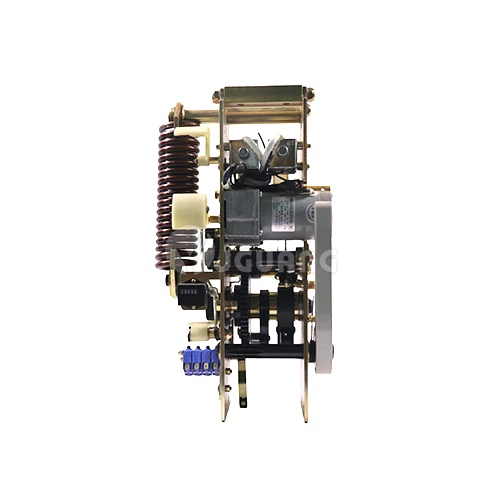
Understanding Permanent Magnet Mechanisms in Circuit Breakers
How Magnetic Latching Works
A permanent magnet device uses a magnetic circuit that can switch between two states. A permanent magnet's residual flux keeps it in two stable positions: closed and open, even when no energy is being sent to it all the time. When you send a short electrical pulse to a coil, it temporarily stops that flow.
This moves the armature to the opposite position, where the magnet holds it again. There is no mechanical trip latch, no worn-out springs, and no oil-filled dashpot. According to IEC 62271-100 durability standards, this makes an actuator that can do more than 20,000 operations, while most conventional spring systems can only do 10,000.
Key Structural Advantages
The armature, magnetic yoke, and drive coil are all packed together into a small package that fits inside a modular frame. Yuguang builds this assembly with parts made of a corrosion-resistant alloy and seals that are rated IP67. It is made with aerospace-grade tools that keep the dimensions within acceptable ranges that affect the regularity of the contact trip, which is a key factor in the performance of the circuit breaker mechanism. A steady contact travel distance means consistent arc-extinguishing performance, which is very important in 40.5 kV solid-insulated vacuum interrupters where contact bounce can start the arc up again.
Top 5 Applications of Permanent Magnet Mechanisms in Power Distribution Systems
Because permanent magnet actuation can be used in so many different situations, it is a natural choice in many demanding industries. Here are five situations in which this technology gives clear operational benefits.
- Utility substation bus protection (6 kV–40.5 kV): State-owned grid branches and regional power bureaus require breakers that can interrupt fault currents within one half-cycle. The magnetic mechanism's coil-energize time is typically under 30 ms, satisfying protection coordination requirements without the mechanical pre-travel delay inherent in spring-driven units. Yuguang's 40.5 kV vacuum breakers covering this range have passed national authoritative certification testing.
- Wind and photovoltaic collection feeders: Renewable generation sites experience frequent switching cycles driven by variable output. A permanent magnet mechanism tolerates high-frequency open/close commands without lubrication degradation, reducing turbine-side maintenance visits—a direct cost benefit for remote onshore and offshore installations.
- High-energy industrial process lines (steel, metallurgy, chemical): Motor feeder circuits in arc furnace bays and compressor halls demand fast reclosing after voltage dips. Magnetic actuation achieves consistent close times regardless of ambient temperature swings between −40 °C and +70 °C, which spring mechanisms struggle to match at extremes.
- Urban rail traction substations and airport power centers: Infrastructure operators running 24/7 systems treat every planned outage as a service-level event. The near-zero mechanical wear profile of permanent magnet circuit breakers extends the overhaul interval from roughly 5 years to over 10 years in typical cycle-count environments.
- Data center critical bus transfer schemes: Millisecond-class transfer times between normal and backup sources require actuation technology with tight timing repeatability. Magnetic mechanisms achieve cycle-to-cycle close-time variance under 2 ms, supporting uninterruptible transfer without relying on mechanical latching precision.
One thing that all five of these applications have in common is that they all punish unplanned downtime harshly and praise technologies that lower both the chance of failure and the amount of maintenance that needs to be done.
Comparing Permanent Magnet Mechanisms to Other Circuit Breaker Mechanisms
Purchasing engineers often compare the use of permanent magnets to other options, such as spring-operated and electromagnetic ones. Each has a valid purpose, but it's important to understand the trade-offs of the circuit breaker mechanism.
Before being told to trip or close, spring systems physically store energy. They are well-developed, cost-effective, and well-known. One problem with them is that spring compression parts wear out over time, need to be oiled every so often, and can become out of whack in places with a lot of moisture or heat. Electromagnetic devices work quickly, but they need a constant current to hold on to. This adds to the heat load on the panel and the cost of energy over the 20-year life of the equipment.
Permanent magnet activation gets rid of all holding current and replaces many moving parts with an armature with a single mass. For that reason, coil drive circuits need steady control power; if the DC supply goes out without a capacitor backup, the breaker could stay in its last state. To fix this problem, Yuguang added capacitor-assisted trip/close modules to its line of permanent magnet breakers. These modules make sure that the equipment can still work safely even if the control power goes out.
When it comes to total cost of ownership, the permanent magnet option always beats other options for high-cycle, harsh-environment, or space-constrained uses. When money is tight and switching frequency is low, spring mechanisms can still be used. But when cycle counts go over 3,000 per year, the maintenance calculations change in a big way.
Procurement Considerations for Permanent Magnet Circuit Breaker Mechanisms
Technical Specifications That Matter
Engineers should write down the nominal voltage (6 kV, 12 kV, 24 kV, or 40.5 kV), nominal current (630 A to 3150 A), short-circuit breaking capacity (25 kA or 31.5 kA per IEC 62271-100), and mechanical life class when they write a purchase specification. The insulation level needs to match the insulation coordination study for the switchgear cabinet in terms of both power-frequency withstand voltage and lightning impulse withstand voltage (BIL).
Yuguang works with a single maker to cover the whole range of voltages from 6 kV to 40.5 kV. Yuguang has 39 registered patents and ISO 9001:2015, ISO 14001, and ISO 45001 certifications, which means it can bid on big utility, EPC, and industrial projects without having to go through any extra supplier checks. The company is a National High and New Technology Enterprise, which means it is taken seriously when buying things in the United States and other countries.
Delivery, Customization, and MOQ
It takes 7–15 days to ship standard stock items. There is a 30–60 day wait time for customized setups like special truck kits, changed pole spacing for retrofit projects, or enclosures designed for coal mines or salt fog along the coast. The lowest amount you can order is one unit, which helps project teams that are doing pilot installations or emergency replacements along with larger orders, while the circuit breaker mechanism remains a critical component throughout.
Maintenance, Testing, and Troubleshooting of Permanent Magnet Circuit Breakers
Routine Inspection Protocol
Permanent magnet breakers don't need as many regular maintenance tasks as spring-type peers, but when they do, they need very careful checks. Every year, technical teams should use a travel recorder to check the contact travel distance, compare the coil resistance to the manufacturer's baseline (which is usually within a 10% tolerance), and look for surface contamination on the magnetic yoke that could change the latching force.
Yuguang provides installation instructions and maintenance contracts that include on-site support, access to spare parts, and free modification plans in case operational conditions change after the system is put into service. For customers in other countries, the company's import-export service handles technical support across time zones and ships parts in wooden boxes that are resistant to shock and moisture and meet international freight standards.
Diagnosing Common Faults
A failure to close is usually caused by not enough control voltage (below 85% of rated DC), a broken coil, or a capacitor module that has been worn down. If a fault condition doesn't cause the trip, it means that there are problems with the continuity of the coil circuit or that the armature is binding against corrosion buildup. This is rare in IP67-sealed units but can happen in places that aren't well taken care of. Yuguang's technical support team offers fault response service, which cuts down on the time it takes to fix problems in operations areas that can't afford to wait for long diagnosis delays.
Conclusion
Permanent magnet systems used to be a niche technology, but now they are widely used in critical infrastructure, heavy industry, utility substations, and renewable energy lines. Their quick response, almost no maintenance wear, and ability to work with digital security tools meet the major needs of today's B2B power sector for dependability and low lifecycle costs, especially when integrated into a circuit breaker mechanism.
Many of Yuguang's products are approved, the company can make large changes to them, and they offer full service from research and development to installation and after-sales. This makes them a reliable long-term supplier for engineers and buying teams that are building systems that can't afford unplanned downtime.
FAQ
What voltage classes are suitable for permanent magnet circuit breakers?
It has been shown that permanent magnet systems work with middle voltages ranging from 6 kV to 40.5 kV. Yuguang makes units that cover the whole range. Above 40.5 kV, SF6 or air-insulated technologies usually win out because of the way the external insulation geometry needs to be set up. However, vacuum-plus-solid-insulation hybrid designs are slowly pushing the upper limit further.
How does permanent magnet actuation reduce long-term maintenance costs?
Since there are no spring compression parts, lubricated pivot points, or mechanical trip latches, there are no main wear items that need to be replaced on a regular basis. Studies of magnetic actuator service records show that they need to be serviced two to three times less often than similar spring systems that do the same amount of flipping.
Can permanent magnet breakers integrate with smart grid monitoring systems?
Yes. The electronics in modern permanent magnet units that move the coils can connect to additional circuits for relay safety and SCADA systems. Standard IEC 61850 transmission designs used in digital substations can work with Yuguang units.
What certifications should I require from a supplier?
These include IEC 62271-100, GB 1984 (for equipment sold in China), ISO 9001:2015, and national type-test reports from labs that have been approved. Of these, Yuguang has all of them. He also has ISO 14001 and ISO 45001 safety and environmental licenses.
What is the minimum order quantity for Yuguang products?
It costs one unit to place an order. Yuguang can handle both emergency replacements of a single unit and purchases of a lot of units for a project, with the same level of engineering and logistics care.
Partner with Yuguang for Reliable Circuit Breaker Mechanism Solutions
Yuguang has been making things for 17 years, has 39 patents, and has a full range of products from 6 kV to 40.5 kV. As a reputable circuit breaker mechanism manufacturer, Yuguang can send you basic goods in 7–15 days or configurations that are specially made for your needs. Email our engineering team at ygvcb@hotmail.com or go to ygvcb.com to get a technical consultation, a product datasheet, or a quote that is tailored to your project. Your next reliable switching solution is just a phone call away.
References
1. IEEE Transactions on Power Delivery — "Performance Evaluation of Permanent Magnet Actuators in Medium-Voltage Circuit Breakers," 2019.
2. IEC 62271-100: High-Voltage Switchgear and Controlgear — Alternating-Current Circuit Breakers, International Electrotechnical Commission, 2021.
3. CIGRE Technical Brochure 135: Controlled Switching of HVAC Circuit Breakers, Study Committee A3, 2018.
4. Electric Power Systems Research — "Reliability Modeling of Vacuum Circuit Breaker Operating Mechanisms," Elsevier, 2020.
5. GB 1984: AC High-Voltage Circuit Breakers, Standardization Administration of China, 2014.
6. IEEE Industry Applications Magazine — "Advances in Magnetic Actuator Technology for Power Distribution Equipment," 2022.

Send Inquiry
You may like
