
Vacuum Breaker vs Air Circuit Breaker
When choosing between vacuum circuit breakers and air circuit breakers, the primary difference lies in their interrupting medium and application scope. Vacuum circuit breakers utilize a vacuum interrupter to extinguish arcs, making them ideal for medium to high voltage applications (6kV-40.5kV) with superior reliability and maintenance-free operation. Air circuit breakers use compressed air for arc quenching and typically serve low to medium voltage applications, offering cost-effective solutions for less demanding environments.
Understanding the Core Technology: How Each Breaker Type Works?
The primary difference between these two groundbreaking technologies rests in their flare extinction methodologies and essential operating concepts. One version focuses on quickly elongating along with cooling the arc inside a pressured gas or vacuum condition, while the other employs a succession of interconnected plates to fracture, cool, and oxygenate the arc plasma. These varied techniques directly influence their applicability for certain electrical and electrical applications.
Vacuum circuit breakers feature a sealed vacuum bottle holding contacts that function inside a total vacuum environment. When the contacts split during fault delay, the arc develops in the vacuum space where it spontaneously extinguishes owing to the lack of ionizing particles. This vacuum interrupter technique offers quick current interruption with low contact wear.
Air circuit breakers employ ambient air or air that is compressed to act as the interruption medium. The arc develops between separate contacts and becomes extinguished by air blast or transpiration-induced cooling. The arc dampening process depends on deionization for the air medium around the contacts.
Three core operational differences:
- Arc extinction speed: Vacuum breakers achieve arc extinction within 0.5-1 cycle, while air breakers require 2-3 cycles
- Contact materials: Vacuum units use copper-chromium alloys, air breakers typically employ silver-tungsten contacts
- Operating force requirements: Vacuum mechanisms need 30-40% less operating force compared to air breakers
If you need rapid fault clearing with minimal system disruption, vacuum technology provides superior performance characteristics.
Performance Analysis: Reliability and Maintenance Perspectives
A study of reliability measures between the vacuum along with air circuit interrupting components indicates major operating variations that effect long-term system performance. Vacuum interrupters often provide superior dielectric strength, little maintenance, and a longer lifetime owing to their completely sealed, oxidation-free environment. In contrast, air disrupting substances, although durable, are more subject to environmental conditions and contact degradation, which may influence their consistency over lengthy durations. These intrinsic variances directly impact maintenance schedules and overall cost of ownership.
Vacuum circuit breakers offer outstanding dependability with average times between failures (MTBF) surpassing 30 years under typical working circumstances. The enclosed vacuum environment avoids oxidation as well as contamination, resulting in stable dielectric strength through the equipment lifetime. Test data reveals vacuum breakers retain 95% of original functionality after 10,000 switches have been made.
Air circuit breakers typically achieve MTBF ratings of 15-20 years, with performance degradation occurring more rapidly due to environmental exposure. Contact oxidation and dust accumulation affect interrupting capacity over time, requiring periodic maintenance interventions. In contrast, the vacuum circuit breaker's sealed interrupting chamber offers inherent protection against atmospheric conditions.
Maintenance comparison highlights:
- Vacuum breakers: Maintenance-free operation for 20+ years, no routine contact inspection required
- Air breakers: Annual inspection recommended, contact cleaning every 2-3 years
- Spare parts availability: Vacuum units require minimal spare parts inventory
- Downtime duration: Vacuum breaker maintenance completed in 2-4 hours vs 8-12 hours for air breakers
If you need minimal maintenance requirements with maximum uptime reliability, vacuum technology offers compelling advantages for critical power infrastructure.
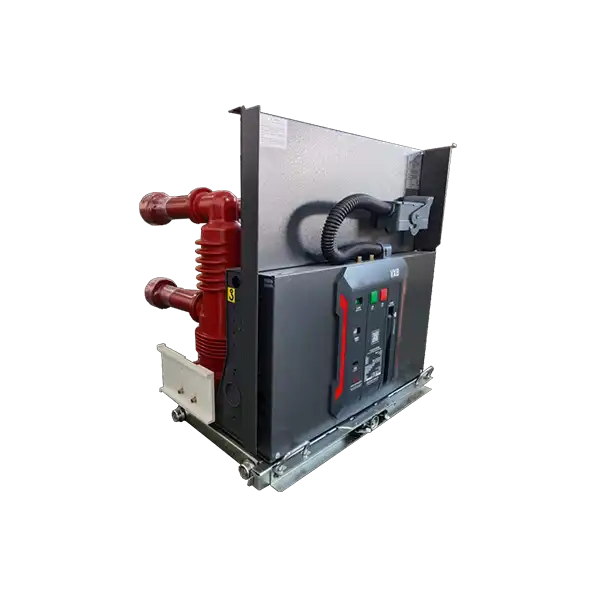
Application Scenarios: Matching Technology to Requirements
Different operational environments and voltage levels determine the optimal breaker selection for specific applications. Vacuum circuit breakers shine in midrange to high voltage operations ranging from 6 kilometers per second to 40.5kV. These devices perform particularly effectively in frequent switching situations such as motor ignition, capacitor bank transitioning, and transformer protection. The technique proved especially beneficial in tough climatic circumstances like high humidity, spraying with salt, and extreme temperatures.
Air circuit breakers remain cost-effective solutions for low voltage applications up to 15kV where switching frequency stays moderate. These units work well in indoor installations with controlled environmental conditions and adequate ventilation systems.
Industry-specific applications:
- Power generation facilities: Vacuum breakers preferred for generator protection and medium voltage distribution
- Manufacturing plants: Air breakers suitable for low voltage motor control centers
- Wind power systems: Vacuum technology essential for frequent switching operations
- Urban substations: Vacuum breakers mandatory due to space constraints and reliability requirements
If you need equipment for outdoor installations or frequent switching operations, vacuum circuit breakers provide superior environmental resistance and operational longevity.
Cost Analysis: Total Ownership Economics
The economic evaluation must consider initial investment, operational costs, and lifecycle expenses to determine the optimal solution. Vacuum circuit breakers typically require 20-30% higher initial investment compared to equivalent air breakers. However, the total cost of ownership analysis reveals significant long-term savings through reduced maintenance, extended service life, and improved reliability.
Lifecycle cost breakdown over 20 years:
- Initial equipment cost: Air breakers 100%, Vacuum breakers 125%
- Maintenance expenses: Air breakers 100%, Vacuum breakers 25%
- Replacement parts: Air breakers 100%, Vacuum breakers 15%
- Downtime costs: Air breakers 100%, Vacuum breakers 30%
- Total ownership cost: Air breakers 100%, Vacuum breakers 85%
The analysis demonstrates vacuum technology provides 15% lower total ownership costs despite higher upfront investment. This advantage increases in applications requiring high reliability and minimal maintenance windows.
Economic factors favoring vacuum breakers:
- Reduced maintenance labor: 75% fewer maintenance hours required
- Extended replacement cycles: 2-3 times longer equipment life
- Lower insurance premiums: Reduced risk of equipment failure
- Energy efficiency: Lower contact resistance reduces power losses
If you need optimal long-term economic performance with reduced operational complexity, vacuum circuit breakers provide superior value proposition.
Environmental Impact and Safety Considerations
Environmental performance and safety characteristics significantly influence breaker selection in modern power systems. Vacuum circuit breakers offer exceptional environmental advantages through their sealed construction and maintenance-free operation. The vacuum interrupter contains no hazardous gases or liquids, eliminating environmental contamination risks. These units operate silently without producing arc byproducts or electromagnetic interference.
Air circuit breakers may generate ozone and nitrogen oxides during arc extinction, requiring adequate ventilation in enclosed installations. The open-air construction allows ingress of moisture, dust, and contaminants that can affect performance over time.
Environmental comparison factors:
- Greenhouse gas emissions: Zero from vacuum breakers, minimal from air units
- Noise levels: Vacuum <45dB, Air 60-75dB during operation
- Contamination resistance: Vacuum units completely sealed, air units vulnerable
- Disposal requirements: Vacuum breakers 95% recyclable materials
Safety advantages include:
- Arc flash protection: Vacuum technology reduces arc flash energy by 60-80%
- Personnel exposure: Sealed construction eliminates contact with live parts
- Fire risk reduction: No combustible gases or explosive mixtures
- Seismic performance: Compact design improves earthquake resistance
If you need enhanced safety performance with minimal environmental impact, the vacuum circuit breaker provides comprehensive technological advantages.
Yuguang's Advanced Vacuum Circuit Breaker Solutions
Shaanxi Yuguang Electric delivers cutting-edge vacuum circuit breaker solutions engineered for demanding power system applications. Our comprehensive product portfolio covers 6kV-40.5kV voltage ranges with 39 patented technologies ensuring superior performance and reliability.
Yuguang's unique competitive advantages:
- Outstanding scenario-based customization: Adaptable designs for harsh environments including wind power, metallurgy, and mining applications
- Integrated modular architecture: Compact design with IP67 sealing and extended operational life exceeding 30 years
- Full-chain service capability: Complete R&D, production, installation, and after-sales support eliminating vendor coordination challenges
- International quality standards: ISO 9001:2015 certification with IEC and GB compliance ensuring global project compatibility
- Advanced manufacturing processes: Aerospace-grade precision technology with multi-round testing protocols
Our permanent magnet operating mechanism technology eliminates routine maintenance requirements while delivering 30,000 mechanical operations reliability. The vacuum interrupter design utilizes copper-chromium contact materials providing consistent performance throughout the equipment lifecycle.
Technical specifications highlight:
- Voltage coverage: 6kV, 10kV, 35kV, 40.5kV standard ratings
- Breaking capacity: Up to 50kA with superior arc quenching performance
- Delivery timeframes: Standard products 7-15 days, customized solutions 30-60 days
- Minimum order quantity: Single unit availability supporting both pilot projects and bulk procurement
- Comprehensive warranty: Installation guidance, maintenance agreements, and spare parts supply
Yuguang's vacuum circuit breaker manufacturer expertise spans power generation, industrial manufacturing, infrastructure development, and renewable energy sectors.
Conclusion
The choice between vacuum and air circuit breakers depends on specific application requirements, voltage levels, and operational priorities. Vacuum circuit breakers excel in medium to high voltage applications requiring superior reliability, minimal maintenance, and extended service life. Air circuit breakers remain viable for low voltage applications where initial cost considerations outweigh long-term operational benefits. Modern power systems increasingly favor vacuum technology due to enhanced safety, environmental benefits, and total ownership economics. Contact our technical team at ygvcb@hotmail.com for customized solutions addressing your specific power system requirements and operational challenges.
References
1. IEEE Standard C37.06-2009: AC High-Voltage Circuit Breakers Rated on a Symmetrical Current Basis - Preferred Ratings and Related Required Capabilities for Voltages Above 1000V
2. IEC 62271-100:2021 High-voltage switchgear and controlgear - Part 100: Alternating current circuit-breakers
3. CIGRE Technical Brochure 234: Guide for Application of IEC 62271-100 and IEC 62271-1 to Switchgear Assemblies
4. NEMA SG 4-2009: AC High-Voltage Circuit Breakers Applied with Definite Purpose Switching Devices
5. IEEE Standard C37.04-2018: Rating Structure for AC High-Voltage Circuit Breakers
6. ANSI/IEEE Standard C37.010-2016: Application Guide for AC High-Voltage Circuit Breakers Rated on a Symmetrical Current Basis

Send Inquiry
You may like
