
What are the different types of breaker switches?
Circuit breaker switch types are safety-related electrical devices that stop current flow instantly when problems happen. This keeps equipment from getting damaged and keeps people safe. There are Miniature Circuit Breakers (MCBs) for home use, Molded Case Circuit Breakers (MCCBs) for business use, Air Circuit Breakers (ACBs) for big industry loads, and Vacuum Circuit Breakers (VCBs) for high-voltage systems in these switches. Each type works with a certain range of voltages and security needs, making sure that electrical systems are safe and reliable in a wide range of settings, from homes to power plants.
Understanding Circuit Breaker Switches: Overview and Functions
Circuit breaker switches are the most important part of electrical safety systems because they stop the flow of electricity immediately when something dangerous happens. When these high-tech devices sense abnormal current conditions like overloads, short circuits, and ground problems, they quickly open their contacts to protect equipment and wiring systems further down the line.
Core Protection Mechanisms
Modern circuit breakers have more than one way to protect you, so you are completely safe. When there is a prolonged overload, thermal protection uses bimetallic strips that bend when heated by too much power. Through electromagnetic bands that set off mechanical trip mechanisms when current levels rise above certain limits, magnetic protection responds instantly to short circuit situations.
Circuit breakers do more than just protect electrical lines; they also let you control them manually for repair and operational reasons. Circuit breakers can be changed and used again and again, unlike fuses that need to be replaced after use. This makes them more cost-effective and useful for both home and business use.
Technical Specifications and Standards
To make the right choice and use, you need to know about breaker grades. Breaking capacity, which is usually given in kiloamperes (kA), is the largest problem current that a breaker can safely stop without damaging anything. The breaker's voltage rating tells you the highest voltage it can handle, and its current rating tells you the usual amperage amounts it can handle.
Modern breakers are made to international standards, such as IEC 60947 and IEEE standards. This makes sure that they work with all markets and are safe. These standards tell makers how to test their products, what performance standards they must meet, and what safety requirements they must meet to make sure their products work reliably in certain situations.
Types of Circuit Breaker Switches: Classification and Features
Electrical professionals divide circuit breaker switch types into groups based on how they are built, the power levels they handle, and the needs of the application. Each group covers a different set of security needs and working conditions, ranging from homes to power plants.
Miniature Circuit Breakers (MCBs)
Most of the time, circuit breaker switch types such as MCBs are used to protect electrical systems in homes and small businesses. They can handle currents between 1 and 125 amps. These small devices have thermal-magnetic trip features that protect them from both overload and short circuit situations.
MCBs are grouped by their trip properties, which show how sensitive they are to inrush currents. For motor starting, Type B breakers trip at 3 to 5 times the rated current. Type C breakers, on the other hand, trip at 5 to 10 times the rated current and are better for general lights and power lines. Type D breakers (10–20 times the maximum power) can handle loads that come on quickly, like transformers and big motors.
Molded Case Circuit Breakers (MCCBs)
MCCBs handle currents between 100 and 2,500 amps, which is in between MCBs and bigger commercial breakers. These devices have trip settings that can be changed to fit the needs of a specific application. They also have small sizes that make them ideal for panelboard setups. Newer MCCB types have electric trip units with digital displays that let you set the exact level of safety and do diagnostics. These features make proactive maintenance possible and improve the dependability of systems in important business and industry settings.
Air and Vacuum Circuit Breakers
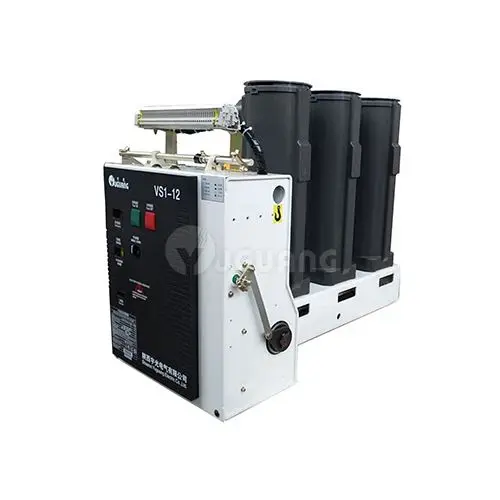
Air Circuit Breakers (ACBs) put out sparks during interruptions by using compressed air or ambient air. In low-voltage uses, they can handle currents of up to 6,300 amps. These durable devices are built in a way that lets trip units and tools be replaced on the spot. Vacuum Circuit Breakers (VCBs) work very well in medium-voltage situations (1kV to 38kV). They use vacuum technology to put out sparks very reliably and with little need for upkeep. Because they don't contain any shielding gases or oils, VCBs are safe for the environment and perfect for installations inside where room is limited.
Specialized Breaker Applications
DC circuit breakers are better than AC breakers in situations where solar systems and energy storage need to deal with special problems. Because DC arcs are so hard to put out, they need special touch materials and arc chutes that are made for stopping direct current. Solar-specific breakers have extra features like safety against reverse current and better UV resistance for setups outside. These special devices make sure that the link can be safely cut off during maintenance and protect against failure modes that are common in green energy systems.
How to Choose the Right Circuit Breaker Switch Type
It is important to carefully consider the electrical system parameters, security needs, and operating environment conditions when choosing the right circuit breaker switch types. As part of the decision-making process, the load factors, voltage levels, and specific security needs are looked at to make sure the best safety and performance.
Load Analysis and Protection Requirements
Understanding the features of the load is the first step in choosing a breaker. Inductive loads, like motors, make large inrush currents when they first start up, while resistive loads, like heating elements, draw a steady amount of current. When power factor correction devices use capacitive loads, they create special current waveforms that need special security.
For motor safety, circuit breaker switch types need to have higher magnetic trip sets so they can handle starting currents that can be 6 to 8 times the normal running current. Standard trip features work well for lighting circuits, but transformer loads need breakers that can handle magnetizing inrush currents without tripping them too often.
Voltage and Current Considerations
System voltage has a direct effect on the choice of breaker. For most business and industrial uses, low-voltage breakers (up to 1000V) are sufficient. For systems with a voltage between 1kV and 38kV, you need special switches that can better insulate and stop arcs. When choosing a current rating, you need to think about the temperature outside, the effects of the cage, and the conductor's derating factors. If you put breakers in places with high temperatures or inside panels, you might need to make them bigger to make up for the fact that they can't carry as much power.
Industry-Specific Applications
To avoid costly downtime, data centers need switches that are more reliable and can be monitored. Electronic trip units that can talk to each other are useful for these uses because they can be connected to building management systems to allow real-time tracking and planned repair. Breakers with better vibration protection and longer mechanical life ratings are needed for transportation structures like rail transit systems. Ground power systems at airports need breakers that are approved for use in flight and have certain arc-fault safety features.
Comparing Leading Circuit Breaker Brands and Models
When making global purchasing choices, it helps to know what the main circuit breaker makers do best and what they specialize in. Each brand offers different technologies and customer service options that affect the long-term success of a project and the dependability of operations.
International Market Leaders
Siemens has a wide range of breaker products that are all digitally updated and meet strict European building standards. Their goods are great at integrating industrial technology and have a lot of diagnostic features for use in predictive maintenance. ABB focuses on high-voltage uses and has developed new arc-extinction technologies and flexible designs that let the field be customized. Their world service network is great for helping with foreign projects that need to be reliable for a long time.
Schneider Electric works on integrating energy management. Their breakers have communication and power tracking built right in. Their EcoStruxure tool makes it easy to connect to smart grid technologies and systems for managing energy.
Certification and Quality Standards
Certifications of quality show that a product is reliable and meets foreign standards. UL listing makes sure that the product meets North American safety standards, while IEC approval shows that the product is compatible and accepted in the global market. Manufacturing quality systems that are approved to ISO 9001 standards show that the company is dedicated to consistently high product quality and processes that are always getting better. By offering a wide range of circuit breaker switch types, manufacturers trust their products to last and work well for a long time through extended guarantee programs and full service support networks.
Procurement Guide: Where and How to Buy Circuit Breaker Switches
If you want to buy electrical safety equipment, you need to know about your supply chain choices, how to check the quality of the equipment, and how to keep costs as low as possible. Modern electricity systems are very complicated, so it's important to carefully evaluate suppliers and make sure quality.
Supply Chain Options
Authorized dealers offer direct support from the maker, warranty coverage, and expert help for uses that are more complicated. These relationships make sure that people can get real goods that come with full manufacturer help and technical support in their own language. Online markets have low prices and a lot of products, but you have to be very careful to make sure that the products are real and that the sellers are legitimate. By buying in bulk through these platforms, big projects can save a lot of money while still meeting quality standards thanks to the right checking steps.
Quality Assurance and Authentication
When buying from multiple sellers or foreign markets, it's important to make sure that the products are real. As part of the verification process, the manufacturer's serial numbers should be checked, the quality of the packaging should be checked, and certification marks should be compared to real goods. Protocols for testing and inspecting help find fake goods that might not have the right safety licenses or use low-quality materials. When the validity of a product is still unknown, independent testing labs can make sure that it meets safety standards and works properly electrically.
Project-Specific Considerations
For big industrial jobs, it's best to work directly with makers or their approved representatives. These partnerships make it possible to offer customization choices, set firm release dates, and provide ongoing technical help for the duration of a project's lifecycle. Engineering support services help choose the best breakers for each job, making sure they follow all area rules and codes. Professional advice can help find possible connection problems and suggest ways to fix them before a purchase is made.
Conclusion
Understanding the various circuit breaker switch types empowers electrical professionals to make informed decisions that enhance system safety, reliability, and operational efficiency. From residential MCBs to industrial VCBs, each breaker type serves specific applications with unique protection characteristics and performance capabilities. Proper selection requires careful analysis of load requirements, environmental conditions, and project-specific needs. The investment in quality circuit protection equipment pays dividends through reduced downtime, enhanced safety, and long-term operational reliability across diverse electrical applications.
FAQ
What distinguishes MCBs from MCCBs in practical applications?
MCBs typically handle currents up to 125 amperes in residential and light commercial settings, featuring fixed trip characteristics and compact designs. MCCBs manage higher currents (100-2,500 amperes) with adjustable trip settings, making them suitable for industrial applications requiring customizable protection parameters.
How do I determine the correct breaker rating for my application?
Calculate the maximum expected load current, then apply safety factors and derating considerations for ambient temperature and installation conditions. The breaker rating should exceed the calculated load by 25% minimum, while ensuring protection coordination with upstream and downstream devices.
Can residential breaker types be used in industrial applications?
While some overlap exists in current ranges, industrial applications typically require breakers with higher breaking capacities, enhanced environmental ratings, and coordination capabilities not found in standard residential devices. Industrial environments also demand compliance with different safety standards and performance requirements.
Ready to Source Reliable Circuit Breaker Switch Types for Your Next Project?
Yuguang Electric combines 16 years of specialized experience in high-voltage equipment manufacturing with comprehensive circuit breaker switch types solutions tailored for demanding industrial applications. Our vacuum circuit breakers and auxiliary switching devices meet international standards while delivering exceptional reliability for power plants, steel mills, and infrastructure projects. With 39 patents, ISO certifications, and proven performance in critical applications worldwide, Yuguang serves as your trusted circuit breaker switch types manufacturer for custom solutions and dependable supply chain partnerships. Contact our engineering team at ygvcb@hotmail.com to discuss your specific requirements and discover how our advanced manufacturing capabilities can support your project success.
References
1. IEEE Standards Association. "IEEE Standard for AC High-Voltage Circuit Breakers Rated on a Symmetrical Current Basis." IEEE C37.06-2009.
2. International Electrotechnical Commission. "Low-voltage switchgear and controlgear - Part 2: Circuit breakers." IEC 60947-2:2016.
3. National Institute of Standards and Technology. "Electrical Safety Guidelines for Industrial Facilities." NIST Special Publication 800-82.
4. Electric Power Research Institute. "Circuit Breaker Technology Assessment and Reliability Study." EPRI Technical Report 3002011816.
5. Institute of Electrical and Electronics Engineers. "Guide for AC Motor Protection." IEEE C37.96-2012.
6. Underwriters Laboratories. "Standard for Safety of Molded-Case Circuit Breakers, Molded-Case Switches." UL 489-2018.

Send Inquiry
You may like
