
What is an Indoor Vacuum Circuit Breaker? Working Principle & Key Applications
When power transfer equipment breaks down during important activities, it causes unwanted downtime, lowers safety, and raises costs across entire sites. An Indoor circuit breaker is a tried-and-true way to stop this from happening. This switching device works in medium-voltage electrical systems, which are usually between 6kV and 40.5kV. It stops fault currents safely and effectively by using vacuum technology.
Vacuum breakers are different from oil-filled or air-magnetic breakers because they use the shielding qualities of vacuums to quickly put out electrical sparks. This makes them perfect for substations, factories, and building projects where reliability must not be compromised. When procurement managers, chief engineers, and project workers know how these devices work and what their actual benefits are, they can make decisions that directly affect operating stability and long-term cost efficiency.
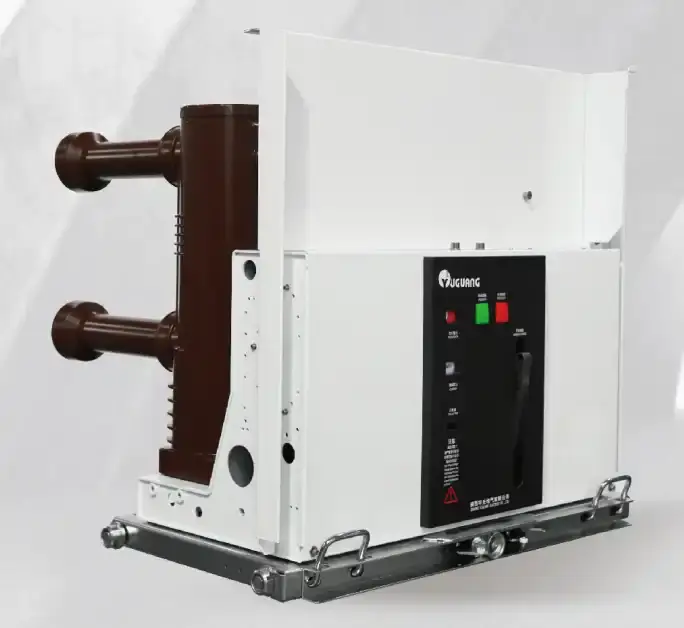
Understanding Indoor Vacuum Circuit Breakers
Core Definition and Structural Components
Indoor circuit breakers are safety devices that control and stop the flow of electricity in medium-voltage networks. The main idea is based on arc extinction: when electrical contacts split in a vacuum room that is shut off, the lack of air or gas stops the arc from continuing. This system stops fault currents very quickly—within milliseconds—protecting people and equipment further downstream from harm.
These breakers are made up of several combined parts that work together to make them strong. The vacuum interrupter is the device's heart. It is a tightly sealed cylinder with both fixed and moving contacts. The working part (often a permanent magnet actuator), the insulation box, the control electronics, and the fixing framework are all around this core. Yuguang's designs use aerospace-grade precise technology to make solid-sealed poles and arc-extinguishing cells that are very accurate and keep their seals. The flexible design makes placement small while still ensuring strong performance in a wide range of working situations.
Arc Extinction Mechanism Explained
When electrical connections break, the vacuum atmosphere is very important. A short-lived arc forms between two contacts when they split under load. At normal air pressure, this arc stays alive thanks to charged particles in the medium around it. But there is no such medium inside the vacuum interrupter. At first, the arc is carried by metal vapor from the contacts. But as the contacts move farther apart, the vapor quickly spreads out into the space. At the natural current zero point (which happens in AC systems), the arc goes out totally because there aren't enough particles left to keep the ionization going.
This process takes very little time—about 1 to 3 milliseconds on average. The vacuum space's dielectric strength returns almost instantly, stopping the arc from starting up again even when there are high transient voltages. Yuguang uses modern copper-chromium contact materials that don't join or wear down easily. This means that the equipment can work for more than 30,000 switching cycles without any upkeep.
Classification by Voltage and Installation Type
There are different voltage classes for vacuum breakers, and each one is best for a certain job. Electricity plants and business buildings use the 6kV to 12kV range, and power company substations and big infrastructure networks with the 24kV to 40.5kV range. Yuguang covers the whole range from 6kV to 40.5kV and has 39 patents to back it up, which show decades of research and development.
How the installation is set up is very important. Fixed-type breakers are installed permanently in switchgear panels and offer cost-effective options for stable setups. Withdrawable (draw-out) designs let workers separate and remove the breaker without taking apart the other equipment around it, which is very helpful for repair or emergency replacements. Yuguang's combined modular design has smaller areas and better sealing than traditional systems. This makes it easier to work with limited room in urban substations and upgrade projects.
Key Applications and Benefits of Indoor Vacuum Circuit Breakers
Industrial and Commercial Deployment Scenarios
Medium-voltage distribution is needed to handle large amounts of electricity in factories that use heavy machinery, metal processing lines, and automatic production systems. Motors, transformers, and battery banks are kept safe from damage by Indoor circuit breakers. In steel mills and chemical plants, the switching frequency rises during shift changes or process adjustments. Yuguang's permanent magnet working mechanisms provide reliable, low-maintenance performance that is ideal for frequent use.
Another important area of application is data centers. For computer farms and cooling systems to work, these buildings need power that doesn't go out. Vacuum breakers quickly cut off faulty sections, stopping failures that spread to other alternative power lines. Pollution resistance built into sealed vacuum tanks makes them reliable even in places where floating pollutants are a problem, which is often the case in industrial zones.
Vacuum breakers are used in renewable energy setups like wind farms and solar plants to handle changing output trends and keep the grid in sync. Yuguang's scenario-based customization options let you make changes for tough outdoor collection systems that feed indoor substations. This connects power plants to transmission networks.
Operational Advantages Over Alternative Technologies
When you compare vacuum technology to older types of breakers, you can see how useful it is. Oil circuit breakers need to have their fluid tested on a regular basis and can catch fire, which makes setups inside more difficult. Because of rust, air-magnetic breaks need regular contact repair. These worries are completely taken away by vacuum breaks. Their sealed rooms don't react to changes in temperature, humidity, or dust as long as they stay within the stated limits.
The long mechanical life is clearly a big plus. Yuguang's goods are rated E2 for electricity endurance and M2 for mechanical endurance, which means they can be used over 10,000 times without any parts needing to be replaced. Total cost of ownership goes down a lot because of this, which helps buying managers who are focused on long-term business economics.
International standards like IEC 62271-100 and GB 1984 are met by the safety features. Built-in interlocks stop operations that could be dangerous, and obvious contact position markers give operators more faith while they're doing repair. The small size cuts down on arc flash exposure zones, keeping people safe during regular checks.
Maintenance Guidelines and Troubleshooting Essentials
Even though it's advertised as maintenance-free, regular checks make sure it's still working at its best. A visible checkup once a year checks for damage on the outside, stable control voltage, and proper positioning of mechanical indicators. Every five years, the contact resistance should be checked to make sure there isn't too much wear and tear. Readings should stay in the micro-ohm range. Yuguang offers full after-sales support, which includes installation instructions, upkeep contracts, and extra parts delivery to make these tasks easier for operations teams.
Most problems don't happen with the vacuum interrupter itself, but with other connections. Control power drops can make running coils stop working, and mechanical connections need to be oiled every so often. Protocols for troubleshooting stress thorough checking: make sure the power source is working properly, check the resistance of the running coil, and look at how freely the mechanical links can move. Competing providers often don't provide enough technical support, but Yuguang's team responds quickly to problems so that unplanned downtime is kept to a minimum.
How to Choose the Right Indoor Vacuum Circuit Breaker for Your Business
Critical Electrical Specifications
Matching electricity factors to system needs is the first step in choosing the right Indoor circuit breaker. If you put a 12kV breaker on a 15kV system, the insulation is likely to fail. The rated voltage must be the same as or higher than the standard voltage of the system. The rated current should be enough to handle the constant load plus a safety cushion, which is usually 125% of the estimated maximum current. The short-circuit termination capacity (kA value) must be higher than the estimated fault currents for the placement point.
Compatibility with current equipment is very important. Different makers have different size limits, busbar layouts, and control input methods. Yuguang's engineering team offers free technical advice, which includes system integration analysis, to make sure that everything works well together before an order is placed. This cautious method keeps expensive changes from having to be made on-site during installation.
Environmental and Installation Considerations
There are a lot of different indoor settings. Foundries are dirty, but substations are clean. Installations near the coast have to deal with salty air. Breaker covers with an IP54 rating or higher keep particles from getting into the internal parts. Yuguang uses ceramic coating and powder coating processes, followed by constant temperature drying, which makes the products more resistant to rust and increases their useful life in harsh environments.
The dielectric performance changes with altitude; locations above 1,000 meters need derating or special shielding. In seismic zones, fixing systems need to be stronger. Extreme temperatures call for warmer parts or ways to let air flow. Talking about these things during the buying process makes sure that the product provided fits the real working conditions, not just the claims made in the catalog.
Supplier Evaluation and Certification Verification
Certifications and track records help you tell a reliable provider from others. Certifications like ISO 9001:2015 for quality management, ISO 14001 for environmental compliance, and ISO 45001 for work safety show that operations are run in a structured way. Yuguang has these qualifications and is also recognized as a national high-tech company. This shows that it can both make things and come up with new ideas.
As proof of real R&D spending, procurement managers should check patent collections. Yuguang's 39 patents cover more than just small changes to the design of vacuum interrupters. They also cover how they work and how to integrate modules. Objective performance confirmation comes from national inspection records from reputable testing labs. Asking for test papers along with product datasheets makes sure that the specs match the reality.
Project plans are directly affected by how reliable deliveries are. Yuguang sends standard goods in 7–15 days and special solutions in 30–60 days, which takes care of the common problem of supplies being late. Having open communication during production and using wooden packing that meets international standards for shock and moisture resistance saves investments while they are in transit.
Indoor Vacuum Circuit Breaker Installation and Commissioning Guide
Pre-Installation Preparation Protocols
Installations that go well begin long before the equipment gets there. You need to look over the engineering plans to make sure that the breaker sizes, busbar places, and wire entry points are correct. Foundations or fixing bars must meet load-bearing requirements because vacuum breaks weigh a lot more than their size makes them look. The temperature, humidity, altitude, and air levels of the environment should be compared to the equipment's values.
Safety rules must not be ignored. Before you start the actual installation, you should separate the incoming and outgoing wires, use regulated tools to make sure there is no voltage, and set up grounding connections. Work with the operations teams to plan work for planned downtime so that there is as little impact as possible. Yuguang gives thorough installation guides and on-site help for difficult jobs, which lowers the risk of failure.
Step-by-Step Installation and Testing Procedures
The first step in installing is to place the Indoor circuit breaker inside the switchgear box so that the mounting holes line up with holes that have already been drilled. Safely tighten screws to the torque values recommended by the maker. If you over-tighten, the frame could warp, and if you under-tighten, it could vibrate free. Make sure there are enough space between the main wires (busbars or lines) and that the right phases are identified. Check the voltage levels and orientation of the control wires against graphic models.
Functional testing is done in a planned way. When you work the breaker device by hand, make sure it moves smoothly and engages properly. Check the contact resistance. The readings should match what the maker says they should be. Insulation resistance tests should be done between the stages and the ground, and values should be more than 1,000 megohms. Use special tools to test the trip and close timings to make sure they work within certain millisecond ranges.
Post-Commissioning Verification and Documentation
After testing goes well, gradually power up the circuits. Put in the control power, check the indicator lights, and run the interlocks. As soon as the breaker is closed on the busbars that are not in use, the system should be turned on step by step while being watched for strange noises or temperatures. When the connections are loaded, use thermal imaging to check the temps of the connections. Hot spots show that the connections are weak and need to be fixed right away.
Full ordering records include all measures, test results, and situations that were seen. These records set a standard for efficiency that can be used to compare future repair work. Yuguang's full-chain service attitude continues in this phase, making sure that the change from installation to normal running goes smoothly.
Procurement Guide and Choosing Yuguang as Your Trusted Partner
Market Channels and Pricing Considerations
There are several ways for business-to-business buyers to get vacuum breakers: directly from the maker, through registered dealers, or through EPC companies who offer tools and installation services as a package deal. Direct buying usually gets you better prices, but you need to have professional know-how on staff. Yuguang can handle a range of buying scenarios, from sales for a single unit (minimum order quantity of 1) to bulk customization for deployments across multiple sites.
Prices depend on a number of things, including power class, stoppage capacity, level of customization, and order volume. Standard stock items are cheaper, but designed solutions that solve specific problems cost more, but the risks they avoid are worth it because they work better and last longer. Getting budget approvals is easier for procurement managers when the quote process is clear and includes detailed cost breakdowns.
Warranty Coverage and After-Sales Assurance
Warranties on equipment show that the maker trusts you. Yuguang offers full support, including free change plans in case outdoor conditions vary from the original specs. This protects against the problem of tools not working well together, which can be very frustrating. When spare parts are easy to get through established supply lines, fixes don't take too long. Planned repair trips are part of service agreements and make sure that problems are found before they break down.
Why Yuguang Stands Out Among Indoor Circuit Breaker Suppliers
Yuguang Electric was founded in 2008 in Baoji, Shaanxi, which is the center of Indoor circuit breaker production in China. The company has 20 years of experience in the Chinese market and is now growing its reach around the world. Our 39 patents show that we are always coming up with new ideas for fixed magnet systems, flexible designs, and adapting to different situations. Multiple quality awards and national licenses, such as "high-tech enterprise status," show that the company is very good at making things.
Our full-life-cycle service method is what makes Yuguang stand out. We don't just sell things; we offer answers. Specialized research and development (R&D) helps solve problems that only happen in certain situations, like in hard mine sites or very important data centers. Modern production lines use aerospace-grade accuracy to work with corrosion-resistant metals and IP67 locks. Before shipping, multi-round testing makes sure that the arc quenching, insulation, and load flexibility work as they should.
Our combined skills include changing the shape of equipment, processing mechanical parts, and making customized trucks for upkeep needs. Cross-border technical help makes sure that clients in other countries get the same quick service as partners in the same country. This end-to-end feature directly fixes common problems like maintenance being hard, delivery taking too long, and not being able to change well to unique situations.
Conclusion
Indoor circuit breakers are an example of mature, stable technology that is needed for modern power distribution. Their vacuum-based arc extinction system offers the fastest stoppage speed, the least amount of upkeep, and the longest operating life. These devices protect important equipment in factories, businesses, and green energy sites while lowering the total cost of ownership.
To choose the right switch, you need to pay close attention to the electrical requirements, the working conditions, and the supplier's skills. Yuguang is a reliable partner for procurement managers and engineering teams around the world thanks to our wide range of products, which covers voltages from 6kV to 40.5kV and is backed by 39 patents and official certifications.
Our dedication to scenario-based customization, strict quality control, and full-chain service solves the main problems that B2B buyers face, such as worries about compatibility, maintenance costs, delivery delays, and the difficulty of integrating different systems. When you choose tried-and-true technology from a provider that cares about your success, you get more than just tools. You gain operating faith and a competitive edge.
FAQ
What distinguishes indoor vacuum breakers from outdoor models?
It is designed so that Indoor circuit breakers can work in controlled settings and keep out harsh weather. Their cases are small and designed to work with metal-clad hardware. Outdoor models, on the other hand, need waterproof housings and materials that don't fade in UV light. Because they work in better environments, indoor units usually have lower IP ratings (IP54 vs. IP67 for outdoor units). Installation costs are usually lower for indoor types because they are easier to put and don't need as much support.
How often should maintenance inspections occur?
Vacuum breakers don't need much care, but they should be visually checked every year to make sure the mechanical signs, control circuits, and external links are all working properly. Measurements of touch resistance and cleaning of the device every five years make it last longer. Oil breaks need to have their fluid tested every three months, but vacuum technology cuts down on upkeep work by a large amount. Yuguang offers maintenance contracts that include regular checks, which makes sure that rules are followed without putting too much pressure on internal teams.
Can existing switchgear accommodate vacuum breaker retrofits?
How well a retrofit works depends on how well the dimensions and electricity ratings work together. Many setups are able to change oil or air-magnetic breaks with vacuum types that work just as well or better. Yuguang's tech help includes site visits and interface analyses, which find problems before they are bought. Our flexible designs usually fit into spaces that are already there, but sometimes changes need to be made to the busbars or the control circuits. Retrofit risks and project delays are kept to a minimum with free transformation plan creation.
Partner with Yuguang for Reliable Indoor Circuit Breaker Solutions
If you want to improve your power distribution, you need to find a reliable Indoor circuit breaker maker who knows more about how things work than just what's written in a book. Yuguang combines 20 years of experience making products with proven ability to customize, so they can make vacuum breakers that are perfect for your power needs, the surroundings, and the space you have for them. Our 6kV–40.5kV product range, which is backed by 39 patents and ISO certifications, makes sure that international standards are met while also meeting the specific needs of power plants, industry facilities, and important building projects.
We get rid of common buying problems by delivering quickly (7–15 days for basic models), communicating clearly, and offering full after-sales support, including fitting help and extra parts. Email our expert team at ygvcb@hotmail.com to talk about your project needs and get a full quote that fits your facility's needs. Find out how Yuguang's full-chain service method, which includes personalized research and development, installation, and support, turns buying equipment into a strategic relationship that drives practical success.
References
1. IEEE Standards Association. (2021). IEEE Guide for Application of Circuit Breakers in Medium-Voltage Systems. Institute of Electrical and Electronics Engineers.
2. National Electrical Manufacturers Association. (2020). NEMA SG 3: Low Voltage Power Circuit Breakers – Safety and Performance Standards. NEMA Publications.
3. International Electrotechnical Commission. (2019). IEC 62271-100: High-voltage Switchgear and Controlgear – Part 100: Alternating Current Circuit-Breakers. IEC Standards Catalog.
4. Smith, J.R., & Chen, L. (2022). Vacuum Arc Phenomena in Medium-Voltage Switching Devices. Springer Publishing.
5. Anderson, P.M. (2018). Power System Protection and Control: Fundamentals and Advanced Applications. McGraw-Hill Education.
6. Global Power Equipment Consortium. (2023). Best Practices for Medium-Voltage Switchgear Installation and Maintenance. Industry Technical Report Series.

Send Inquiry
You may like
