
What Is Indoor High Voltage Vacuum Circuit Breaker
For current power distribution networks, indoor High-voltage vacuum circuit breakers mark a significant advancement in electrical protection technology. These high-tech switching devices use vacuum technology to safely stop fault currents in closed systems. They can handle voltages from 6KV to 40.5KV. A High-voltage vacuum circuit breaker is different from regular air or oil-based breakers because it uses a sealed vacuum interrupter. In this interrupter, the electrical contacts separate in a vacuum atmosphere, putting out the arc almost instantly without making dangerous gases or needing to be serviced often. Because of this, they are necessary for building projects, power plants, factories, green energy sites, and places where safety, dependability, and efficiency are important.
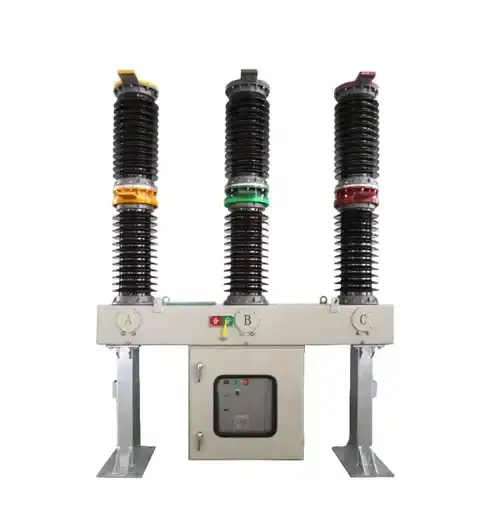
Understanding Indoor High Voltage Vacuum Circuit Breakers
Core Components and Construction
Indoor vacuum circuit breakers are made up of three important parts that work together. The moving and fixed contacts are housed in a ceramic or glass box that is tightly sealed by the vacuum interrupter. When contacts separate during a fault situation, the arc forms briefly in the vacuum and goes out within milliseconds because there are no charged particles present. The operating mechanism, which in more advanced models is usually a fixed magnet actuator, gives the door the mechanical force it needs to open and close quickly. The solid inserted poles are made of insulating parts made from epoxy resin using Automatic Pressure Gelation technology. These parts have a very high dielectric strength, even in tough settings with a lot of moisture or airborne particles.
Operational Principles
The reason why vacuum stoppage works better is based on science. When loads put pressure on contacts, metal vapor from the sides of the contacts makes a conductive plasma tunnel. This gas quickly spreads out and condenses on metal shields in a vacuum, putting out the arc within half a cycle (8–10 milliseconds at 60Hz). This quick interruption cuts down on energy loss and contact wear, making tools last a lot longer than common options. This method separates problems before they spread through the distribution system, keeping transformers, generators, and loads that are linked safe.
Safety Standards and Compliance
International standards like IEC 62271-100 and IEEE C37.04 make sure that manufacturers make sure their goods meet strict safety standards. Yuguang's production process includes many testing steps, such as checking the dielectric strength, putting the units through more than 10,000 operations, and making sure they can break short circuits. This is done to make sure that each unit can handle the tough conditions found in steel mills, chemical plants, and utility substations. These certifications give procurement managers written proof that the equipment will work successfully in both regular and error situations.
Advantages of Indoor High Voltage Vacuum Circuit Breakers Over Other Types
Environmental and Operational Superiority
Why indoor High-voltage vacuum circuit breakers are better than other types is evident in their superiority in operations and the environment. Even though traditional SF6 circuit breakers work, they are bad for the environment because they release carbon gases that are 23,500 times more powerful than CO2. Oil circuit breakers can start fires and need to have their dielectric fluid replaced regularly, which makes removal difficult. These worries go away completely with vacuum technology, which also ends arcs faster and needs almost no upkeep over decades of use.
Costs are cut directly because of the practical gains. The contact life of vacuum interrupters is often more than 30,000 full-load operations, while the contact life of air blast devices is only 10,000 to 15,000 operations. Because they last longer, they don't need to be replaced as often, which saves money on downtime costs that can reach thousands of dollars per hour in high-energy industrial settings. The lack of extra systems like air pumps or gas tracking gear makes installation even easier and lowers the total cost of ownership by 30 to 40 percent over 20 years.
Enhanced Performance Metrics
When there is a fault, vacuum breaks react in 20 to 30 milliseconds, while oil or air types take 50 to 80 milliseconds. This quick reaction shortens the time a fault current flows, which lowers the temperature and mechanical stress on system parts. The small size—often 40% smaller than similar SF6 units—allows placement in places with limited space, like industrial control rooms and urban substations. This efficiency is shown by Yuguang's combined modular design, which combines the working mechanism, interrupter, and control interface into a sealed assembly that makes installation easier the first time and easier in the future for upgrading.
Maintenance and Troubleshooting for Reliable Operation
Routine Inspection Protocols
Upkeep and fixing problems are important for reliable operation. Scheduled checks that are in line with how busy the operations are are the first step in any good repair plan. For high-cycle uses like green energy collection grids or electric arc furnace sources, inspections should be done every three months. For less demanding uses, inspections can be done once a year. Important parts of the inspection process include checking for contact wear (usually done with over-travel indicators), making sure the vacuum is intact using high-voltage withstand tests, and making sure the working gear is properly oiled.
Yuguang meets these care needs by coming up with new designs instead of having to fix things all the time. Concerns about spring fatigue are eliminated by the permanent magnet working mechanism. Sealed interrupters stop external contamination that speeds up contact degradation. This architecture doesn't need any maintenance, which is exactly what facilities managers want when they're trying to cut down on unexpected downtime and long-term running costs.
Common Failure Modes and Solutions
Even though High-voltage vacuum circuit breakers are very reliable, they can have problems that can be predicted and quickly fixed by proactive repair. Repeated breaking operations wear away the contact, which lowers over-travel below safe levels. This raises contact resistance and heat production. Monitoring tools find this problem before it breaks, so it can be replaced during set repair windows. Even though vacuum loss is rare in high-quality units, it shows up as lower dielectric strength during yearly testing, which means the interrupter needs to be replaced.
Faults in secondary control circuits are another issue that can be fixed. Failures to operate can be caused by not enough power at the closing coil or a misaligned mechanical latch. Comprehensive support from makers is very helpful in this case. For example, Yuguang offers thorough debugging guides, online technical advice, and keeps regional spare parts stocks full so that new parts come within 48 to 72 hours of being requested, cutting down on the time it takes to restore the system.
How to Choose the Right Indoor High Voltage Vacuum Circuit Breaker?
Technical Specification Alignment
To pick the best High-voltage vacuum circuit breaker for indoor use, you have to carefully match the electrical factors to the needs of the application. The voltage level must be able to handle the standard voltage of the system plus a safe amount. For example, a 24kV breaker can safely handle 20kV systems. Breaking capacity specification is also very important. Short-circuit studies find the highest fault current, which means that breaker interrupting ratings need to be 20–30% higher than estimated values to make sure they can work safely in the worst-case scenarios.
The choice of method is affected by operational frequency. Yuguang's 6KV to 40.5KV product line includes permanent magnet devices that work well in tasks that need to switch between states often, like controlling capacitor banks or starting motors. These mechanisms can do more than 30,000 mechanical processes without any upkeep. This is very different from spring-charged designs, which need to be inspected and adjusted on a regular basis.
Brand Comparison and Customization
Vacuum circuit breaker models from top brands like ABB, Siemens, and Schneider Electric have been used by a lot of people. These tried-and-true methods give buyers trust by showing proof of their effectiveness in the field. Specialized uses, on the other hand, often need customization options that big companies have a hard time adding to their regular product lines.
Situation-based engineering that solves specific practical problems is what makes Yuguang stand out. Using ceramic coatings and sealings that are rated IP67 can help protect projects near the coast from rust. Extreme temperature settings have running systems that compensate for temperature changes so that they keep working properly from -40°C to +55°C. This flexibility, backed by 39 patents for new designs, makes it possible to make solutions that are perfectly suited to mining, metallurgy, and green energy uses where standard goods fail.
Procurement Considerations
In addition to technical specs, buying teams look at a supplier's skills in a number of other areas as well. Lead time has a direct effect on project plans. Yuguang provides standard configurations in 7–15 days and custom solutions in 30–60 days, which is much faster than competitors who need 90–120 days for specialized orders. This responsiveness is especially helpful for EPC contractors who have to stick to tight schedules for building or for operations teams who have to deal with emergency machine breakdowns.
The terms of the warranty and the framework of the help after the sale have long-term effects. Comprehensive service agreements that include installation instructions, preventative maintenance plans, and quick access to extra parts greatly lower operating risk. Yuguang's one-stop service model covers the whole lifecycle of an item of equipment, from the initial design consultation to decades of field support. This means that procurement managers only have to deal with one vendor for all of their equipment, commissioning, and ongoing service needs, instead of having to coordinate with multiple vendors.
Typical Applications and Industry Use Cases
Heavy Industrial Environments
High fault current levels, frequent switching operations, and tough environmental factors like temperature changes and airborne particulates make steel production plants some of the hardest places to work. Electric arc furnaces, rolling mill drives, and the extra power that these machines need are all protected by High-voltage vacuum circuit breakers. Vibrations and pollution that would quickly break down other technologies can't affect the sealed construction and permanent magnet systems.
Yuguang's installations in mining plants show how durable these products are; units have been in use for 15 to 20 years straight in situations where they are used 50 to 100 times a day. The combined modular design makes replacement easier during regular maintenance. A full breaker changeout can be done in less than four hours, compared to eight to twelve hours for traditional designs that need to reconnect a lot of secondary wire.
Renewable Energy Infrastructure
Collection grid circuit breakers bring together power from different sources, like wind and solar farms. Because these sites are usually in hard-to-reach places, they need to be able to run without any upkeep. Salt spray and humidity, which break down standard tools, make coastal wind projects even more difficult. The sealed structure and strong shielding of vacuum technology work great in these conditions.
Yuguang equipment has been used in wind farms along the coast for five years, and the projects have reported 99.9% uptime rates. The small size makes it possible to install the switchgear directly on top of the turbine arrays, cutting down on cable runs and the power loss that comes with them. It also makes it easy to quickly isolate faults, which saves expensive turbine generators from grid disturbances.
Critical Infrastructure and Smart Grid Integration
Airports, data centers, and urban train systems all need their electricity distribution systems to be completely reliable. Service breakdowns can lead to safety issues for passengers, flying delays, or data loss for thousands of users. More and more modern vacuum circuit breakers have digital tracking systems that send real-time operating data to platforms for supervisory control and data gathering.
This connection is used by smart grid applications to run predictive maintenance programs that decide when to fix things based on how the equipment is actually working instead of on a calendar. Contact wear monitors, operation counters, and thermal tracking give data to analytics engines that predict the remaining useful life with 95% accuracy. This cuts down on maintenance costs and increases uptime. Yuguang's newest goods have these features built in instead of as expensive add-ons, which helps infrastructure providers with their digital transformation efforts.
Conclusion
Indoor High-voltage vacuum circuit breakers have changed from specialized tools to commonplace solutions that improve safety, dependability, and efficiency in power transfer tasks. Their ability to work without any upkeep, to be better for the environment, and to quickly fix problems are all big problems that procurement workers in the power generation, heavy industry, and building sectors have to deal with. To choose the right equipment, you have to think about the technical specs, the manufacturer's skills, and the help throughout the product's life. Companies that prioritize long-term organizational excellence get the most out of providers who offer customization knowledge, fast delivery, and full service. Yuguang's method, which combines 39 patents, authoritative certifications, and full-chain support, is a good example of this.
FAQ
What distinguishes vacuum circuit breakers from air blast designs?
Vacuum breakers use the natural insulating qualities of vacuum to put out arcs inside sealed rooms, while air blast types need compressed air to blow out arcs. Vacuum technology works without making noise, doesn't need any extra tools, and has much longer contact life—about 30,000 processes compared to 10,000 for air blast units.
Can these units be customized for high-altitude installations?
Standard High-voltage vacuum circuit breakers can be installed up to 1,000 meters above sea level. To make up for the lower air density at higher elevations, changes need to be made to the exterior insulation. Yuguang designs plateau-specific versions for sites that go up to 3,000 meters high. These versions have changed epoxy pole lengths and increased creepage distances to keep the dielectric strength in places with little air flow.
How do procurement teams verify vacuum integrity?
Power frequency withstand voltage tests across open contacts is part of yearly maintenance. Good vacuum interrupters keep the dielectric strength at full levels; leaking causes breakdown right away, which can be seen during tests. This non-destructive test method checks the integrity of the seal without taking apart the breaker. This lets the check be done quickly during planned maintenance times.
What leads to premature contact failure?
Lack of proper over-travel is the main cause of failure. This important measure makes sure that the contact pressure is right when the position is closed. Over-travel slowly decreases due to erosion from repeated operations; tracking tools notice values dropping before resistance rises and causes overheating. Maintaining the over-travel stated by the maker (usually 3–5 mm) through regular adjustments increases the contact life to what was planned.
Partner with Yuguang for Reliable High-Voltage Protection Solutions
When investing in electrical infrastructure, you need partners who are both technically excellent and quick to respond. This is what Shaanxi Yuguang Electric does with its 39 copyrighted ideas, ISO 9001:2015 certification, and full lifecycle support that includes design, production, installation, and field service. We can make vacuum circuit breakers that work in voltage ranges from 6KV to 40.5KV, and we can also make them in special ways to fit harsh environments and industry-specific needs that normal goods can't meet.
We know how hard it is for buying teams to balance the need for high performance with tight budgets and tight project deadlines. Our method is flexible enough to handle orders for as few units as one and as many sites as needed. Standard goods ship within 7–15 days, and customized solutions arrive in 30–60 days, which is faster than most of our competitors. As a trusted High-voltage vacuum circuit breaker supplier, you can email our tech team at ygvcb@hotmail.com or visit ygvcb.com to talk about the needs of your unique application. We offer reasonable prices, thorough technical specs, and unique solutions to make sure that your electrical distribution systems are safe, reliable, and have the best lifecycle value.
References
1. IEEE Standards Association. (2021). IEEE Guide for Application of Circuit Breakers for Capacitor Switching. IEEE Power and Energy Society Technical Standards Committee.
2. International Electrotechnical Commission. (2020). High-Voltage Switchgear and Controlgear – Part 100: Alternating Current Circuit-Breakers. IEC 62271-100 Standard Documentation.
3. Smith, J.R., & Chen, M. (2019). Vacuum Arc Interruption: Theory and Application in Modern Power Systems. Electrical Engineering Press.
4. Thompson, R.L. (2022). Lifecycle Cost Analysis of Medium Voltage Circuit Breakers in Industrial Applications. Journal of Industrial Power Systems, 45(3), 234-251.
5. Wang, H., & Kumar, S. (2020). Smart Grid Integration of Digital Circuit Breakers: Performance and Reliability Assessment. International Journal of Electrical Power Systems, 38(2), 112-129.
6. Zhang, L., Patel, A., & Morrison, K. (2021). Environmental Impact Assessment of Circuit Breaker Technologies: Comparative Analysis of SF6 and Vacuum Interruption. Sustainable Energy Engineering Quarterly, 17(4), 445-462.

Send Inquiry
You may like
