
What is the primary function of a load switch in a circuit?
A Load switch is a gate that can be controlled to control the flow of electricity to parts or sections further down in the circuit. This switching device is very different from safe circuit breakers because it can connect or disconnect power lines on demand when there is a normal load. Orderly shutdowns are made possible by the Load switch, which also lowers idle power consumption and shields against damage from inrush currents during restart procedures. Vacuum or air Load break switches (LBS) safely stop rated load currents, which are usually between 200A and 630A, in medium and high-voltage distribution systems. They don't trip when there is a short-circuit problem. The device is essential in power substations, industrial feeders, and ring main units where safety and operating freedom are very important because it can interrupt power in a controlled way.
Understanding the Primary Function of Load Switches
What Load Switches Actually Do in Power Systems?
A Load switch, which serves as a clever go-between for the source and the load, is at the core of modern power distribution. A simple mechanical break can only work when there is no current flowing through it. A properly rated Load switch, on the other hand, can safely cut off circuits that are fully operationally current. This is possible because of advanced arc-extinguishing technologies, such as vacuum interrupters for indoor use and gas puffer systems for outdoor use. The Load switch opens under controlled conditions when a circuit needs to be disconnected for repair or change. This stops voltage spikes that could damage sensitive equipment further down the line.
The device is important for three reasons that procurement managers and chief engineers look at when choosing tools. It handles capacitive and inductive Load switching without damaging touch surfaces, provides obvious isolation for repair workers' safety, and works with upstream safety devices like fuses to build layered defense systems. For example, steel mills, chemical plants, and data centers that run continuous processes can't afford unexpected power outages that are caused by simple switching methods that cause damaging sparks or voltage sags.
Why Traditional Relays and Contactors Fall Short?
In older electrical systems, electromechanical switches worked well, but they don't work well with the needs of today's infrastructure. When high-current switching happens over and over, contact erosion speeds up. This can cause failure modes that are hard to predict, which lowers the stability of the system. Contactors need to be replaced often and send out electromagnetic waves that mess up control circuits next to them. The relatively slow speeds at which they work (usually 50–100ms) make time difficult in automatic distribution systems where milliseconds matter.
Through sealed vacuum or gas-insulated contacts that completely stop oxidation and corrosion, Load switching technology handles these limits. Since there are no open air holes, the performance stays the same for decades instead of months. Yuguang's engineering team used aerospace-grade precise production to make vacuum interrupters with contact resistance below 50 microohms that stay that way even after 10,000 mechanical operations. This means that less energy is lost and the temperature stays stable under full load for a long time. These are important things to keep in mind when running three-phase 630A circuits at 12kV or 24kV voltage levels.
Arc Extinguishing Mechanisms That Define Performance
An electrical arc forms between the separating contacts as soon as a Load switch starts to open while current is flowing through it. Whether the gadget works or fails horribly depends on how safely this arc is managed. Vacuum Load switches work on the idea that electric sparks can't survive in high vacuum conditions. The metal vapor arc quickly spreads and cools, going out within milliseconds, as the contacts part inside a ceramic shell that has been drained to 10^-6 torr. This process doesn't release any harmful fumes and doesn't cause much contact erosion, which is why vacuum technology is used most often in indoor switchgear uses.
Pneumatic Load break switches that squeeze air during the release stroke are needed outside and in some industrial settings. As the mechanism moves, a piston-cylinder arrangement builds up pressure. At the exact moment that the AC waveform's current zero crossing happens, the mechanism lets out a high-speed air blast. This blast makes the arc longer and cooler until it can't start up again. The whole process is over in less than 40ms, which is fast enough to keep nearby parts from getting damaged by heat. Yuguang's FZN21-40.5 and YGFZN25B lines have improved nozzle geometries that make the blast more effective while reducing the pneumatic system's size. This helps with the space issues that often come up in renovated substations.
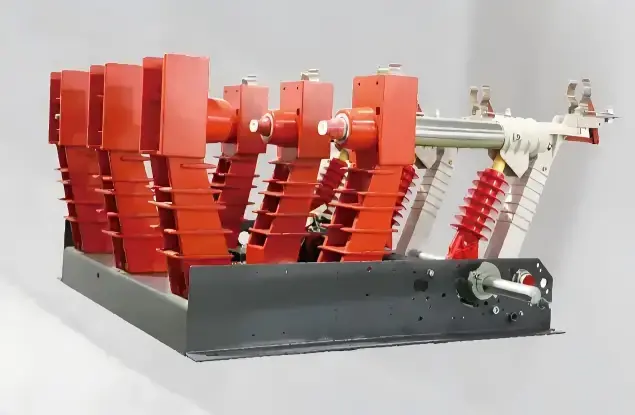
Types of Load Switches and Their Applications
Voltage Classification and Industrial Segmentation
Medium-voltage Load switches have values ranging from 6kV to 40.5kV, with each tier meeting different infrastructure needs. The 12kV class makes up most of the distribution networks in North America. It matches the secondary voltage outputs of utility substations that serve light industry and business areas. 24kV and 36kV equipment is often used in mining operations and big manufacturing facilities to keep transmission losses to a minimum across large plant layouts. Ultra-high-power uses, like renewable energy collection hubs and connecting regional transmission companies, need 40.5kV devices that can handle gigawatt-scale power flows.
Load switches are used at the main sides of generator step-up transformers in thermal power plants. This type of switching allows for flexible unit commitment schedule without affecting the stability of the grid. To make self-healing distribution systems, wind and solar farms use ring main units with vacuum Load break switches. When there is a problem with one feeder, automatic sectionalizing cuts off the affected part while power keeps flowing through other lines. The System Average Interruption Duration Index (SAIDI) metrics that regulators look at and users see as reliable are cut down by this design.
Specialized Configurations for Harsh Environments
Coastal sites are constantly hit with salt spray, which eats away at standard equipment within months. Yuguang solves this problem by treating the surface with ceramic coating and powder coating after precise cutting. The two layers of protection are cured at a steady temperature, which forms a molecular link with the corrosion-resistant alloy layer below. According to IEC 60068-2-52, this finish can survive salt fog exposure for 2,000 hours without breaking down. This is a performance that can't be achieved with regular paint or galvanization.
There are different risks when you work underground, like gritty dust, changes in humidity from 20% to 95%, and vibrations from blasting. Yuguang's idea of combined modular design is very important here. We get IP67 ingress protection without the size of standard sealed enclosures by putting together arc chambers, contact assemblies, and working mechanisms into sealed modules ahead of time. A 630A 12kV vacuum Load switch takes up only 40% of the space of similar air-insulated designs, which makes room for more equipment in tunnels that are already tight.
Smart Grid Integration and Remote Operation
For modern distribution automation systems to work, switches must be able to react instantly to digital orders. The Load break switches made by Yuguang can work with both motorized workers and electronic devices that talk to SCADA systems using IEC 61850 protocols. When these switches are paired with feeder terminal units, they turn into smart nodes that can make choices on their own based on voltage patterns, the direction of current flow, and coordination algorithms. A fault further down the line opens the valve right away without any help from a person, and then it closes itself automatically again once the safety switches confirm that the area is clear.
This intelligence includes the ability to do predictive maintenance, which cuts down on unplanned downtime. Embedded sensors keep an eye on the position of the contacts, the working force profiles, and the temperature changes. Deviations from baseline signals show that a part is about to wear out before it fails. Cloud-connected analytics systems collect data from all of a switch's switches, finding widespread problems and figuring out the best time to replace them. Managers in charge of buying things can see the real total cost of ownership instead of just comparing list prices.
How to Choose the Best Load Switch for Your Application?
Defining Your Technical Requirements Framework
To make good specifications, you must first understand the electricity limits that your system sets. The rated voltage has to be able to handle the highest steady-state working voltage plus short-term overvoltages caused by lightning and switching events. For a 12kV circuit, you usually need tools that can handle 7.2kV continuously and 75kV Basic Impulse Level (BIL). When you don't account for these gaps, shielding fails early and flashovers happen in terrible ways.
Matching the load's stated amperage isn't the only thing that goes into current rating. Changes in the surrounding temperature, height above sea level, and the amount of air flow in an area can all affect how heat is lost. At sea level, 20°C air may need a 630A switch for a transformer that draws 600A. But at 2,000 meters above sea level, air density drops 25%, so the transformer may need a 630A switch. During the quote process, Yuguang's application engineering team offers derating formulas and thermal simulation results. This takes away the need for guessing and makes sure that IEEE and IEC thermal rise standards are met.
Breaking Capacity Versus Short-Circuit Ratings
A common misunderstanding is that Load break switches and circuit breakers are the same thing. The difference is crucial: Load switches can safely stop regular operating currents, but they can only break short circuits up to two to four times their rated current. When high-rupturing-capacity (HRC) current-limiting fuses are put together, they make a "fuse-switch" system. The fuse handles fault currents greater than 20kA, and the switch gives visual isolation and normal switching duty.
This combination method saves a lot of money compared to circuit breakers without lowering safety. The YGFZN25B line from Yuguang has striker pin mechanisms that open the switch automatically when any phase fuse blows. This stops single-phasing situations that are dangerous and damage motors and transformers. From the start of the fault to the opening of the switch, the whole process takes less than 50ms, which is faster than most relay-operated breakers can react.
Evaluating Long-Term Operating Costs
The purchase price is only a small part of the total costs over the product's lifetime. Over 20 years, maintenance times determine how much work costs and how much downtime is lost. Older designs had to deal with lubrication plans, contact resurfacing, and gas leak tracking. Vacuum interrupter technology gets rid of these problems. This is reflected in Yuguang's maintenance agreements, which set review times of 5 years or 5,000 activities instead of the usual yearly servicing that most equipment needs.
Differences in energy economy add up to a lot when there are a lot of switches. If the contact resistance on a 630A circuit goes from 50 microohms to 150 microohms, an extra 60 watts are wasted constantly, which adds up to 528 kilowatt-hours per phase per year. When you add up the losses from dozens of lines in a distribution network, you can see why special components are needed. Micro-ohm readings taken during factory acceptance testing show that the resistance stays the same over the estimated mechanical life because we use silver-tungsten carbide contact materials and precision-ground mating surfaces.
Market Overview and Leading Load Switch Suppliers
Global Supply Chain Dynamics
The medium-voltage switchgear market is mostly made up of companies that know a lot about metalworking and have the right equipment for testing at high voltages. Established Western companies charge higher prices because their brands are well-known and they have built-in support networks. Asian makers have cut down on technology gaps by a large amount while keeping costs low enough to compete on the international market. Yuguang is in a good spot from a strategic point of view. Our factories use China's modern vacuum interrupter supply chain, and our engineering teams use their knowledge from installing thousands of units in China to meet the standards for foreign certification.
Cost, delivery reliability, and technical help must all be taken into account in procurement plans. When demand goes up or there are problems in the world, single-source supply relationships make you vulnerable. Dual-source qualification, in which goods from two different makers meet the same standards, protects against supply gaps. Yuguang backs this approach by making goods that can be used interchangeably with equipment from existing providers in terms of size and function. This makes the qualification process easier for infrastructure managers who don't want to take risks.
Certifications That Matter in B2B Procurement
Early on in the selection process, regulatory compliance takes out candidates that don't meet the requirements. The performance standards for alternating current switches above 1kV are spelled out in IEC 62271-103. These include limits on everything from mechanical longevity to temperature rise. For North American uses, IEEE C37.74 lists extra standards, mostly related to earthquake qualification and altitude derating. Concerns about self-certified claims are taken care of by Yuguang's independent third-party test reports from CESI, KEMA, and other widely known labs.
Certifications for quality management systems, like ISO 9001 for quality, ISO 14001 for environmental management, and ISO 45001 for workplace health, show that a business has grown beyond just meeting product requirements. These systems make sure that all production batches are the same and allow for easy tracking when problems happen in the field. Getting Intellectual Property Management Standardization certification and being recognized as a High and New Technology Enterprise shows that Yuguang is committed to constant innovation. The company has been granted 39 patents that protect design improvements in arc chamber geometry, contact materials, and operating mechanisms.
Technical Documentation and Support Infrastructure
Datasheets are good places to start, but you need dimensional drawings, security coordination studies, and environmental qualification reports to make a full choice. If a supplier only gives you marketing material and not engineering paperwork, that means they don't have enough technical depth. Yuguang's project teams give full technical packages that include AutoCAD drawings for panel integration, advice on how to set up safety relays, and the results of finite element analyses for testing against earthquakes and vibrations.
After-sales support for load switch products distinguishes long-term partners from transactional sellers. When compatibility issues arise during load switch commissioning, rapid technical support prevents costly project delays. Yuguang maintains regional expert representatives and 24/7 emergency response plans for load switch, with spare parts stocked for 48-hour delivery. Load switch maintenance agreements include free design modification plans when system updates require equipment adaptation, protecting customers' load switch investments from premature obsolescence.
Practical Insights – Load Switch Performance Optimization
Thermal Management in Enclosed Switchgear
The projected service life of insulation is cut in half for every 10°C rise in temperature, according to the Arrhenius relationship. In uses with limited room, small switchgear designs that combine heat sources create hot spots that infrared scans miss until damage happens. To make a good thermal design, you need to do accurate loss estimates. The total heat load is made up of contact resistance losses, dielectric losses in insulators, and eddy current losses in nearby steel structures.
Yuguang's modular building theory makes it easier to optimize heat by choosing the right materials. When surface size is the most important factor, aluminum busbars are better at getting rid of heat than copper ones with the same conductivity. Ceramic insulator designs with circular fins that improve convection cooling make the creepage distance as long as possible. Computational fluid dynamics simulations check the flow patterns of air before building a prototype. These simulations show that natural convection keeps all parts below their rated temperature rise limits, even when they are overloaded for a long time.
Contact Wear Monitoring and Predictive Replacement
Damage that builds up over time in mechanical parts is damage that can't be seen. Contact erosion happens slowly at first, but eventually the remaining thickness of the material can't stand up to the forces of operation, causing it to suddenly fall and fail catastrophically. In traditional upkeep, problems aren't fixed until they show signs of them, like heating, arcing, or total failure. This reaction method increases the cost of repairs and damages other equipment nearby the most.
By following leading signs, condition-based monitoring changes the way things are done. When you measure the operating force, you can see that friction rises because of worn bearings or mismatch before binding happens. Travel distance logging measures contact loss by finding the extra stroke that is needed to fully close the gap. Yuguang builds these sensors into motorized operators, and standard industrial methods let them see how the data is moving. When parameters move outside of normal areas, automated alerts are sent to maintenance teams. This lets them do their jobs during planned downtime instead of having to rush in to fix problems that happen out of the blue.
Case Study: Reducing Unplanned Outages in Steel Production
The distribution system for a large integrated steel mill's 24kV arc furnace was frequently disrupted by Load switch failures. Existing air-insulated switches needed to be serviced every three months because humidity and airborne pollution caused the contacts to oxidize. Failures happened about once every 18 months, and each one cost $300,000 in missed production during the 36-hour repair period.
Working with Yuguang's applications engineering team, the facility replaced six important feeds with our IP67-rated modular vacuum Load break switches. The sealed vacuum interrupters completely cut off external contact. After four years of use and more than 8,000 switching cycles, measures of the contact resistance show that they have not changed from the numbers that were set up at the beginning. The facility got rid of all unexpected power outages caused by Load switch failures, and even though the vacuum technology cost 35% more than options that use air insulation, it paid for itself in less than eight months.
Conclusion
Load switches are the most important part of stable power distribution systems because they connect safety devices to regular circuit management. Because they can safely cut off energized lines under controlled conditions, they give modern utility and industrial operations the freedom they need. Vacuum and pneumatic technologies offer upkeep benefits that standard switching methods can't match. This means that life-cycle costs and unexpected downtime are cut by a significant amount.
Successful equipment selection requires looking beyond initial purchase price to consider environmental compatibility, supplier support capabilities, and long-term reliability data. Because Yuguang uses advanced production methods, can customize products based on unique situations, and has a full service infrastructure, it can handle all kinds of medium and high-voltage switching needs. Our 39 patents and official certifications give our customers the technical help they need, and our full-chain support, from creation to installation and maintenance, gives them the partnership they need.
FAQ
What distinguishes a load switch from a circuit breaker?
Load switches consistently cut off normal working currents, but they can only break short circuits up to 2-4 times their rated current. Full fault currents greater than 20kA can be handled by circuit breakers. When used together, a Load switch and HRC fuses provide security for the generator and feeder that is just as effective as breakers but costs a lot less.
How does altitude affect vacuum load switch performance?
Vacuum interrupter arc interruption happens no matter how dense the air is outside, so altitude doesn't change how well it breaks. When you go above 1,000 meters, the external insulation (bushings and air gaps) needs to be derated by about 1% for every 100 meters of elevation gain. Yuguang offers designs that are adjusted for altitude so that works up to 4,000 meters can go ahead without any problems with performance.
Can pneumatic load switches operate reliably in extreme cold?
Normal air systems can work in temperatures as low as -25°C. When this temperature is reached, seals strengthen and water in compressed air can freeze. Arctic-rated models have warming housings and dry breathers that keep them working at -50°C. These traits are standard on all of Yuguang's cold-climate designs for work in the north.
What maintenance does vacuum technology actually require?
There is no way to open the vacuum interrupter again. The working system is what the inspection is mostly about. The pivot points are oiled, the motor brushes are checked, and the auxiliary contacts are made sure to work. Five years or 5,000 treatments are the usual time between visits. This is very different from air-insulated equipment that needs to be cleaned and adjusted every year.
Partner with Yuguang for Reliable Load Switch Solutions
Choosing the right Load switch provider has effects on the project's success that go far beyond just getting the tools. Yuguang has 16 years of experience in switching technology for 6kV to 40.5kV and 39 patents that protect new ideas in vacuum interrupter design, air working mechanisms, and environmental protection systems. Our manufacturing processes are ISO 9001:2015 approved, and we are a national high-tech company. These are examples of the quality systems that are needed for big building projects.
Whether you need standard goods in 7–15 days or custom solutions for tough environments in 30–60 days, we can handle projects of any size thanks to our flexible production methods and low minimum order amounts that start at just one unit. Our technical team can be reached directly at ygvcb@hotmail.com by procurement managers and chief engineers who want to talk about Load switch specs, get test results, or set up factory acceptance testing. We give you full technical documentation, help with installation, and upkeep deals that lower your long-term costs and make the system more reliable.
References
1. Institute of Electrical and Electronics Engineers (IEEE). IEEE Std C37.74-2023: Standard Requirements for Subsurface Load-Interrupting Switches, Interrupter Switches, and Accessories. New York: IEEE Press, 2023.
2. International Electrotechnical Commission (IEC). IEC 62271-103:2021 High-voltage switchgear and controlgear – Part 103: Switches for rated voltages above 1 kV up to and including 52 kV. Geneva: IEC Central Office, 2021.
3. Slade, Paul G. The Vacuum Interrupter: Theory, Design, and Application. Boca Raton: CRC Press, 2017.
4. Dahinden, V., and Schultz, J. "Long-Term Performance of Vacuum Interrupters in Distribution Networks." IEEE Transactions on Power Delivery 34, no. 2 (2019): 445-453.
5. National Electrical Manufacturers Association (NEMA). NEMA SG 5-2018: Power Switching Equipment – Medium Voltage Load Interrupter Switches. Rosslyn: NEMA Standards Publication, 2018.
6. Wang, Zhongdong, and Liu, Xinghua. "Arc Extinguishing Mechanisms in Pneumatic Load Break Switches for Outdoor Applications." Electric Power Systems Research 187 (2020): 106471-106483.

Send Inquiry
You may like
