
What Is the Role of Operating Mechanism in Circuit Breaker Safety
The Operating mechanism is the most important part of a circuit breaker when it comes to safety. This important part controls the exact opening and shutting actions that keep electrical systems from failing in terrible ways. The Operating mechanism turns saved mechanical, hydraulic, or electrical energy into the fast motion needed to separate contacts when there is a fault, which usually happens in 40 to 80 milliseconds. Without a reliable mechanism, even the most advanced circuit breaker can be interrupted too late, the arc can't be completely extinguished, and equipment damage could happen. Knowing how these mechanisms work has a direct effect on decisions about what to buy, how to maintain things, and the long-term safety of power grids, factories, and other important infrastructure.
Understanding the Operating Mechanism in Circuit Breakers
What Defines an Operating Mechanism?
Circuit breaker contacts are literally moved from closed to open and back again by an Operating mechanism, which acts as the actuator. It has a number of linked parts, including energy storage elements like springs or compressed air, locking assemblies that keep contacts in place, trip units that find problems, and drive shafts that move the contact assembly. When there is a problem, the trip unit sends a message to open the latch. This lets the stored energy move the contacts apart at a controlled speed. This combined action makes sure that the arc is broken within the limits of the shielding medium, which could be air, SF6 gas, or vacuum.
How the system is built directly affects how fast it switches, how much force it produces, and how long it lasts for. In high-voltage situations involving 6kV to 40.5kV—which is the range of Yuguang's products—mechanisms must work reliably over thousands of operations while being able to handle vibration, temperature changes, and environmental stress. Yuguang solves these problems with an integrated modular design that uses corrosion-resistant alloys and IP67-grade sealing to keep things reliable in harsh industrial settings like steel mills, mines, and coastal substations.
Core Components and Their Functions
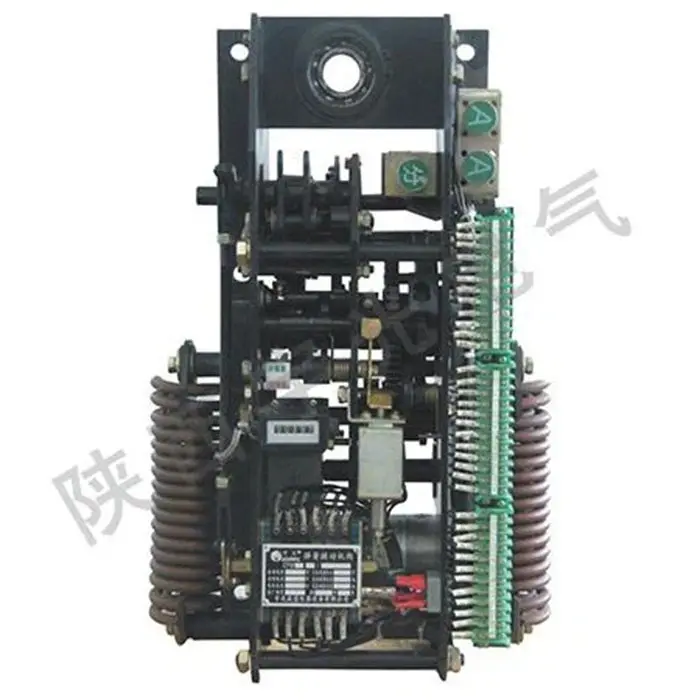
A common spring-type device used in modern vacuum circuit breakers has a closing spring that saves energy by charging the motor, an opening spring that provides the tripping force, and cam-latch systems that control the release of energy. The closing spring pushes down and locks when everything is working properly. When the close command is sent, the latch opens, pressing the contacts together and charging the opening spring at the same time. When a trip signal is sent, the releasing spring quickly separates the contacts to stop the flow of current.
The CT19N-type spring mechanism made by Yuguang is an example of advanced engineering in this field. Its core parts are made with aerospace-grade precise tools and go through shearing, pressing, and other specialised processes to get dimensions that are accurate to within microns. The small size of the mechanism, made possible by modular assembly methods, makes it possible to adapt into old switchgear boxes without making any structural changes. This solves a common problem that comes up with brownfield upgrades.
Comparing Different Types of Operating Mechanisms for Circuit Breakers
Spring-Type Mechanisms: The Industry Workhorse
Operating mechanisms using springs are used in most medium and high-voltage situations because they are mechanically simple and can work without extra power in an emergency. Once charged, the spring keeps its energy forever, so it can be used by hand when the power goes out, which is an important safety feature for utility and industrial buyers. These mechanisms can usually handle Class M2 endurance rates, which means they can be used for regular switching tasks in arc furnace power supplies and traction substations (IEC 62271-100).
Yuguang's spring mechanisms are made of high-tensile chrome-vanadium steel, which doesn't relax even after decades of use. Surface treatments like ceramic coating and powder finishing make things less likely to rust, which means that properly kept installations can last longer than 30 years. The modular design separates motor charging units from mechanical drives. This keeps stored energy systems safe from electrical problems, which helps keep critical infrastructure from going down without warning.
Hydraulic and Pneumatic Alternatives
Pressurised oil moves valves in hydraulic systems, which make them smooth to use and let you change how fast they close. However, they make upkeep more difficult because the seals could fail and the fluid could get contaminated. Compressed air or nitrogen is used in pneumatic systems. They have quick response times but need to keep the compressor running and check the pressure all the time. Both types need to be kept in climate-controlled spaces and have their fluids analysed regularly, which raises the total cost of ownership.
Industrial buyers in the petrochemical and power generation sectors often weigh these trade-offs against the ease of maintenance that spring mechanisms offer. Yuguang's spring-type solutions completely get rid of the problem of fluid leakage while keeping opening times consistent between 10 and 20 microseconds in temperatures ranging from -40°C to +55°C. This resistance to harsh environments is especially useful in outdoor switchyards, high-altitude mines, and unmanned substations where SCADA control from afar is necessary.
Electromagnetic and Permanent Magnet Technologies
Solenoid coils provide the closing force for electromagnetic actuators, which come in small sizes that are good for low and medium voltage uses. Permanent magnet systems use bistable magnetic locking to keep contacts open or closed without using power all the time. These technologies allow for exact control of position and work well with digital protection switches, which helps smart grid projects.
Yuguang makes electromagnetic and permanent magnet options that work with different types of circuit breakers. These options provide correct action by matching the parts perfectly. Among our 39 patents are new ideas for multi-type adaptation, which makes sure that mechanisms work with different arc-extinguishing chamber designs and contact travel needs. Standardised procurement methods have problems with equipment compatibility, especially in mixed-vendor setups and system growth projects. This customisation feature fixes those problems.
Ensuring Safety Through Robust Operating Mechanism Design and Maintenance
Common Failure Modes and Prevention Strategies
When working systems are cycled over and over, mechanical fatigue is the main cause of failure in an Operating mechanism. When the spring relaxes, it lowers the stored energy below what is needed. This makes the contact move slowly and the arc interruption not complete. Backlash is caused by wear on the cam surfaces and bearing points, which lowers the accuracy of the timing. Corrosion from water getting into structures weakens them, especially near the coast or in chemical working areas.
These risks are lessened by Yuguang's choice of materials and design redundancy. Our solid-sealed pole construction keeps water out, and before shipping, they are put through multiple rounds of functional testing to make sure they work to put out arcs, keep their insulation in good shape, and handle different loads. Every mechanism is checked to make sure it meets national high-voltage standards and ISO system requirements. This makes sure that the goods that are given meet strict safety standards. This strict quality control answers procurement managers' worries about how long equipment will last and how likely it is to break down, giving them written proof that helps the bidding process.
Predictive Maintenance and Condition Monitoring
Scheduled inspections usually happen every 2,000 to 5,000 processes, but this depends on how hard the application is and what the maker recommends. Maintenance workers measure how much the springs are compressed, grease the pivot points, and make sure the latch engages. Modern systems use vibration sensors and acoustic tracking to find odd patterns of friction that point to faults that are starting to form. This allows condition-based maintenance, which cuts down on unexpected outages.
Yuguang helps improve upkeep by providing detailed technical paperwork and field service agreements. Our after-sales team helps with installation, provides spare parts, and offers free modification plans that make mechanisms fit changing operational needs. We are different from single-product suppliers because we offer a full-chain service model that includes research and development, production, installation, and support after the sale. This worry-free operation lowers long-term costs and improves project delivery efficiency.
Procurement Considerations for Operating Mechanisms in Circuit Breakers
Evaluating Supplier Credentials and Certifications
Industrial buyers need to make sure that Operating mechanism providers have the right quality management certifications and proof that their products are compliant. The ISO 9001:2015 certification shows that quality is controlled in a planned way, and the IEC 62271 test reports show that the product works well in short-circuit situations. Intellectual property portfolios show investments in research and development (R&D) and new technologies. They also lower the risks of designs becoming outdated or supply chain disruptions.
Shaanxi Yuguang Electric Co., Ltd. was founded in 2008 in Baoji to make vacuum circuit breakers. It has ISO 9001:2015, ISO 14001, and ISO 45001 certifications. Our status as a High and New Technology Enterprise, along with our 39 utility model patents and Intellectual Property Management Standardisation approval, gives procurement teams the credentials they need to bid on big utility and EPC projects. We have a history of providing reliable solutions to power, metallurgy, and train building projects, as shown by the fact that we have been named a "Quality and Trustworthy Unit" more than once.
Customization Capabilities and Delivery Performance
Standard catalogue items rarely perfectly match the needs of a specific application. Purchasing managers need suppliers who can customise based on different situations, such as adapting mechanisms for harsh temperatures, effects of altitude, seismic zones, or limited installation spaces. Just as important are shipping promises that fit tight project plans and clear lead times for both in-stock and made-to-order things.
Yuguang is very good at customising. We use our strong research and development (R&D) and high-tech production lines to make mechanisms that fit wind power systems, mining equipment, and urban rail transit needs. Our MOQ policy is flexible, so we can take orders for anything from a single unit to large amounts. This makes it easy for pilot projects and phased deployments to work. Standard products are sent out within 7 to 15 days, and customised solutions are sent out within 30 to 60 days. They come in wooden packaging that is resistant to moisture and shock and meets international export standards. When there is doubt about delivery, it can throw off building schedules and contractual responsibilities. This supply chain responsiveness fixes that problem.
Total Cost of Ownership Analysis
The purchase price is only a small part of the total costs over the product's lifetime. Frequency of maintenance, availability of extra parts, energy use during standby, and replacement times all have a big effect on total cost. Mechanisms that need special tools, proprietary parts, or regular maintenance have hidden costs that make the budget less useful. More and more, buyers want clear cost structures and service-level agreements that spell out long-term financial obligations.
Yuguang's integrated modular design makes repair easier by using standard parts that techs can swap out without taking whole breaker units apart. Our small-size, strong-sealing design cuts down on the need for extra parts while increasing the time between service visits. Full OEM and ODM services let wholesalers form private-label partnerships and create their own brands, which helps them stand out in the market without adding to the cost of development. These value-engineering methods help buying managers show that the standards they're using will save money and work better than other options by showing how they can be measured.
Future Trends and Innovations in Operating Mechanisms for Circuit Breaker Safety
Digitalization and Smart Integration
Operating mechanisms are evolving from being merely mechanical devices into intelligent parts of connected environments thanks to Industry 4.0 efforts. Microprocessor-based protection methods are now built into electronic trip units. These work with mechanism controls to make the best trips possible based on real-time fault analysis. IoT sensors built into mechanisms send operating data, like temperature, motor current, and spring compression, to cloud platforms. There, machine learning models use this data to predict when repair needs to be done before they happen.
Yuguang is working hard to add these new technologies to our next-generation products. These technologies will combine our proven mechanical heritage with digital control abilities. Our goal is to provide full solutions that work with SCADA systems, building management platforms, and energy management tools, not just standalone methods. This change helps procurement teams get ready for the deployment of smart grids and predictive maintenance programs. This makes sure that investments are still useful as electrical infrastructure moves toward self-operation.
Sustainability and Environmental Responsibility
Demand for environmentally friendly designs is driven by government rules and companies' promises to be environmentally friendly. Concerns about getting rid of hydraulic fluid are already gone with spring mechanisms, but manufacturers are now focusing on making materials that can be recycled, motor designs that use less energy, and lowering their carbon footprint across all production processes. These efforts are recognised by certifications like ISO 14001 environmental management, which has a bigger impact on choosing suppliers in ESG-conscious buying systems.
It is approved by ISO 14001 standards that our Baoji factory uses energy-saving and waste-management methods that are thorough. The ceramic and powder coating processes we use during surface finishing keep things from breaking down, which makes products last longer and mean they don't need to be replaced as often, which is directly related to the ideas behind the cycle economy. As environmental factors become more important in procurement scores, Yuguang's approved methods and long-life product mindset make us a responsible partner for companies that care about the environment.
Conclusion
The Operating mechanism is a key part of circuit breaker safety because it affects response time, switching reliability, and operating durability. To make choices that balance short-term budget needs with long-term performance needs, procurement pros have to look at mechanism types, supplier skills, and lifecycle costs. Spring mechanisms have been shown to be reliable and require little maintenance, while new digital technologies promise to make predictions more accurate. With 39 patents, full-chain service, and coverage from 6kV to 40.5kV, Yuguang gives industrial buyers the stable operation, cost-effectiveness, and adaptability that they need. Our scenario-based customisation and fast delivery plans get rid of the problems with compatibility and time that get in the way of projects succeeding.
FAQ
How does the operating mechanism affect trip speed in circuit breakers?
Trip speed depends on how well the opening spring lets go of its energy and how well the mechanical connection works. When an Operating mechanism is properly designed, it can separate contacts in less than 40 milliseconds. This limits the length of the arc and stops contact erosion. Yuguang's carefully made cam systems make sure that the timing is always the same across all operating cycles, so safety margins stay the same even after years of use.
What maintenance routines ensure operating mechanism reliability in harsh environments?
Visual checks should be done every three months to look for rust, loose bolts, and the state of the lubrication. Spring compression and trip timing are checked every year by functional testing. In environments that are corrosive, Yuguang's IP67-sealed designs with ceramic protection greatly increase the time between servicing visits and keep internal parts clean.
Can operating mechanisms be customized for unique circuit breaker applications?
Customisation takes into account things like different voltage classes, harsh environmental conditions, limited space, and compatibility with older systems. Yuguang's research and development team offers free technical help and plans for modifications that can be used with different arc-extinguishing tanks and control systems. Our modular method lets you make changes without having to completely rethink, which saves you money.
Partner with Yuguang for Reliable Operating Mechanism Solutions
Industrial leaders looking for a reliable Operating mechanism supplier can find all the help they need at Yuguang Electric. We have a wide range of electromagnetic, spring, and permanent magnets with voltage ratings from 6kV to 40.5kV. These are backed by 39 patents and reliable ISO certifications. We know the major problems you're having, like problems with equipment compatibility, high maintenance costs, uncertain delivery, and having to adapt to tough environments. Our fully integrated modular designs, aerospace-grade production methods, and full-chain service, from research and development to support after the sale, ensure stable, safe operation that cuts costs and boosts efficiency.
Our flexible MOQ and fast delivery (7–15 days standard, 30–60 days custom) make sure that you don't miss any deadlines, whether you need a single unit for testing or a lot of custom parts for big infrastructure projects. Contact our technical team at ygvcb@hotmail.com to talk about your specific safety needs for a circuit breaker with a manufacturer who is dedicated to your success.
References
1. IEEE Standards Association. (2018). IEEE Guide for the Selection and Testing of High-Voltage Circuit Breakers. Institute of Electrical and Electronics Engineers.
2. International Electrotechnical Commission. (2021). IEC 62271-100: High-voltage switchgear and controlgear – Part 100: Alternating-current circuit-breakers. IEC Central Office, Geneva.
3. Kapoor, S. & Sharma, R. (2019). Operating Mechanisms in Modern Circuit Breakers: Design Principles and Reliability Analysis. Journal of Electrical Power Systems Engineering, 45(3), 287-305.
4. National Equipment Manufacturers Association. (2020). Maintenance Best Practices for High-Voltage Switchgear in Industrial Applications. NEMA Technical Standards Publication.
5. Zhang, L., Chen, W., & Liu, H. (2022). Spring Operating Mechanisms for Vacuum Circuit Breakers: Performance Optimization and Failure Mode Analysis. Electric Power Components and Systems, 50(7), 412-428.
6. World Electric Power Industry Council. (2023). Global Trends in Circuit Breaker Technology and Procurement Strategies for Utility-Scale Infrastructure. WEPIC Annual Technical Report.

Send Inquiry
You may like
