
Why Choose Vacuum Circuit Breakers for Safe Power Distribution?
It's easy to fix faults with a vacuum circuit breaker because it doesn't use oil or gas, and it doesn't need as much regular maintenance. Since it doesn't use oil or SF₆ gas, medium-voltage switchgear doesn't have to worry about fires or gas handling. Its small size lets it fit into tight panels, and when engineers tell it to, it can handle frequent switching on motors, transformers, and feeders. People who want to match ratings, applications, and supplier strength before they order can use this guide. It was written for procurement managers, engineers, EPC contractors, and OEM integrators. From 6 kV to 40.5 kV, Yuguang sells vacuum circuit breakers.
What a Vacuum Circuit Breaker Is and How It Works?
Why Safe Power Distribution Starts With Fast Fault Clearing?
When the safety device clears them too late, short circuits, overloads, and insulation failures can hurt transformers, motors, cables, and switchgear. A longer fault also makes the arc flash stronger, which is dangerous for maintenance workers. Power plants, steel mills, data centers, and transit operators all need breakers that always open when they are told to. The four problems that procurement teams usually bring up are: panels that don't fit well with other panels, panels that are hard to maintain, deliveries that are late, and panels that don't offer enough support for harsh sites. All four can be dealt with by a well-specified medium-voltage breaker from a reliable supplier. Here are some tips on how to choose one and what to ask before you buy.
What Is a Vacuum Circuit Breaker?
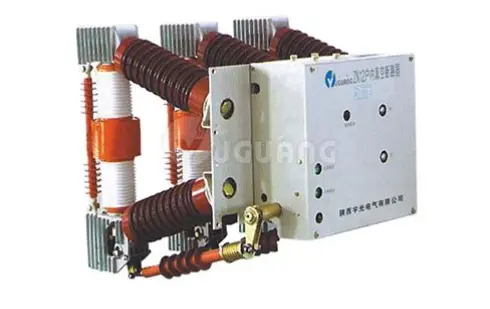
A vacuum circuit breaker stops the flow of electricity inside a sealed vacuum interrupter. It is a medium-voltage switching and protection device. There is more than just the interrupter. Contacts, an operating mechanism, coils, insulation, auxiliary contacts, interlocks, control terminals, and, if needed, a fixed or drawout truck are also part of a complete assembly. People can buy versions that are fixed, drawout, motor-operated, indoor, outdoor, or with switchgear built in. In utility networks, substations, and industrial distribution systems, you can find these kinds of units. It's easier to read datasheets and compare quotes when you know the difference between the interrupter and the whole assembly.
How Does a Vacuum Circuit Breaker Work?
In a normal state, current flows through the interrupter's closed fixed and moving contacts. An arc is made when the contacts separate, which is caused by metal vapor being released by the contacts. This can be done by a relay or an operator. The room doesn't hold any air, oil, or SF₆, so the vapor quickly spreads and condenses. After that, the dielectric strength goes back to being close to the natural current zero of the AC waveform, and the arc doesn't start up again. Control, status feedback, and safe operation are all coordinated by trip coils, closing coils, auxiliary contacts, and interlocks. This physics is talked about in great detail in Paul Slade's reference book on vacuum interrupters.
Core Advantages of Vacuum Circuit Breakers in Medium-Voltage Systems
Fast Interruption in a Compact Package
The contacts of a vacuum circuit breaker open in a chamber that is sealed off, so the arc stays inside and ends across a short contact gap. That keeps the interrupter small and lets makers make poles and switchgear that are small. When faults are cleared faster, they don't release as much energy into cables, busbars, and equipment. Vacuum units can also handle switching on and off a lot, which is good for motors, furnaces, pumps, and compressors. When given the right instructions, they can protect transformers, generators, cables, and distribution panels. You can choose the best way to maintain your plant between fixed and drawout designs. It is still better to look at switching duty, mechanical endurance, and electrical endurance instead of relying on general advantages.
No Oil, No SF₆, and Lower Routine Servicing
Oil breakers can start fires and need to sample and handle oil. SF₆ breakers need to be checked for gas leaks and managed. The IPCC says that SF₆ has more than 22,000 times the global warming potential of carbon dioxide over 100 years. As of now, California has rules that phase out SF₆ in new gas-insulated switchgear in stages. This is something that many US owners are reflecting on. Since a vacuum interrupter is sealed at the factory, crews don't have to do any work on the oil or gas. Instead, they check the mechanism, wiring, and insulation. That cuts down on routine work and makes it easier to follow environmental rules.
Vacuum Circuit Breaker vs. Air, SF₆, and Oil Breakers
Each technology is good for a different range of voltages and tasks. Most low-voltage systems use air circuit breakers, while most medium-voltage systems use vacuum technology. SF₆ might still work in some high-voltage situations, but it needs more work on how it handles gas and stops leaks. There are more fire, maintenance, and environmental concerns with oil breakers. Overall, VCBs do very well. They may cost more up front, and some loads, like motors and some transformers, may need arresters or snubbers to protect them from overvoltage. Before you replace an old breaker in a retrofit project, you should also carefully check the box's dimensions, interlocks, and control circuits.
Ratings, Applications, and Maintenance Checks
Key Ratings Buyers Must Check
It's not enough to just match the nominal system voltage. Check the rated voltage, insulation level, power-frequency withstand voltage, lightning impulse withstand voltage, continuous current, short-circuit breaking current, making capacity, and short-time withstand current. In many places, 12 kV, 24 kV, and 33 kV classes are used. These classes have current ratings like 630 A, 1250 A, and 2000 A. ANSI/IEEE classes like 15 kV, 27 kV, and 38 kV are used by most US systems. Make sure your system is mapped to the right class. Before you buy, write down the type tests, routine tests, interlocks, control voltage, coils, motor charging, and interlocks. The rating structure is set by IEC 62271-100 and IEEE C37.04.
Matching a VCB to Your Application
Depending on the job, you may need a fixed or drawout unit, to mount it indoors or outdoors, and to operate it manually or from a distance. It's possible for substations to need incoming feeders, protection for transformers, bus couplers, and SCADA links. Motors, capacitor banks, furnaces, and a lot of switching must all be taken into account in industrial plants. Selection is also affected by things like altitude, temperature, humidity, dust, vibration, pollution, and corrosion. The solid-embedded poles in Yuguang's VS1-24 protect the interrupter from dust, humidity, and contamination. This is important at 24 kV, where air gaps are smaller than at 12 kV. Check for transient overvoltage early on when switching motors and transformers.
Maintenance Requirements You Should Plan For
Even though vacuum interrupters are sealed at the factory for a vacuum circuit breaker, no breaker works perfectly without any help. Contact travel, mechanism operation, coils, control wiring, insulation, extra contacts, interlocks, and drawout parts should all be checked on a regular basis. It is important to follow the steps given by the manufacturer when checking for vacuum integrity and contact erosion. Also, never open a sealed interrupter in the field. NFPA 70B, which is now a full standard with its 2023 edition, says that there needs to be a structured program for electrical maintenance. Set intervals based on the number of operations, fault interruptions, the environment, and the manufacturer's instructions. To avoid unplanned downtime, keep important spares on hand and write down every time the switches are used.
Procurement Guide: Selecting a Vacuum Circuit Breaker Supplier
Start With a Complete Technical Schedule
Before you buy something, you need to make a full technical schedule that includes the voltage, frequency, current, fault level, installation environment, load type, control power, communication needs, standards, quantity, destination, delivery date, and any faults. When you compare prices, don't just look at the purchase price. Engineering, integration, freight, commissioning, spares, maintenance, and downtime risk should all be taken into account. For US projects, frequency is important because they run at 60 Hz, so make sure you check each model's rating. The Yuguang VS1-24 says it works at 50/60 Hz, while the ZN12-12 says it works at 50 Hz. Send us your schedule, and our team will make sure it works before we start making things.
Why a Qualified Manufacturer Matters
The interrupter, contact system, insulation, and operating mechanism all have a direct effect on how well it works, how long it lasts, and how safe it is for people to use. Before starting production, an experienced manufacturer looks over single-line diagrams, interface dimensions, control circuits, and protection needs. Project risk is lower when there are type-test reports, routine-test records, factory acceptance tests, serial-number traceability, and clear documentation. Buyers from other countries also need export packaging, help with customs, stable lead times, English technical documents, and quick customer service after the sale. A good supplier can help OEM customers, distributors, EPC contractors, and utilities by providing spare parts and solutions that are tailored to their needs.
Decision Checklist Before You Approve an Order
Before you approve any order for a vacuum circuit breaker, I think you should do these three things.
- Electrical and environmental fit: Confirm that rated voltage and insulation level suit the system and site. Breaking capacity must exceed the calculated prospective fault current, and continuous current should cover present demand plus planned expansion, so you avoid early replacement.
- Interface and duty fit: Check compatibility with protection relays, control voltage, switchgear dimensions, interlocks, racking systems, and communication interfaces. Then review load type, switching frequency, overvoltage protection needs, inspection access, and replacement procedures.
- Commercial fit: Verify accessories, testing, certification, packaging, delivery, warranty, spare parts, and technical support. Also confirm that the supplier can meet project-specific or OEM requirements without delaying your schedule.
These checks lower the chance of delays, problems with the interface, and using the wrong tools.
Why Buyers Choose Yuguang Vacuum Circuit Breakers?
Company Background and Qualifications
Shaanxi Yuguang Electric Co., Ltd. was founded in 2008 in Baoji, Shaanxi, which is where vacuum circuit breakers are made. The equipment we make, install, and provide service for after the sale ranges from 6 kV to 40.5 kV. There are 39 patents on our company, as well as ISO 9001:2015, ISO 14001, and ISO 45001 certifications, as well as High and New Technology Enterprise status and Intellectual Property Management Standardization certification. We also have a number of national inspection reports. We do OEM and ODM work for projects in the areas of power, metallurgy, mining, petrochemicals, communication, and railroads.
Product Range and Design Features
Our 6 kV to 40.5 kV range uses vacuum arc extinguishing and a permanent magnet operating mechanism that works well for heavy use and is made to not need any maintenance. The units are small because they are made up of integrated modules, and the solid-sealed poles give them strong sealing and a long life. For 12 kV indoor systems, there is the ZN12-12, the VS1-12 comes in both side-mounted and handcart styles, the VS1-24 comes in both fixed and handcart styles for 24 kV, and the ZN39-40.5 is rated at 40.5 kV and can handle currents from 1250 A to 3150 A and a breaking current of 25 kA to 31.5 kA. For harsh environments and industry needs, like wind power, we can also make units just the way you want them.
Manufacturing, Delivery, and After-Sales Support
We check the corrosion-resistant alloys and IP67 seals before they are used to make sure they are of high quality. We use aerospace-grade precision and special tools to make core parts like solid-sealed poles and arc-extinguishing chambers. The next step is modular assembly. After that comes ceramic and powder coating with curing at a constant temperature to prevent corrosion and aging. Multiple rounds of tests compare the ability to put out arcs, insulate, and adapt to different loads to national high-voltage standards and ISO standards. Orders are sent in wooden boxes that are resistant to moisture and shock, and international orders are handled according to international standards. You have to order at least one unit. Customized items take 30 to 60 days to deliver, while standard items take 7 to 15 days. Support after the sale includes help with installation, maintenance agreements, spare parts, and a free plan for making changes.
Conclusion
A vacuum circuit breaker keeps medium-voltage systems safe by quickly stopping faults inside a sealed chamber that doesn't need oil or SF₆ gas. This design makes the switchgear smaller, can handle more switching, and needs less regular maintenance. However, it may cost more up front, and some loads need overvoltage protection. Verified ratings, such as voltage class, insulation level, breaking current, and control interfaces, as well as the application, altitude, and environment, all play a role in safe selection. Planned inspections and records are still needed for maintenance. Problems with the interface and delays can be avoided with a full technical schedule and a lifecycle cost comparison. Project risk can be lowered by working with a qualified manufacturer who keeps test records, can be tracked, and offers quick support. As important as the breaker technology itself are the right specifications and the ability of the supplier.
FAQ
Q1: What does a vacuum circuit breaker protect?
A: It keeps transformers, motors, generators, cables, and distribution panels safe by stopping overloads and short circuits in medium-voltage systems. It is still important for every application to have the right breaking capacity and switching duty.
Q2: Is a vacuum circuit breaker really maintenance-free?
A: The sealed interrupter doesn't need oil or gas service, and Yuguang's permanent magnet mechanism is made to not need any upkeep. Inspections of the wiring, terminals, and insulation on a regular basis, along with switching records, still support safe operation.
Q3: What are the minimum order and delivery time?
A: One unit can place an order with us. Customized items take 30 to 60 days to deliver, while standard items take 7 to 15 days.
Q4: What should I send for a quotation?
A: Send the voltage, current, frequency, short-circuit level, installation environment, switchgear type, control voltage, amount, destination, and any standards that apply. Then, our engineers look over the lead times, fit and return datasheets, and drawings.
Request a Vacuum Circuit Breaker Quote from Yuguang
Are you ready to choose safe equipment for distributing power? Yuguang is a company in Baoji that makes vacuum circuit breakers. They have units ranging from 6 kV to 40.5 kV, a minimum order size of one unit, OEM and ODM customization, and full-chain support from R&D to after-sales. Send your requirements to ygvcb@hotmail.com, and one of our engineers will get back to you with datasheets and lead times.
References
1. IEC 62271-100: High-voltage switchgear and controlgear – Part 100: Alternating-current circuit-breakers, 2021
2. IEEE Std C37.04: IEEE Standard for Ratings and Requirements for AC High-Voltage Circuit Breakers with Rated Maximum Voltage Above 1000 V, 2018
3. IEEE Std C37.20.2: IEEE Standard for Metal-Clad Switchgear, 2015
4. NFPA 70B: Standard for Electrical Equipment Maintenance, 2023
5. The Vacuum Interrupter: Theory, Design, and Application, CRC Press, 2007
6. Climate Change 2007: The Physical Science Basis (Fourth Assessment Report), IPCC, 2007

Send Inquiry
You may like
