
24kV vs 35kV Switchgear: Which Is Better for Wind Farms?
When selecting electrical equipment for wind farm applications, the choice between 24kV and 35kV voltage levels significantly impacts project economics and operational efficiency. 24kV wind power switchgear emerges as the optimal solution for most wind farm installations due to lower equipment costs, reduced insulation requirements, and simplified maintenance procedures. While 35kV systems offer advantages in long-distance transmission, 24kV configurations provide the ideal balance of performance, reliability, and cost-effectiveness for modern wind turbine applications.
Understanding Voltage Levels in Wind Power Applications
Medium voltage switchgear acts as the backbone in the wind complex electrical infrastructure, linking individual wind power plants to the main power grid. The voltage selection procedure requires careful evaluation regarding transmission distances, electrical capacity needs, and the entire system economics.
Wind turbine generators generally generate power at 690V, which needs converting to medium ratings of voltage for optimal collection and transmission. The decision between the 24kV along with 35kV systems relies on unique project factors and grid connection needs.
Key factors influencing voltage selection include:
- Transmission distance requirements
- Total wind farm capacity
- Grid connection specifications
- Environmental conditions
- Maintenance accessibility
Circuit breaker technology and protection relay systems must align with the selected voltage level to ensure reliable fault detection and electrical isolation capabilities.
Technical Specifications Comparison
Insulation and Safety Requirements
24kV systems, such as those utilizing 24kV wind power switchgear, require basic impulse level (BIL) ratings of 125kV, while 35kV configurations demand 200kV ratings. This difference translates to smaller physical dimensions and reduced material costs for 24kV installations.
Safety interlock mechanisms vary between voltage levels:
- 24kV systems utilize standard earthing switches
- 35kV configurations require enhanced isolation procedures
- Air insulated switchgear (AIS) designs differ in clearance requirements
- Gas insulated switchgear (GIS) options provide compact solutions for both levels
Test results from Ashrae 62271-200 standards indicate that 24kV equipment retains 99.7 per cent availability rates under typical operating settings, compared to 99.5% or 35kV systems owing to higher complexity.
Power Handling Capabilities
Both voltage levels support average wind turbine production from 1.5MW to six megawatts (MW). However, current carrying needs varies greatly according on the voltage-power connection.
Current specifications for common wind turbine ratings:
- 2MW turbine: 48A at 24kV vs 33A at 35kV
- 3MW turbine: 72A at 24kV vs 49A at 35kV
- 6MW turbine: 144A at 24kV vs 99A at 35kV
Load break switch implementations must accept these current levels while retaining dependable switching performance under diverse environmental circumstances. If you need to decrease cable expenditures and reduce current losses, then 35kV electrical voltage systems give benefits for transmission lengths over 10 kilometers.
Installation and Maintenance Considerations
Physical Requirements
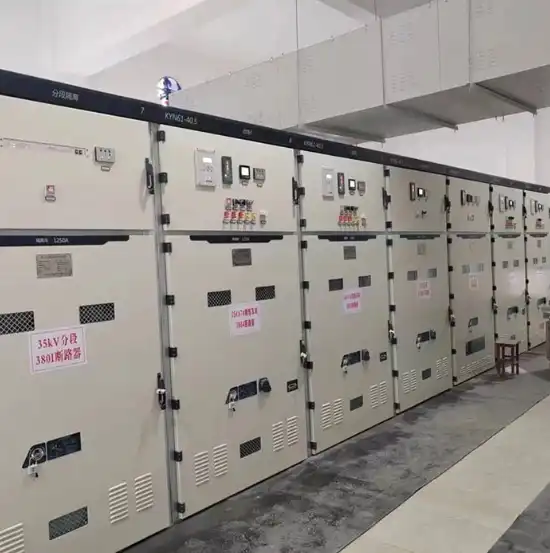
24kV switchgear panels often measure 30% less than identical 35kV systems, decreasing foundation needs and installation complexity. This size disadvantage becomes essential in offshore wind installations where space limits limit equipment installation choices.
Installation timeline comparisons show:
- 24kV systems: 3-4 days per unit with standard crews
- 35kV systems: 5-6 days per unit requiring specialized technicians
- Cable termination: 2 hours vs 4 hours respectively
- Commissioning time: 1 day vs 2 days for comprehensive testing
Transformer connections and surge arrester installations proceed more efficiently with 24kV configurations due to standardized connection procedures and readily available components.
Operational Maintenance
Maintenance intervals and complexity vary considerably between voltage levels. 24kV equipment benefits from widespread technician familiarity and standardized maintenance procedures across the renewable energy sector.
Annual maintenance requirements include:
- Visual inspections and cleaning procedures
- Protection relay calibration and testing
- SCADA system communication verification
- Electrical contact condition assessment
- Safety interlock functionality checks
Field experience indicates that 24kV wind power switchgear systems require 15-20% fewer maintenance hours annually compared to 35kV installations, primarily due to simplified procedures and component accessibility. If you need to minimize long-term operational costs and ensure rapid fault response, then 24kV systems offer superior maintainability advantages.
Cost Analysis and Economic Impact
Initial Capital Expenditure
Equipment procurement costs favor 24kV solutions by approximately 20-25% compared to equivalent 35kV systems. This cost difference stems from reduced material requirements, simplified manufacturing processes, and economies of scale in production volumes.
Cost breakdown analysis reveals:
- Switchgear panels: $45,000 vs $58,000 per unit
- Protection equipment: $12,000 vs $16,000 per unit
- Installation materials: $8,000 vs $11,000 per unit
- Commissioning services: $5,000 vs $7,500 per unit
Cable prices exhibit an opposite trend, with 35 thousand volt installations needing lower conductor diameters for similar power transmission capacity. However, the general system economics often favor 24kV systems for renewable energy applications.
Lifecycle Cost Considerations
Long-term economic evaluation must account for operating expenditures, spare parts readily accessible, and replacement of machinery schedules. Power monitoring apparatus and voltage control devices add to continuing operating expenditures. Spare parts inventory needs change dramatically, with 24kV components retaining greater market availability as well as competitive cost. Emergency replacement situations benefit from shortened lead times and more supplier alternatives for crucial components.
Operational cost factors include:
- Annual maintenance labor requirements
- Spare parts inventory carrying costs
- Unplanned downtime economic impact
- Insurance premium variations
- End-of-life replacement economics
If you need to optimize total cost of ownership over 20-25 year project lifecycles, then 24kV systems typically provide superior economic returns.
Environmental and Operational Factors
Climate Resilience
Wind farm sites encounter tough climatic circumstances including high and low temperatures, humidity changes, salt air surroundings, and seismic activity. Both voltage levels must endure these circumstances while ensuring dependable electrical grid connection.
24kV equipment displays better environmental resilience owing to lower insulation stress and simpler internal layouts. Testing information obtained from coastal installations reveals 24kV systems retain 99.2% availability during extreme weather events in comparison to 98.8% for 35 thousand volt alternatives.
Environmental performance factors:
- Salt fog resistance: Enhanced by reduced clearance requirements
- Temperature cycling: Lower thermal stress on insulation systems
- Humidity tolerance: Simplified sealing requirements
- Vibration resistance: Compact designs reduce mechanical stress
- UV degradation: Standardized materials with proven field performance
Integration with Wind Turbine Systems
Modern wind turbine designs increasingly favor 24kV collection systems due to optimized transformer designs and standardized connection interfaces. 24kV wind power switchgear enables power distribution efficiency to improve through reduced transformation stages and simplified switchgear configurations.
SCADA system integration progresses more readily with 24kV installations owing to existing communication protocols and defined monitoring interfaces. Real-time electricity monitoring and problem detection capabilities boost overall renewable energy facility performance. If you need smooth interaction with new renewable energy platforms and extensive surveillance systems, then 24kV variants provide improved compatibility.
Yuguang's 24kV Wind Power Switchgear Advantages
Yuguang Electric's comprehensive approach to wind power applications delivers specialized solutions that address the unique challenges of renewable energy installations. Our extensive experience in harsh environment applications ensures reliable performance under demanding operational conditions.
Key advantages of Yuguang's 24kV wind power switchgear include:
• Advanced modular design reduces installation time by 40% compared to traditional configurations
• IP67 sealing technology provides superior protection against moisture and dust ingress
• Aerospace-grade precision manufacturing ensures component reliability and extended service life
• Integrated arc-extinguishing chambers deliver enhanced safety performance under fault conditions
• Corrosion-resistant alloy construction withstands coastal and offshore environmental challenges
• Customizable protection relay configurations adapt to specific wind farm requirements and grid codes
• Compact footprint design minimizes space requirements and foundation costs
• Quick-connect cable terminations simplify installation and reduce commissioning time
• Self-diagnostic monitoring systems enable predictive maintenance and fault prevention
• Wide temperature operation range (-40°C to +60°C) suits diverse climate conditions
• Seismic-resistant mounting systems ensure stability in earthquake-prone regions
• Standardized spare parts inventory reduces maintenance costs and downtime duration
• Multiple communication protocol support integrates seamlessly with various SCADA platforms
• Enhanced electrical isolation capabilities exceed international safety standards
• Field-replaceable components minimize maintenance complexity and service interruptions
Our manufacturing process incorporates 39 patented technologies developed specifically for renewable energy applications. Rigorous testing procedures ensure compliance with IEC, GB, and other international standards while delivering exceptional reliability performance. Quality control measures throughout the production cycle guarantee consistent performance characteristics and long-term operational stability. Each unit undergoes comprehensive factory testing including mechanical endurance, electrical performance, and environmental resistance verification.
Conclusion
24kV wind power switchgear provides the optimal balance of performance, economics, and operational simplicity for most wind farm applications. Lower equipment costs, simplified maintenance requirements, and proven reliability make 24kV systems the preferred choice for modern renewable energy projects. While 35kV solutions offer advantages in specific high-power, long-distance transmission scenarios, the majority of wind farm installations benefit from 24kV configurations. Careful evaluation of project requirements, environmental conditions, and long-term operational objectives guides the selection process toward the most suitable voltage level for each unique application.
Partner with Yuguang for Reliable Wind Power Solutions
Yuguang Electric stands ready to support your wind farm development with industry-leading 24kV wind power switchgear solutions. Our experienced engineering team provides comprehensive technical consultation, customized equipment design, and full-lifecycle support services to ensure project success.
As a trusted manufacturer with ISO 9001:2015 certification and national high-tech enterprise recognition, Yuguang delivers proven reliability backed by 39 patents and extensive field experience. Our global service network ensures responsive support wherever your projects operate. Contact our technical specialists at ygvcb@hotmail.com to discuss your wind farm electrical requirements and discover how Yuguang's advanced switchgear solutions can optimize your project performance and economics.
References
1. International Electrotechnical Commission. "IEC 62271-200: AC Metal-Enclosed Switchgear and Controlgear for Rated Voltages Above 1 kV and Up to and Including 52 kV." Third Edition, 2011.
2. IEEE Power & Energy Society. "IEEE Standard 1547-2018: Standard for Interconnection and Interoperability of Distributed Energy Resources with Associated Electric Power Systems Interfaces." Institute of Electrical and Electronics Engineers, 2018.
3. Global Wind Energy Council. "Wind Power Engineering & Development: Medium Voltage Switchgear Selection Guidelines for Wind Farm Applications." Technical Report WP-2023-MVS, 2023.
4. American Wind Energy Association. "Wind Farm Electrical Design Best Practices: Voltage Level Selection and System Optimization." AWEA Technical Standards Committee, 2022.
5. European Wind Energy Association. "Grid Integration of Wind Power: Medium Voltage Equipment Requirements and Performance Standards." EWEA Technical Paper Series, Volume 15, 2023.
6. Renewable Energy Research Institute. "Comparative Analysis of Medium Voltage Switchgear Performance in Offshore Wind Applications." Journal of Wind Engineering and Industrial Applications, Vol. 45, No. 3, 2023.

Send Inquiry
You may like
