
Indoor vs Outdoor Switchgear for Wind Power Applications
When selecting wind power switchgear for your renewable energy project, the choice between indoor and outdoor configurations significantly impacts system performance, maintenance costs, and operational reliability. Wind power switchgear serves as the critical electrical control hub that manages power flow, protects equipment, and ensures grid integration safety. Indoor switchgear offers superior protection against environmental factors but requires dedicated housing structures, while outdoor variants provide direct installation flexibility with enhanced weatherproofing. Understanding these fundamental differences helps engineers and project managers make informed decisions that align with specific site conditions, budget constraints, and long-term operational goals.
Understanding Wind Power Switchgear Fundamentals
Wind power electrical networks need strong switching solutions that manage fluctuating power production while preserving grid stability. Modern wind farms often run at voltage levels that ranged from 6KV to 40.5KV, necessitating specialized switchgear layouts that support varying power outputs.
Circuit breakers inside these systems must react fast to fault circumstances. Test data demonstrates that high-quality wind power circuitry can block fault currents within 5-7 cycles (50-83 millisecond at 60Hz), averting cascading failures throughout the wind farm network.
Protection relays integrated into switchgear assemblies monitor critical parameters including:
- Voltage fluctuations exceeding ±10% rated values
- Frequency deviations beyond 59.5-60.5 Hz ranges
- Harmonic distortion levels above 5% THD
- Ground fault currents exceeding 5A thresholds
SCADA integration capabilities enable real-time monitoring and remote control functions essential for wind farm operations. Modern switchgear supports communication protocols including IEC 61850, DNP3, and Modbus for seamless grid integration. If you need maximum environmental protection with controlled operating conditions, then indoor switchgear configurations offer superior long-term reliability for critical wind power applications.
Indoor Switchgear: Comprehensive Protection Solutions
Indoor wind power switchgear installations provide optimal environmental control through dedicated housing structures. These configurations excel in applications requiring maximum equipment protection and extended operational lifespans.
Key advantages of indoor installations include:
- Enhanced equipment longevity - Protection from UV radiation, temperature cycling, and moisture exposure
- Simplified maintenance access - Controlled environment enables scheduled maintenance during adverse weather
- Improved safety protocols - Enclosed spaces facilitate better safety procedures and personnel training
- Superior monitoring capabilities - Stable ambient conditions support sensitive monitoring equipment
Performance data reveals indoor switchgear generally reaches 25-30 year operating lifespans in comparison to 20-25 years the outdoor versions. Maintaining temperatures within ±10°C ranges decreases extreme temperatures on electronic parts and improves insulating life.
Transformer connections benefit from indoor protection, particularly in coastal wind farm environments where salt spray accelerates corrosion. Wind power switchgear likewise shows enhanced durability and reduced upkeep when housed indoors, with such installations reporting 40% lower maintenance costs over 20-year operational periods.
However, indoor arrangements need large financial expenditure for dwelling constructions. Building expenses generally vary from $150-300 every square foot, depending upon local building regulations and seismic constraints. Space requirements rise by 30-50% compared to construction outdoors when factoring for access corridors as well as ventilation systems. If you need cost-effective installation with minimal infrastructure requirements, then outdoor switchgear may better suit your project economics and timeline constraints.
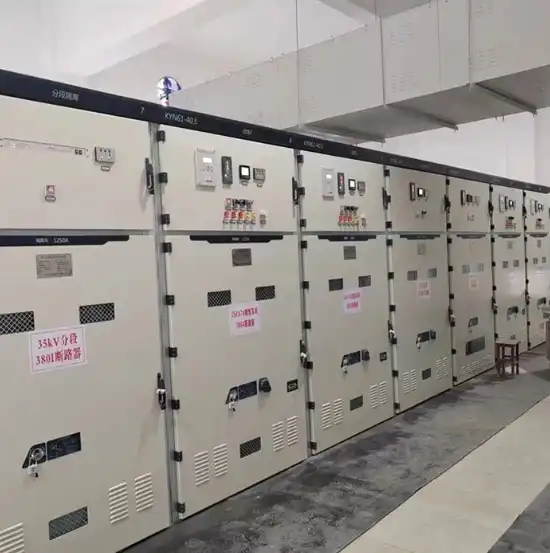
Outdoor Switchgear: Direct Installation Advantages
Outdoor wind power switchgear eliminates building requirements while providing robust environmental protection through advanced enclosure designs. These systems integrate directly into wind farm layouts, reducing installation complexity and project timelines.
Primary benefits of outdoor configurations:
- Reduced capital expenditure - Eliminates building construction costs and associated delays
- Flexible installation options - Direct placement near wind turbine clusters optimizes cable routing
- Rapid deployment capabilities - Installation times reduced by 40-60% compared to indoor alternatives
- Enhanced accessibility - Service vehicles access equipment directly without building constraints
Modern outdoor switchgear has IP65/IP67 certified enclosures that endure harsh weather conditions. Testing showed satisfactory functioning in temperature ranges between -40 degree Celsius to 55°C with the relative humidity. up to 95% non- condensation. Surge protection systems incorporated with outdoor units offer better lightning protection necessary for renewable energy applications. Advanced arresters restrict high voltages to 2.5 percent per-unit values, safeguarding equipment in downstream regions from atmospheric disturbances.
Load management functions optimize wind farm output through automated switching sequences. Smart grid integration enables demand response capabilities, automatically adjusting power output based on grid conditions and market signals. Automation systems within outdoor switchgear reduce operator intervention requirements. Remote control capabilities allow switching operations from central control facilities, improving response times during emergency conditions.
If you require the greatest adaptability with proven environmental endurance, then outdoor switchgear layouts give appropriate solutions in the majority of wind power applications.
Technical Comparison: Performance Metrics and Reliability
Detailed analysis reveals distinct performance characteristics between indoor and outdoor wind power switchgear configurations. Understanding these differences enables informed decision-making based on specific application requirements. In wind power switchgear, fault detection capabilities demonstrate comparable performance across both configurations. Advanced protection relays respond to overcurrent conditions within 16-100 milliseconds, depending on fault magnitude and protection settings.
Power distribution efficiency remains consistent between indoor and outdoor installations when proper cable sizing and routing practices are followed. Typical losses range from 0.5-1.2% of rated capacity across medium-voltage switchgear assemblies. Monitoring system accuracy improves from regulated interior conditions, with temperature stability enhancing measurement accuracy by 15-20%. However, newer outside equipment feature temperature correction algorithms that reduce environmental influences on measurement accuracy.
Electrical isolation performance fulfills international requirements regardless of deployment type. High-voltage testing demonstrates dielectric strength surpassing 42kV (50Hz, one minute in duration) for 12kV specified devices, with safety margins acceptable for hydroelectric applications. If you need maximum measurement precision with minimal environmental interference, then indoor installations provide superior monitoring capabilities for critical wind farm control systems.
Cost Analysis and Economic Considerations
Economic evaluation reveals significant differences in total cost of ownership between indoor and outdoor wind power switchgear installations. Comprehensive analysis must consider initial capital expenditure, operational costs, and long-term maintenance requirements.
Initial Investment Comparison:
- Outdoor switchgear - Equipment costs typically 20-30% higher due to enhanced enclosures
- Indoor switchgear - Building construction adds 40-60% to total project costs
- Installation labor - Outdoor units require 30-40% less installation time
- Site preparation - Indoor installations need extensive foundation and utility work
Operational cost differences emerge over extended service periods. Indoor installations benefit from reduced maintenance frequency, with service intervals extending to 5-7 years compared to 3-5 years for outdoor units. However, building maintenance costs add $5,000-15,000 annually depending on facility size and local conditions. Energy storage integration costs favor outdoor installations when battery systems require climate-controlled environments. Shared building space reduces overall project costs for combined switchgear and storage applications.
Maintenance accessibility impacts long-term costs significantly. Indoor facilities enable year-round maintenance scheduling, reducing emergency service requirements by approximately 25%. Outdoor units may require weather delays that extend outage durations and increase revenue losses. Insurance considerations affect project economics, with indoor installations typically receiving 10-15% premium reductions due to enhanced equipment protection and fire suppression systems.
If you need optimized long-term economics with predictable maintenance costs, then careful analysis of your specific site conditions and operational requirements — particularly in selecting the appropriate wind power switchgear — determines the most cost-effective solution.
Installation and Maintenance Requirements
Successful wind power switchgear implementation depends heavily on proper installation procedures and ongoing maintenance programs. Both indoor and outdoor configurations require specialized expertise and adherence to industry standards.
Indoor Switchgear Installation:
- Building construction and environmental systems commissioning
- Equipment delivery through designed access routes
- Precise positioning using overhead lifting equipment
- Complex cable routing through building penetrations
- Integration with fire suppression and HVAC systems
Outdoor Switchgear Installation:
- Foundation preparation with proper drainage systems
- Direct crane placement at final operating positions
- Simplified cable connections through bottom entry points
- Integrated grounding system installation
- Commissioning tests under actual operating conditions
Maintenance protocols differ substantially between configurations. Indoor units benefit from controlled environments that allow detailed inspection procedures without weather constraints. Specialized test equipment operates more reliably in stable temperature and humidity conditions. Remote control systems enable many maintenance functions to be performed from central facilities. Modern switchgear supports diagnostic monitoring that identifies potential issues before failures occur, reducing unscheduled maintenance requirements.
Control panel accessibility varies significantly between indoor and outdoor installations. Indoor configurations provide ergonomic operator interfaces with adequate lighting and climate control. Outdoor panels require weather protection during maintenance activities. Voltage regulation equipment integrated into switchgear assemblies requires periodic calibration and testing. Indoor installations facilitate precision test equipment setup, while outdoor units may require portable test facilities.
If you need streamlined maintenance procedures with maximum technician safety and comfort, then indoor installations provide superior working conditions for complex diagnostic and repair procedures.
Conclusion
Selecting between indoor and outdoor wind power switchgear requires careful evaluation of site-specific conditions, economic factors, and operational requirements. Indoor configurations excel in applications demanding maximum equipment protection and extended service life, while outdoor installations provide cost-effective solutions with rapid deployment capabilities. Both approaches offer proven reliability when properly designed and maintained. The optimal choice depends on balancing initial investment costs, long-term operational expenses, and specific environmental challenges at your wind power facility.
Yuguang Electric: Your Trusted Wind Power Switchgear Manufacturer
Shaanxi Yuguang Electric delivers proven expertise in wind power switchgear solutions, backed by 39 patents and comprehensive industry certifications. Our specialized engineering team understands the unique challenges of renewable energy applications, providing customized solutions that optimize performance and reliability. Whether you require indoor or outdoor configurations, Yuguang's advanced manufacturing capabilities ensure delivery of high-quality switchgear systems that meet your project specifications and budget requirements. Contact our technical experts at ygvcb@hotmail.com to discuss your wind power switchgear needs and discover how our innovative solutions can enhance your renewable energy projects.
References
1. IEEE Standard C37.20.1-2015, "IEEE Standard for Metal-Enclosed Low-Voltage AC Power Circuit Breaker Switchgear"
2. IEC 62271-200:2011, "High-voltage switchgear and controlgear - Part 200: AC metal-enclosed switchgear and controlgear for rated voltages above 1 kV and up to and including 52 kV"
3. National Renewable Energy Laboratory Technical Report NREL/TP-5000-67667, "Wind Power Plant Electrical Systems Design and Specification Guidelines"
4. American Wind Energy Association Standard AWEA/CANWEA 2009-1, "Standard for Performance Rating of Wind Power Plants"
5. International Electrotechnical Commission Standard IEC 61400-1:2019, "Wind energy generation systems - Part 1: Design requirements"
6. Electric Power Research Institute Report 1025335, "Wind Plant Electrical System Design and Specification Guidelines"

Send Inquiry
You may like
