
What is a VCB breaker?
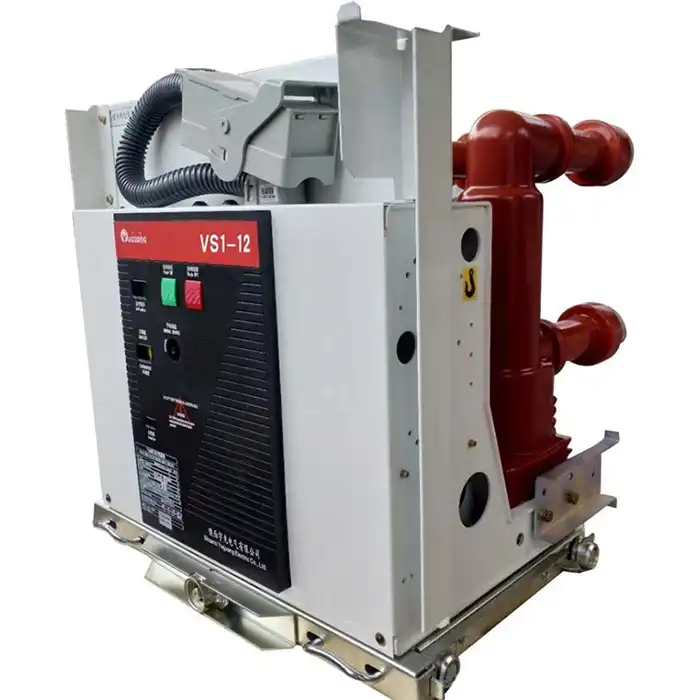
A VCB breaker, which stands for "Vacuum Circuit Breaker," is a device that safely and effectively breaks electrical connections by using vacuum technology. The vcb circuit breaker works by making an arc between two contacts in a vacuum chamber. The lack of air molecules in this chamber speeds up the arc's end and provides better electrical separation. With this technology, VCB breakers work well in medium-voltage situations with voltages between 6kV and 40.5kV. They make industrial power systems safer, better for the environment, and more effective.
Understanding the Basics of VCB Breakers
Using the special properties of vacuum environments to make better circuit interruption powers, vacuum circuit breakers are a big step forward in electrical safety technology. These high-tech gadgets are now essential to current power distribution systems in many businesses around the world.
How Vacuum Technology Works in Circuit Interruption
The basic idea behind vacuum circuit breakers comes from how electrical sparks behave in vacuums. An arc forms between the contacts when they split because of a crack. In a vacuum container, this arc can't keep going because there aren't any gas molecules to support ionization. The vacuum setting makes sure that deionization happens quickly, usually in microseconds, so the circuit can be safely broken.
The process takes place in vacuum interrupters, which are sealed rooms that hold the moving and fixed contacts. The vacuum level inside these tanks is usually between 10^-4 and 10^-6 torr. This makes a setting where much higher voltages are needed for electrical breakdown than in air or other mediums.
Core Components and Technical Architecture
In order to ensure effective operation, modern vcb circuit breaker systems are made up of a number of important parts. The vacuum interrupter is the system's heart. It holds the contact assembly inside a ceramic or glass case that can't be opened. The mechanical force needed for contact action comes from the working mechanism, which is usually driven by a spring.
Special alloys, like copper-chromium or copper-bismuth, are used as contact materials in vacuum interrupters. These alloys are made to withstand the pressures of vacuum arc interruption. These materials need to be able to prevent contact welding while still having low contact resistance when they are not being used.
The control circuits and mounting structure that connect the breaker to switchgear assemblies are examples of supporting systems. The control circuits set the time and order of processes. Modern versions have electronic controls and tracking systems that give real-time information about how the machine is working and can predict when it will need repair.
Advantages and Key Features of VCB Circuit Breakers
It is clear that vacuum circuit breakers are better when you look at how they work and how well they do their job. These gadgets have strong benefits that solve important issues in managing current electrical systems.
Environmental and Safety Benefits
Many of the environmental and safety issues that come with standard stoppage technologies are taken care of by vacuum circuit breakers. They don't pose a fire or environmental pollution risk like oil circuit breakers do. Because they don't use SF6 gas, which is used in some other technologies, VCBs don't add to greenhouse gas emissions or the loss of ozone.
The protected vacuum environment also stops wetness and contamination from getting in, so the performance stays the same even when the environment changes. Because of this trait, vcb circuit breaker is perfect for setups in tough industrial settings where dependability is very important.
Superior Arc-Quenching and Operational Performance
Due to its quick arc extinction and recovery features, vcb circuit breaker technology outperforms many options in terms of arc-quenching. The vacuum atmosphere makes it possible for the dielectric to recover very quickly. Usually, it reaches full insulation strength within half a turn of the arc ending. These fast recovery abilities let VCBs handle many re-closing operations and give great performance in capacitive switching situations, like those found in power factor correction setups or wire charging tasks.
Maintenance Advantages and Cost Effectiveness
Here are the main upkeep perks of VCB technology that make it appealing for use in industry:
• Extended maintenance intervals: Vacuum interrupters require minimal maintenance due to the absence of deteriorating insulating mediums
• Reduced operational costs: No need for oil changes, gas refills, or frequent contact replacements
• Simplified inspection procedures: Visual inspection and electricity tests are usually enough to figure out what the situation is.
• Lower total cost of ownership: Even though the original costs are higher, the lower upkeep needs save money in the long run.
These maintenance benefits have big practical benefits for facilities managers and maintenance teams. They cut down on both planned and unplanned downtime while making sure that safety is always reliable.
VCB Circuit Breakers vs Other Types: Comparative Analysis for Procurement Decisions
When you know the pros and cons of the different circuit breaker technologies and how they can be used, you can make smart purchases that meet your short- and long-term business needs.
Technical Performance Comparison
When looking at different types of circuit breakers, vacuum circuit breakers are better than others in a number of ways. When it comes to medium-voltage VCBs, interrupting capacity—which is the largest problem current a breaker can safely cut off—is one of the most important specs.
Even though oil circuit breakers have been used successfully in high-voltage situations, they need a lot of upkeep and are bad for the environment, which makes them less suitable for modern setups. SF6 breakers work very well, but they are coming under more and more governmental pressure because of worries about sulfur hexafluoride leaks. In contrast, vcb circuit breaker offers a reliable and environmentally friendlier alternative for many applications.
Air circuit breakers and molded case circuit breakers (MCCBs) are used for different voltage ranges and tasks. MCCBs are usually used in low-voltage systems because they are easier to build and less expensive.
Operational Reliability and Lifecycle Considerations
The sturdy design and low reliance on outside factors are the main reasons why vcb circuit breaker systems are so reliable. Other types of breakers can be damaged by dirt, wetness, and changes in temperature, but the sealed vacuum environment keeps vital parts safe from these problems. Lifecycle study shows that the original costs of buying VCBs may be higher than those of some other options, but the total cost of ownership usually works out better for vacuum technology. Longer operational life, less maintenance needs, and better system uptime are some of the things that contribute to this cost benefit.
Application-Specific Selection Criteria
Different manufacturing uses have different needs that affect the choice of breaker. Power plants often put a high value on dependability and quickly fixing problems. This makes VCB technology appealing for protecting generators and other power systems. In manufacturing, it may be important to keep up with upkeep and make sure workers are safe. Vacuum breaks are very helpful in these areas. VCB systems are good for infrastructure projects like transportation systems and data centers because they are small and don't harm the environment. These breakers are great for placement in cities and underground facilities because they can work in small areas without needing to be ventilated.
How to Source and Buy VCB Circuit Breakers: A Procurement Guide
To buy vacuum circuit breakers successfully, you need to know how the market works, what the seller can do, and the technical needs of the uses you want to use them for.
Evaluating Supplier Credentials and Capabilities
When looking for a vcb circuit breaker provider, scientific knowledge and the ability to make the product are the most important things to look at. International standards, such as IEC 62271-100 and IEEE C37.06, control the performance and testing requirements for vacuum circuit breakers. Suppliers should show that they are in line with these standards.
Certifications for manufacturers, like ISO 9001 quality management systems, make sure that output methods are always the same. Suppliers who can do research and development can also make solutions that are special to your needs and provide expert help for the whole lifecycle of your product.
Experience in the right business areas is valuable because it helps you understand the needs of specific applications and the rules that need to be followed. Suppliers that work with the infrastructure, industrial manufacturing, or power generation markets have specific knowledge that can help with choosing products and putting systems together.
Customization Options and Technical Support
Customization is a common part of modern VCB buying to meet the needs of specific applications. Leading sellers offer choices such as special contact materials for certain switching tasks, changed working mechanisms for certain installation limitations, and built-in tracking systems to improve operations visibility.
Technical support services include application planning before the sale, help with installation, help with commissioning, and ongoing operating support. Full support skills lower project risk and make sure the system works at its best throughout its working lifecycle.
Another important thing to think about when buying something is how easy it is to get extra parts and service help. Suppliers with well-established service networks and product management systems can guarantee that help will be available for a long time, which protects the value of VCB installations as investments.
Conclusion
Vcb circuit breaker technology is the best way to protect medium-voltage electrical systems because it combines high technical performance with low environmental impact and low operating costs. Vacuum arc interruption has special features that make it a safe way to protect things while reducing the need for upkeep and operational risks. Knowing what VCBs can do, their relative benefits, and how to buy them helps you make smart choices that will support long-term practical success and cost-effectiveness in industrial electrical systems.
FAQ
What is the typical operational life of a vacuum circuit breaker?
Under normal circumstances, a vcb circuit breaker that is well taken care of should work consistently for 20 to 30 years. Depending on the form and how it is used, the mechanical life expectancy is between 10,000 and 30,000 actions. Because they are well-made and don't wear out quickly, vacuum interrupters can often last longer than these mechanical life standards.
How do you test a VCB for proper operation?
Contact resistance testing, insulation resistance testing, timing tests for opening and shutting processes, and high-voltage testing to check dielectric strength are some of the things that are done during testing. Using special tools for vacuum integrity checking makes sure that the vacuum level stays within acceptable limits. These checks should be done according to the instructions from the manufacturer and any related standards, like IEEE C37.09.
What maintenance is required for vacuum circuit breakers?
Compared to other technologies, vacuum circuit breakers don't need as much upkeep. Visual review of external parts, lubrication of mechanical parts, cleaning of insulators, and regular electrical tests are all common parts of regular maintenance. The sealed vacuum tanks usually don't need any upkeep, unless the integrity of the vacuum is lost, which doesn't happen often in units that were made correctly.
Can VCB breakers be used in outdoor applications?
Yes, vacuum circuit breakers can be made to work outside if they have the right weatherproof housing and mountings. When designing outdoor VCBs, better insulation systems and protective coatings are used so they can handle external stresses like changes in temperature, wetness, and contamination while still working reliably.
Partner with Yuguang for Premium VCB Circuit Breaker Solutions
Yuguang Electric offers vacuum circuit breaker technology that is at the cutting edge. They have been making these products for over 15 years and have 39 patents for new ideas. Our wide range of vcb circuit breaker portfolio can handle voltages from 6kV to 40.5kV. They have modern vacuum interrupter technology and strong spring operating mechanisms that are made for tough industrial settings. As an ISO 9001:2015-certified high-tech company, we offer full OEM and ODM services to make sure that you get solutions that are tailored to your exact technical needs.
Our focused technical team is here to help with everything, from the initial plan consultation to installation help and ongoing upkeep. Get in touch with our experts at ygvcb@hotmail.com to talk about your vacuum circuit breaker provider needs and find out how Yuguang's proven knowledge can improve your electrical safety systems with reliable, maintenance-free solutions that lower costs and make systems more available.
References
1. IEEE Standard C37.06-2009: AC High-Voltage Circuit Breakers Rated on a Symmetrical Current Basis - Preferred Ratings and Related Required Capabilities for Voltages Above 1000V
2. IEC 62271-100:2021 High-voltage switchgear and controlgear - Part 100: Alternating current circuit-breakers
3. Greenwood, Allan. "Vacuum Switchgear." The Institution of Engineering and Technology, 2007
4. Slade, Paul G. "The Vacuum Interrupter: Theory, Design, and Application." CRC Press, 2017
5. Browne, Thomas E. "Circuit Interruption: Theory and Techniques." Marcel Dekker Inc., 1984
6. Naidu, M.S. and Kamaraju, V. "High Voltage Engineering." McGraw-Hill Education, 2013

Send Inquiry
You may like
