
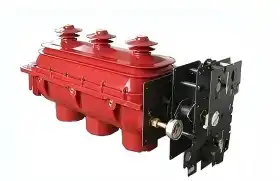
Sulfur Hexafluoride Load Switch
2. 3-position (close/open/earth) with anti-misoperation interlock.
3. K/A dual spring mechanisms; A-type supports fuse tripping, optional electric drive & accessories.
4. Two types: 630A FLN for circuit control, 125A FLRN fuse combo for transformer/RMU protection.
5. Wide ambient adaptability, compact structure, 20-year maintenance-free, IEC & GB certified.

- Free Samples
- Quality Assurance
- 24/7 Customer Service
Product Introduction
1. General Description
The FL(R)N-24D type sulfur hexafluoride (SF₆) load switch is an indoor switchgear with a rated voltage of 24 kV. It uses SF₆ gas as the arc-extinguishing and insulating medium, featuring three positions: closing, opening and grounding. It boasts a compact size, easy installation and operation, and strong environmental adaptability.
When combined with other electrical components, the FL(R)N-24D SF₆ load switch performs control and protection functions. It is suitable for control and protection of electrical equipment in industrial and mining enterprises, civil power supply and secondary substations. Among them, the load switch-fuse combination unit matches the protection characteristics of transformers and is especially applicable for ring main units.
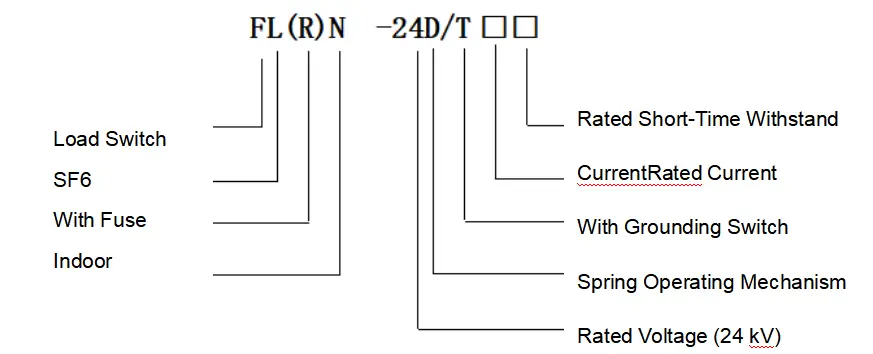
The FLN-24D/T630-20 SF₆ load switch (hereinafter referred to as the load switch) and FLRN-24D/T125-50 load switch-fuse combination unit (hereinafter referred to as the combination unit) comply with the national standard GB 3804-2004 3~63 kV AC High-Voltage Load Switches (equivalent to IEC 60265-1:1997) and GB 16926-1997 AC High-Voltage Load Switch-Fuse Combination Units (equivalent to IEC 420-1:1990).
2. Model Composition and Meaning
3. Operating Environmental Conditions
· Ambient Air Temperature
o Upper Limit: +40°C
o Lower Limit: -15°C
· Ambient Humidity
o Daily Average Relative Humidity: ≤95%
o Monthly Average Relative Humidity: ≤90%
· Altitude: Maximum installation altitude ≤1000 m
· Seismic Intensity: ≤8 degrees
· The ambient air shall be free of corrosive/flammable gases, water vapor and other significant pollutants, with no frequent severe vibration.
4. Main Specifications and Technical Parameters
|
No. |
Item |
Unit |
FLN-24D/T630-20 Load Switch |
FLRN-24D/T125-50 Load Switch-Fuse Combination Unit |
|
1 |
Rated Voltage |
kV |
24 |
24 |
|
2 |
Rated Frequency |
Hz |
50 |
50 |
|
3 |
Rated Current |
A |
630 |
125 |
|
4 |
Rated Insulation Level |
|
|
|
|
|
1-min Power Frequency Withstand Voltage |
kV |
To Ground/ Phase-to-Phase: 65; Breaking End: 79 |
To Ground/ Phase-to-Phase: 65; Breaking End: 79 |
|
|
Lightning Impulse Withstand Voltage (Peak) |
kV |
To Ground/ Phase-to-Phase: 125; Breaking End: 145 |
To Ground/ Phase-to-Phase: 125; Breaking End: 145 |
|
|
Rated Withstand Voltage at Zero Gauge Pressure |
kV |
24 |
24 |
|
5 |
Rated Short-Time Thermal Withstand Current (3 s) |
kA |
20 |
- |
|
6 |
Rated Dynamic Withstand Current (2 s, Peak) |
kA |
50 |
50 |
|
7 |
Rated Short-Circuit Making Current |
A |
- |
125 |
|
8 |
Rated Closed-Loop Breaking Current |
A |
630 |
- |
|
9 |
Rated Active Load Breaking Current |
A |
630 |
- |
|
10 |
Rated Cable Charging Breaking Current |
A |
10 |
- |
|
11 |
Rated Short-Circuit Breaking Current |
kA |
- |
50 (Prospective) |
|
12 |
Rated Transfer Current |
A |
- |
1400 |
|
13 |
Fuse Type |
- |
- |
12 kV/100 A* |
|
14 |
Striking Output Energy |
J |
- |
1±0.5 |
|
15 |
Grounding Switch Rated Short-Time Thermal Withstand Current (3 s) |
kA |
20 |
- |
|
16 |
Grounding Switch Rated Dynamic Withstand Current (Peak, 2 s) |
kA |
50 |
- |
|
17 |
Grounding Switch Rated Short-Circuit Making Current |
kA |
50 |
- |
|
18 |
Mechanical Life |
|
|
|
|
|
Load Switch |
Times |
7000 |
7000 |
|
|
Grounding Switch |
Times |
3000 |
3000 |
|
19 |
Air Insulation Distance Between Live Parts and to Ground |
mm |
≥180 |
≥180 |
|
20 |
SF₆ Gas Pressure (20°C, Gauge Pressure) |
MPa |
0.045 |
0.045 |
|
21 |
Annual Leakage Rate |
- |
≤1% |
≤1% |
|
22 |
Closing/Opening Synchronism |
ms |
≤3 |
≤3 |
|
23 |
Circuit Resistance |
μΩ |
≤65 |
≤65 |
|
24 |
Maximum Manual Operating Torque |
N·m |
85 |
85 |
|
25 |
Rated Operating Voltage |
V |
AC 110, DC 48, AC 220 |
AC 110, DC 48, AC 220 |
*Note: Type test model. Selection of other models requires relevant tests.
At zero gauge pressure, the load switch can still perform closing and opening operations for load current.
5. Installation Instructions
The FLN-24D SF₆ load switch and its combination unit can be equipped in the XGN-24 fully insulated, fully enclosed gas-insulated metal switchgear to meet various main wiring scheme requirements.
The FL(R)N-24D SF₆ load switch consists of a spring operating mechanism and a switch body. It is fixed to the cabinet via 4-φ6.5 holes on the pressure plate.
The FL(R)N-24D load switch can be installed in an independent upper unit.
1. Bus Compartment: Located at the upper part of the cabinet, where main buses are connected to adjacent switch cabinets.
2. Load Switch Compartment:
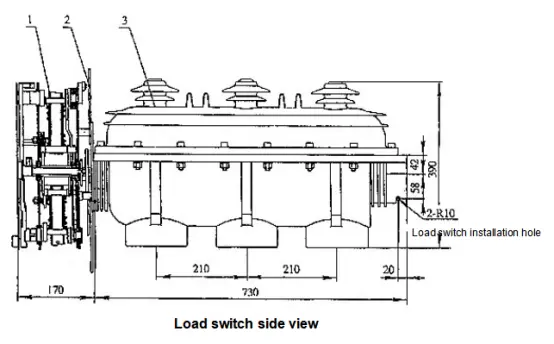
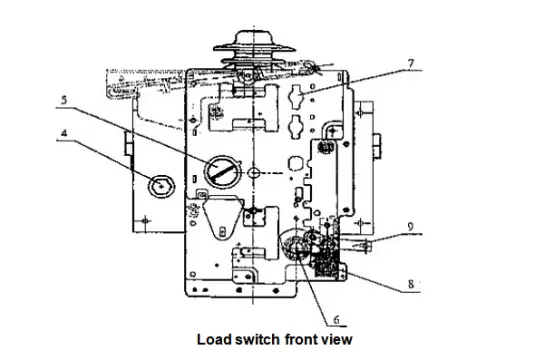
1 Operating mechanism (Type A / Type K)
2 Switchgear mounting plate
3 Switch housing
4 Self-sealing gate
5 Status indicator
6 Load switch operating hole
7 Earthing switch operating hole
8 Trip button
9 Fuse trip pull plate
Figure 1 Outline Dimension Drawing of FL(R)N-24D Load Switch
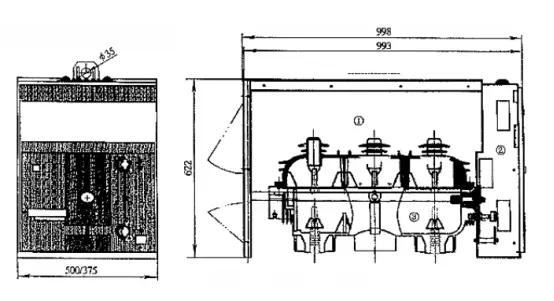
Figure 2 Upper Unit
Equipped with a three-position load switch. The switch housing is cast with epoxy resin and filled with SF₆ gas as the insulating medium. An SF₆ gas density meter or alarm device can be installed as required.
3. Operating Mechanism & Low-Voltage Compartment: Equipped with interlocks for control. It houses a spring operating mechanism with position indication and mechanical interlocks, and can be fitted with auxiliary contacts, emergency trip mechanism, capacitive live display and electric operating device. It also accommodates control circuits, metering instruments and protection relays; a 750 mm wide cabinet can house two identical low-voltage compartments.
Precautions:
1. Do not remove screws marked with dot seals!
2. Do not strike the insulating cover to prevent SF₆ gas leakage.
6. Structure and Working Principle
6.1 Main Circuit Structure
The main circuit of the FL(R)N-24D indoor high-voltage SF₆ load switch and its combination unit is sealed in an epoxy resin insulating housing cast via the APG process, featuring excellent insulation and anti-pollution performance. The housing consists of upper and lower insulating covers filled with 0.05 MPa (gauge pressure) SF₆ gas. A thin-walled explosion-proof membrane is provided on the lower cover to release high-pressure gas during internal arcing faults, protecting operators and other components.
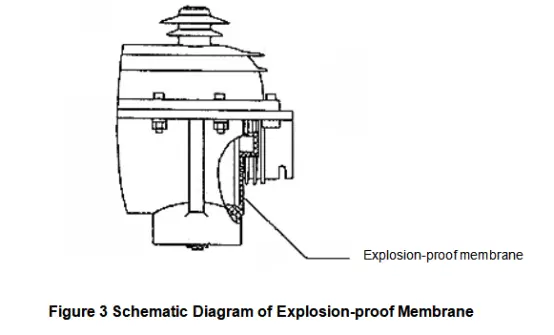
The switch has three working positions: closing, opening, grounding.
External dimensions of main circuit terminals are shown in Figure 4.
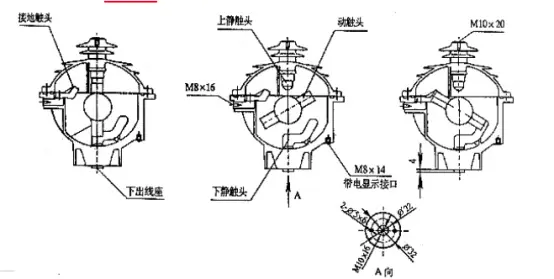
a. Closed position b. Open position c. Earthed position
Figure 4 Schematic diagram of main circuit
6.2 Arc-Extinguishing Principle
SF₆ gas serves as both insulating and arc-extinguishing medium. During opening, the arc is rotated and elongated by a permanent magnetic field, cooled by SF₆ gas, and extinguished at current zero.
6.3 Operating Mechanism
Two spring operating mechanisms are available: K-type (for incoming/outgoing control units) and A-type (for transformer protection units).
6.3.1 K-Type Spring Operating Mechanism
Adopts the over-center release principle of compression springs.
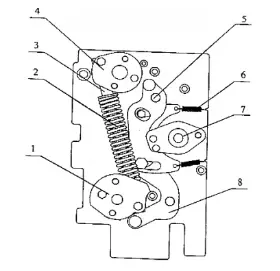
1. Lower cam 2. Energy storage spring 3. Spring rod 4. Upper cam5. Upper link plate
6. Tension spring 7. Shaft Ⅲ 8. Lower link plate
Figure 5 K-type Spring Operating Mechanism (Open Position)
· Grounding Operation: Rotate the handle clockwise to store energy in the spring; release energy to drive contacts to the grounding closing position. Rotate counterclockwise for grounding opening.
· Load Switch Closing: Rotate the handle clockwise to store and release spring energy, driving contacts to close.
· Load Switch Opening: Rotate the handle counterclockwise.
6.3.2 A-Type Spring Operating Mechanism
Same principle as K-type, plus fuse striker trip opening.
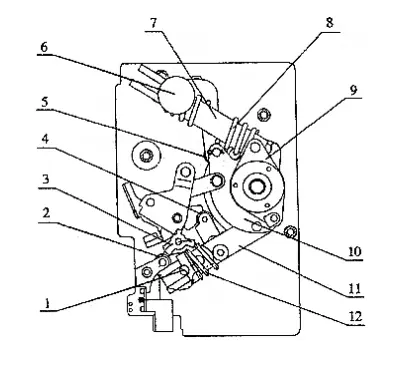
1. Shaft Ⅱ
2. Tripping roller
3. Tri-star wheel
4. Lower roller
5. Upper roller
6. Shaft Ⅰ
7. Spring tube Ⅰ
8. Opening spring
9. Energy storage crank arm
10. Middle crank disc
11. Spring tube Ⅱ
12. Closing spring
Figure 6 A-type Spring Operating Mechanism (Closed Position)
· Grounding Operation: Identical to K-type.
· Closing: Rotate the handle clockwise to store energy in closing and opening springs; release energy to complete closing.
· Opening: Press the trip button to release opening spring energy.
6.3.3 Electric Operation
Manual operation via the handle or optional electric operation.
6.4 Fuse Selection
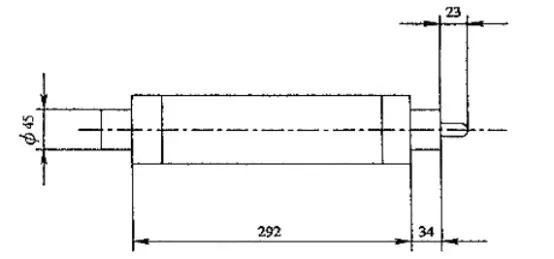
· Dimensions: φ45×292 mm (terminal φ23×34 mm)
· Parameters:
|
Fuse Model |
Rated Voltage (kV) |
Rated Current (A) |
Transformer Capacity (kVA) |
Rated Breaking Current (kA) |
|
XRNT |
24 |
6 |
100, 125, 160 |
31.5 |
|
XRNT |
24 |
10 |
200 |
31.5 |
|
XRNT |
24 |
16 |
315 |
31.5 |
|
XRNT |
24 |
20 |
400 |
31.5 |
|
XRNT |
24 |
25 |
500 |
31.5 |
|
XRNT |
24 |
31.5 |
630 |
31.5 |
|
XRNT |
24 |
40 |
800 |
31.5 |
|
XRNT |
24 |
50 |
1000 |
31.5 |
· The distance between the fuse striker end and the trip transmission plate must be 5~8 mm for reliable opening.
6.5 Accessories
· Auxiliary Contacts: S1 (2NO+2NC), S2 (1NO+1NC) for both K/A-type mechanisms.
· Live Display (Optional): Three-phase sensors detect live status and phase sequence.
· Gas Pressure Monitoring (Optional): Density meter monitors SF₆ pressure; alarm contact triggers at low pressure.
6.6 Interlocks
· Load switch cannot ground when closed.
· Grounding switch cannot close load switch when closed.
· Cabinet lock plate prevents misoperation of live compartments.
· Padlock plates enable interlocking between cabinets.
· A-type mechanism links with cabinet upper/lower grounding switches.
7. Installation and Commissioning
· Inspect for damage; clean surface contaminants.
· Fix the switch per dimensions (factory-set to open position).
· Grounding: Insert handle into grounding hole, rotate 180° clockwise to close, counterclockwise to open.
· Closing: Confirm open position, insert handle into load switch hole, rotate 180° clockwise.
· Opening: K-type: rotate counterclockwise; A-type: press trip button. Verify position via indicators.
8. Maintenance
· 20-year maintenance-free under normal conditions.
· Inspect appearance every 6–12 months; clean contamination/moisture.
· Lubricate and test operating mechanism 1–2 times/year.
· Check SF₆ pressure; refill at <0.02 MPa (by trained personnel only).
· Replace all three fuses if one blows (ground switch closed first).
9. Attached Documents
· Product Certificate
· Operation Manual
· Packing List
· Other Technical Documents
Send Inquiry
You may like
