

High Voltage Reactive Power Automatic Compensation Device

- Free Samples
- Quality Assurance
- 24/7 Customer Service
Product Introduction
High Voltage Reactive Power Automatic Compensation Device
1. Overview
TBBZ type high voltage reactive power automatic compensation device, is suitable for 110kV and 35kV substation, 10kV(6kV or 3kV) bus automatic reactive power tracking compensation. It can achieve reactive power dynamic control and regulation and improve voltage quality and power factor according to the power grid voltage through comprehensive judgment and intelligent automatic switching. It can effectively solve the 10kv(6kV or 3kV) power distribution system reactive power compensation and comprehensive treatment of the problem. It can also meet the need for voltage priority control, and use the capacitor voltage regulation effect to improve the voltage pass rate.It is widely used in metallurgy, iron and steel, petroleum, mining, machinery, building materials, transportation, chemical industry and other industries of the national economy of the power system.
2. Key feature
● Automatic compensation load reactive power, improve the load power factor;
● Reduce network loss, high efficiency and energy saving;
● Control harmonics of the system or control harmonics according to user requirements;
● Reduce reactive current, save transformer capacity cost, improve transformer output.
● Voltage priority control, the voltage regulation function of the capacitor can be used to improve the voltage pass rate.
3. Environmental conditions
● Installation location: indoor, or outdoor box type;
● Altitude: 1000m and below (> 1000m need technical discussion);
● Ambient temperature: -25℃ ~ +45℃;
● Monthly average maximum relative humidity: 90% (25℃);
● There should be no violent mechanical vibration, no toxic and harmful gases and steam, no
conductive or explosive dust in the installation and operation area.
4. Specifications
● The device is allowed to operate for a long time at 1.1 times the rated voltage of the power frequency, in which the peak voltage including all harmonic components should not exceed 1.2√2Un.
● The device allows continuous operation at a steady state overcurrent of 1.3 times the rated
current due to overvoltage and higher harmonics.
● The difference between the actual capacitance of the device and its rated capacitance shall not exceed (0~+10) % of the rated value, and the ratio of the maximum capacitance to the minimum capacitance between any two terminals of the device shall not exceed 1.06.
● The device can limit the inrush current generated by the capacitor bank instantaneously to less than 20 times the rated current of the capacitor bank.
5. Functional Feature
a.Wide range of general use, strong adaptability
● Suitable for all kinds of substations with 3KV, 6kV and 10kV voltage levels.
● Complete Settings. Users do not need to provide substation equipment parameters and operation.
● With automatic control, controller manual operation, remote communication control. There are also input contacts that can be used with local manual input. In addition, there is an input contact that can monitor the power failure of the capacitor switchgear. When the power failure of the capacitor switchgear occurs, the controller automatically cuts the capacitor that has been put in and stops putting the capacitor until the capacitor switchgear recovers power supply.
b. Adapt to unattended stations
● The temporary anomaly of the system voltage can be automatically restored after the fault disappears.
● When any group of capacitors have a fault signal and reject or reject, the controller automatically cuts the capacitor for 30 seconds, and can automatically exit the control of the faulty capacitor, without affecting the normal operation of other capacitors.
● With RS485 communication interface, reliable telemetry, remote communication, remote control, remote control. The communication protocol is MODBUS-RTU.
c. Capacitor control algorithm advanced
● For capacitors with the same capacity, switching is determined according to the reactive power capacity, and the capacitor is selected according to the number of times of action to implement balanced switching.
● For different capacity capacitors, automatically select matching capacitors according to the size of reactive power input and cut one by one and take into account the number of operations, there will be no switching oscillation.
● For both different capacity capacitors and equal capacity capacitors, the matching capacitance capacity can be automatically selected according to the reactive power amount, and then balanced switching of equal capacity capacitors according to the number of actions.
● Can realize capacitor combination switching, with the least number of capacitor groups to achieve the best capacitor control. For example, three sets of capacitors can produce seven capacities. More precise control, reactive power compensation once in place. Reduce the cost and space of the set. The capacitance ratio relationship is unlimited.
● Suitable for filter compensation control, equal capacitance or unequal capacitance can be switched in any specified order.
● Add a line for expanding one to three sets of capacitors under the original set of fixed capacitance cabinet, which can not only control the expanded capacitance, but also control the fixed capacitance.
● The outage capacitor can be withdrawn at will without affecting control.
d. Protection and troubleshooting
● Can resist serious harmonic interference, will not appear control voltage misjudgment and cause misaction.
● With dynamic self-check function, the controller internal control parameter error and non-serious fault can alarm and lock.
● When the power grid voltage is too high or too low, the alarm is automatically cut out after the capacitor and the lock, and the fault can be automatically resumed after the fault disappears.
● In the filter control mode, the low-order filter loop fails, and the current and high-order filter branches are automatically cut out.
● If the capacitor switching sequence is wrong, all compensation branches will be cut automatically.
● The open voltage protection of capacitor bank is realized in the reactive power compensation complete set, and the system overvoltage and undervoltage protection is also realized.
● Compared with traditional relay protection, the installation space is greatly reduced.
Compared with the traditional single capacitor microcomputer protection device, the cost is greatly reduced.
● When the fault occurs, the fault capacitor is removed separately through the fault output contact; You can also jump the total capacitor switch cabinet by connecting the fault contacts of all capacitors.
● You can browse and query the voltage value when the protection is started, which is easy to analyze the cause of the failure.
e. Display function
● it can display the system voltage, current, power factor, reactive power, active power.
● The Chinese characters on the screen indicate the throwing and cutting action to be performed.
● The controller can display the operating status of the capacitor and the capacitor bank that can be put into operation.
● There is a high voltage live display on the panel of the complete control room, which can display the high voltage on the incoming line side. There are also switch status indicator lights for each group of capacitor compensation units.
f.Structural characteristics
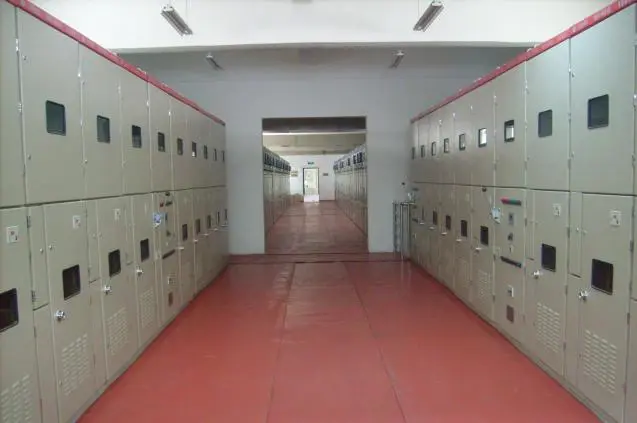
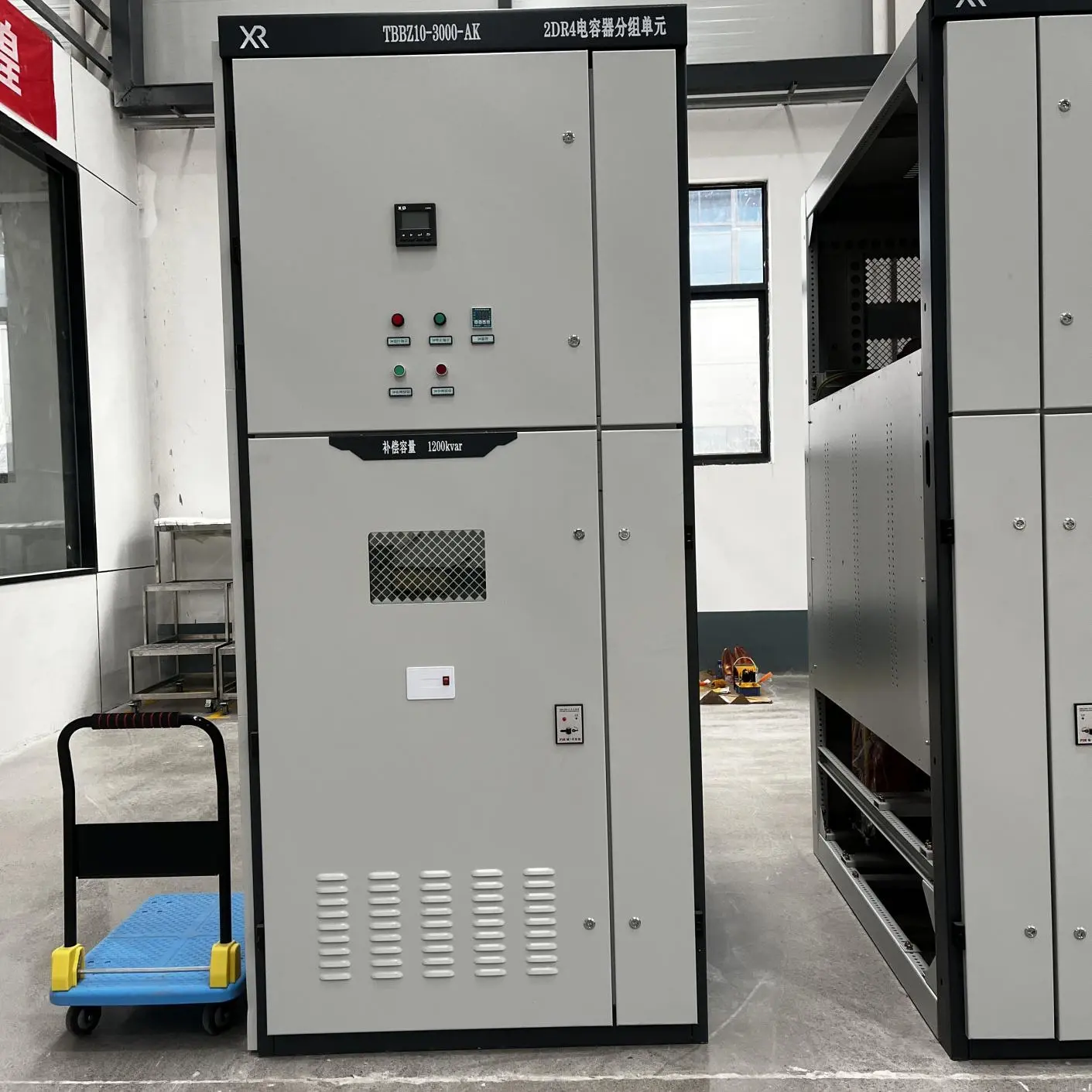
● Combination switch cabinet type structure, spray plastic panel door, the door is open with easy to observe the window and ventilation grid.
● The structure of the combined switch cabinet changes the appearance structure of the traditional frame, grid and frame, and plate door type high voltage capacitor sets. Built-up galvanized beams are installed inside.
● The safety clearance of each component in the cabinet meets the requirements of GB50060 in the Design Code for 3 ~ 110kv high voltage distribution Devices. The fixing and connection of the components in the cabinet shall be carried out according to the national standard.
● It has the advantages of simple appearance, beautiful appearance, structural anti-corrosion, anti-rust, safe use, durable, easy installation and maintenance.
● The device is equipped with a misoperation electromagnetic lock, the tool brake operating handle and the operating door are equipped with an electromagnetic locking device to lock the operation of the isolation switch, the ground switch and the circuit breaker to meet the "five prevention" requirements.
● Electromagnetic locking device or mechanical and electrical double locking device. Ensure that when the isolating knife is pulled down and the grounding knife is closed, the previous circuit breaker cannot be closed; When the circuit breaker is closed, the isolating knife cannot be pulled down; In the case of circuit breaker closing, forcing the isolation knife, the circuit breaker will trip. The protection is complete and reliable.
● According to the design capacity and grouping, the whole device is composed of one side of the line cabinet and several groups of compensation units, each group of units is an independent set of devices, and the control room is in the line cabinet.
● All controls are centralized in the control room of the incoming cabinet for easy control and observation.
● The device includes the following components: isolation switch, reactive power compensation controller, vacuum switch, parallel capacitor, fuse, reactor, discharge coil, zinc oxide arrester, indicating instrument, relay protection, pillar insulator, busbar, lead, and secondary cable terminal room and cabinet door, multi-cabinet door electrical and mechanical interlocking device and other components.
● The operation is safe and reliable, each group of capacitors is installed in a cabinet, once there is a failure, it will not affect other components.
● The device scheme design has good scalability. (With the development of the user enterprise, when the compensation capacity is insufficient, the compensation unit can continue to be added beside the cabinet)
g.Easy installation and maintenance
● The controller gain adjustment function allows maintenance personnel to adjust the accuracy directly on the controller panel with a key.
● The controller is always compatible with the circuit design, and the program can be upgraded online.
● The controller system test function can observe all external access signals and on-off output contacts on site, convenient and quick installation and debugging;
● Split cabinet, easy to transport and install.
● Less installation work on site, after the cabinet is in place according to the layout, only a small number of busbars and secondary wiring can be contacted.
h.Easy to operate
● The design style of the controller "silly machine", simple and practical personality. Automatic operation does not require human work Pre-exit the faulty device automatically when there is a problem.
● Controller LCD display, Chinese display and menu operation and setting, as well as user-friendly shortcut keys. The set parameters are stored permanently and are not affected by power outages.
● The control panel has manual and automatic conversion (left side manual, right side automatic), you can switch the controller or switch the capacitor with the button.
6.Working principle
The integrated control of voltage and reactive power is carried out by a controller with high reliability according to fuzzy control strategy. The capacitor bank is switched by a high voltage vacuum switch (vacuum contactor or vacuum circuit breaker). When the reactive power value detected by the controller exceeds the setting value, the controller gives a control signal according to the required series of capacitor banks, and puts the capacitor banks into operation. When the load reactive power value is lower than the setting value, the controller gives a control signal to disconnect the high-voltage vacuum switch and the capacitor bank exits from work.
7. Main components function introduction
● High voltage shunt capacitor: The capacitor is the main body of the reactive power compensation device, which generates capacitive reactive power to compensate the inductive reactive power of the load.
● High-voltage series reactor: The role of the reactor is to control the inrush current or harmonic resistance during the closing of the capacitor, reduce the interference to the power grid or avoid harmonic amplification during the closing (after), and prevent the impact and damage to the capacitor. Suppress 5, 7 and more harmonics, generally choose 5% ~ 6% reactor; Suppress 3, 5 and more harmonics, generally choose 12% reactor.
● Discharge coil: its function is to act as the discharge circuit of the capacitor after the capacitor is switched on, and the discharge is completed to allow the capacitor to be reinvested. Otherwise, overvoltage will be generated at both ends of the capacitor during reinvestment, which may damage the capacitor. The secondary side of the discharge coil is connected into an open triangle as the zero sequence protection of the capacitor, and the discharge coil can also be subtracted by a voltage transformer.
● Zinc oxide arrester: to limit the operating overvoltage caused by switching capacitor banks. No gap arrester must be selected for zinc oxide arrester used for capacitor bank protection.
● High voltage fuse: each capacitor is equipped with a fuse, as a single capacitor overflow rate break protection.
● Isolation switch: When the equipment is repaired, it is the obvious break point of the whole set of compensation devices. When the isolation switch is opened, the grounding switch is closed at any time, and the neutral point of the capacitor group is grounded at the same time.
● Vacuum switch (vacuum contactor or high voltage vacuum circuit breaker) : for switching capacitors. Its switching is controlled by reactive power compensation controller or manually controlled by button. Non-reignition circuit breaker should be selected for the circuit breaker of the switching capacitor device.
● Reactive power compensation controller, which is the core of the compensation device. It accepts the secondary voltage signal of the bus voltage transformer and the current transformer current signal on the operation panel of the device, calculates the reactive power amount required to be compensated, and controls the switching of 1 or more sets of reactive power automatic compensation cabinets.
8. Installation
● After the product arrives, check whether the product model, quantity, accessories are complete, whether the product is damaged during transportation, whether the fasteners are loose, and whether the technical documents are complete according to the contents of the packing list.
● The installation of the product should be installed by professionals, the device should be in place according to the infrastructure diagram, the cabinet body should be fastened to the base, and the bolt is connected to the cabinet, and then the cabinet shell is reliably grounded. After confirming that the appearance of the cabinet is neatly in place, the order is correct, and the grounding is good, the company personnel will carry out internal installation and debugging.
● Our company sent people to the site to guide the installation and debugging personnel, users should send people to cooperate with our company personnel.
● The complete set of equipment has been fully debugged before leaving the factory, and has been factory test, attached with the inspection report shipped. Users should carry out high voltage tests according to GB50150-19 "Electrical Equipment handover test Standard for Electrical Equipment Installation Engineering".
● After the test is completed, the bus cable can be connected (pay attention to the neutral point hanging), the connection of the control cable, the construction should pay attention to the wiring according to the drawings, and check repeatedly not to connect wrong.
● High voltage test completed, wiring check accurate. Only when conditions are met can
commissioning be carried out. Strictly abide by the corresponding operating procedures.
9. Commission
● Confirm that the primary and secondary lines are connected correctly and the protection setting value is correct.
● First turn on the control power of the complete set of devices.
● Set the transfer switch of the complete set of cabinets to the manual position, manual switching is normal; If automatic switching is selected, first set the parameters in the controller, under the condition of corresponding load, set the automatic position, the controller should be able to automatically switch.
● At this time, the indicator light on the panel of the complete set of devices and the controller should be displayed correctly.
● Close the isolation knife brake and switch on the high voltage power supply. Observe the operation in time and record the parameters.
● The debugging personnel will send the debugging record before power transmission and the operation record after power transmission to the factory together.
● Free training of use and maintenance personnel for the factory.
● After 24 hours of normal power supply operation, the service feedback with the official seal will be single and brought back.
● Before the equipment is delivered to use, it is strictly prohibited for the debugging personnel of the company to debug the device, and the consequences of the violation are their own.
10. Operation
● Pure manual mode (by the control switch button to achieve manual operation), the transfer switch is set to manual, and any group of capacitors can be switched according to actual needs. Note that when the capacitor is removed, in order to put the group of capacitors again, it must be delayed for more than five minutes to make the capacitor fully discharge.
● Push-button manual mode, the transfer switch is set to automatic, according to the controller test instructions, manual switching. Note that when the capacitor is removed, in order to put the group of capacitors again, it must be delayed for more than five minutes to make the capacitor fully discharge.
● Automatic operation mode, according to the controller instruction manual, after setting the parameters, the transfer switch can be placed in the automatic position.
● The normal power failure operation sequence of the device is: Switch the switch to the manual state Manually remove the switch for each group. Switch the switch to the disabled state. Disconnect the capacitor outlet. High voltage switch. Close the capacitor outlet Use a
high-voltage discharge rod to discharge the line (mainly both ends of the capacitor). Use a high-voltage electroscope to check and maintain the line
● The normal power supply operation sequence of the device is opposite to the power failure sequence.
11. Operating instructions
● If the overcurrent protection is easy to trip during closing, please extend the protection delay to avoid the oscillation process of the closing surge current.
● When this device runs in parallel with other capacitor devices that do not contain reactors or reactors with different reactance rates, please calculate whether there is the possibility of harmonic amplification.
● After the self-loop of the capacitor bank is disconnected, it shall not be put in again within five minutes.
● Before contacting the conductive part of the capacitor disconnected from the power grid, check the electricity, confirm that there is no electricity, use the ground rod to short-circuit the outlet end of the capacitor, and then approach.
● During the operation of the capacitor device, once there is abnormal sound, vibration, switch skipping, etc., the cause should be identified, and the switch should not be re-closed before the cause is identified.
12. Fault handling and maintenance
● Complete set of device protection function, protection device action at the same time issued fault indication, troubleshooting as follows:
● Circuit breaker overcurrent signal action, power outage check whether the spray type fuse is broken off, capacitors, reactors have oil leakage, bulge, burning and other phenomena, and measure good or bad and make necessary replacement, confirm that there is no abnormal power supply.
● Capacitor opening triangle signal action, this is due to three-phase capacitor damage, there is no phase break or a phase fuse is broken off, necessary to replace, confirm the correct transmission.
● Overvoltage signal action, check whether the system voltage is high, at this time the controller refuses to work, and then power when the system voltage returns to normal.
● Low voltage signal action, when the system voltage is low or abnormal, the compensation cabinet can not be thrown.
● Maintenance: After the normal operation of the device, it is necessary to clean it every 3 months, and usually observe whether the sound of the components in the cabinet is normal, whether there is oil seepage, and whether the panel display is normal. Maintenance is performed once a year, including:
● Remove surface dust, especially on the surface of the insulator, so as to avoid pollution flashover accidents.
● Check whether fasteners are loose and tighten them in time. All electrical connections in the capacitor bank (vented bus, fuse, discharge coil, circuit breaker, ground wire, etc.) must be tight and reliable. Any contact or poor connection may arcing and cause high-frequency oscillation, causing the capacitor to overheat and overcurrent. Therefore, it is recommended to regularly check all contact points and connection points of capacitor equipment.
● The vacuum contactor arc extinguishing chamber has a service life of 500,000 times, and it can not be replaced in time when it can not meet the requirements.
● Preventive surveys should be carried out on major electrical components, such as checking the capacitance value of capacitors, the insulation resistance of capacitors, reactors and discharge coils, etc.
● When the ambient temperature exceeds the upper limit of the capacitor temperature class, artificial cooling (installation of a fan) or the capacitor bank should be taken out of operation.
● The inspection of the temperature at the installation site and the temperature of the most hot spot on the capacitor housing can be carried out by mercury thermometer, etc., and temperature records must be made (especially in summer).
● The appearance inspection of the capacitor in operation is recommended to be carried out every day. If the case is found to be bulging and deformed, the use should be stopped to avoid accidents.
● When abnormal sound and vibration occur during the operation of the capacitor, if the ammeter indication is also abnormal, it can be considered that it is affected by higher harmonics. Therefore, it is necessary to continue to monitor its temperature rise. If the abnormal sound and vibration are inherent phenomena of the equipment itself, due to the loosening of the internal tightening parts and internal discharge, the operation should be stopped and special inspection should be carried out.
● Before contacting the conductive part of the capacitor disconnected from the power grid, check the electricity, confirm that there is no voltage, use an insulated grounding metal rod to short-circuit the outlet end of the capacitor, discharge separately, and then approach.
13. Lifting and transportation
● When hoisting by crane or forklift, towel is placed on the wire rope hanging joint to protect the finish paint from damage.
● The device is transported by car, and the connecting bus and connecting bolts are packed separately.
14. Order instructions
● The user determines the compensation capacity, the system voltage and the maximum operating voltage, the model of the capacitor device and the single capacitor;
● The user should provide the maximum and minimum short-circuit capacity of the installation site system in order to check whether resonance will occur;
● Indicate whether the reactor is equipped and the size of the reactance rate;
● Capacitors, reactors, discharge coils, fuses, isolating switches and other options
● Installation location, space and existing compensation status.
● Other special requirement
Send Inquiry
You may like
